


A sign of weakness
EU postpones resolution on trade dispute with Beijing until October and backs off punitive tariffs. Simulation by experts of an escalation confirms that China would win.
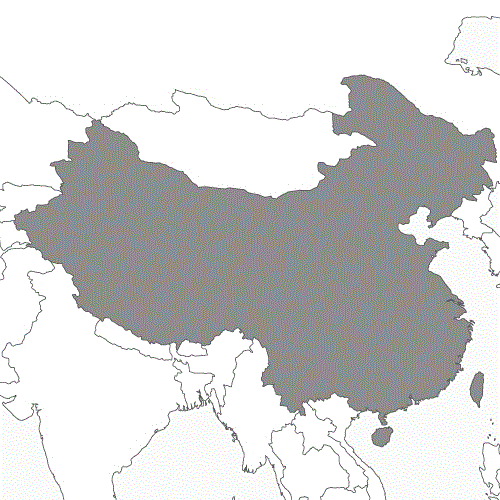
BRUSSELS/BEIJING (our own report) – The European Union is refraining, for the time being at least, from imposing punitive tariffs on imports from China or taking other restrictive trade measures. Brussels is keen to reach a settlement with Beijing by October that could resolve its dispute over the bloc’s growing trade deficit with the People’s Republic. This was confirmed by European Trade Commissioner Maroš Šefčovič on Monday following intensive talks in Brussels with China’s Minister of Commerce, Wang Wentao. The dispute stems from the fact that China’s exports to the EU are still rising, while the export performance of Germany and the EU is flagging. However, a study by the Kiel Institute for the World Economy (IfW) shows that Germany’s deteriorating trade balance with China is primarily due to a lack of investment in innovation in Germany. This contrasts with the government’s claim that the German economy is the victim of unfair Chinese subsidies and a massively undervalued Chinese currency. Chancellor Friedrich Merz recently threatened to introduce tough measures against China. But experts warn that this would trigger an economic war that EU would probably lose. This is the conclusion of a recent table-top simulation of an escalating trade conflict and the options available. The study shows that the EU’s decision to back off from imposing punitive tariffs is a predictable sign of weakness. Read more
Playbook for mass murder
Critics blast Berlin and EU for failing to use leverage to end United Arab Emirates’ support for genocidal RSF militia. Empty words won’t stop the Sudan war.
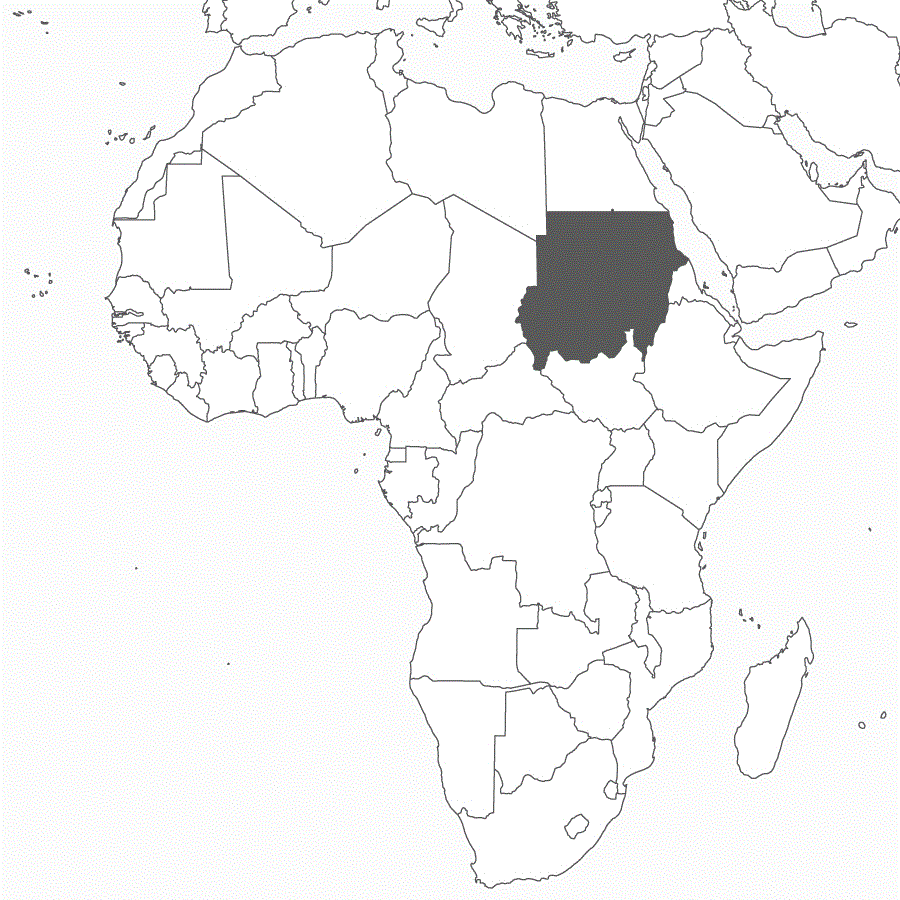
KHARTOUM/ABU DHABI/BERLIN (own report) – Human rights organisations and foreign policy experts are levelling strong criticism at Germany and the EU for their failure to act over the genocidal war being waged by the RSF militia in Sudan. Civilians are currently facing the threat of another massacre by the Rapid Support Forces. This militia, which has been fighting the regular Sudanese armed forces for more than three years, has a history of major human rights violations and is closing in on the town of Al Obeid, strategically situated between the Nile Valley and the western Sudanese region of Darfur. Previously, whilst seizing towns in Darfur, they had deliberately targeted and murdered sub-Saharan Africans. Most recently, during the capture of Al Fashir, they may have massacred between 60,000 and 100,000 people, selected for killing on the basis of their skin colour. Backed by money from the United Arab Emirates, the RSF is dependent on Abu Dhabi for its weapon supplies. The UAE has been supporting these militias for geostrategic reasons. Experts argue that European and North American countries are perfectly capable of exerting sufficient pressure on the Emirates to make them cease backing the RSF. This move could finally bring the war to an end. However, critics of those in power in Western Europe say they have effectively failed to act. They prioritise unhindered cooperation with the oil-rich Emirates over the prevention of genocidal massacres. Read more
Strategic minerals corridor, against China
EU and US invest heavily in Lobito Corridor. Rail link to Atlantic gives access to minerals-rich Zambia/Congo region. While officially promoting development, the project is driven by China rivalry and commercial interests.

LUANDA/LUSAKA/BRUSSELS (our own report) – In southern Africa, competition between China, the US and the EU for access to strategic raw materials is hotting up. A key role is played by the Lobito Corridor, a rail and logistics link planned to run from the ‘copper belt’ of Zambia and the Democratic Republic of the Congo to the Angolan port of Lobito on the Atlantic. This major infrastructure project is regarded as one of the most important initiatives under the European Global Gateway strategy. Both Brussels and Washington, which is also investing in the scheme, are desperate to reduce dependency on China for critical minerals. In future, copper, cobalt, lithium and other raw materials required for the production of batteries, electric vehicles, digital technologies and defence equipment are to be transported westwards along this route. The initiative builds on infrastructure that was originally constructed during the colonial era to get hold of African raw materials and ship them to Europe. Critics argue that the upgrading of the Lobito Corridor now perpetuates a longstanding pattern of extractivist colonialism under a new guise. Read more
Austerity and militarisation
International anti-war conference in London attracts 3,000 activists. Spending on the arms build-up is dismantling social welfare systems. Protests grow louder across Europe. EU imposes draconian sanctions on individuals.
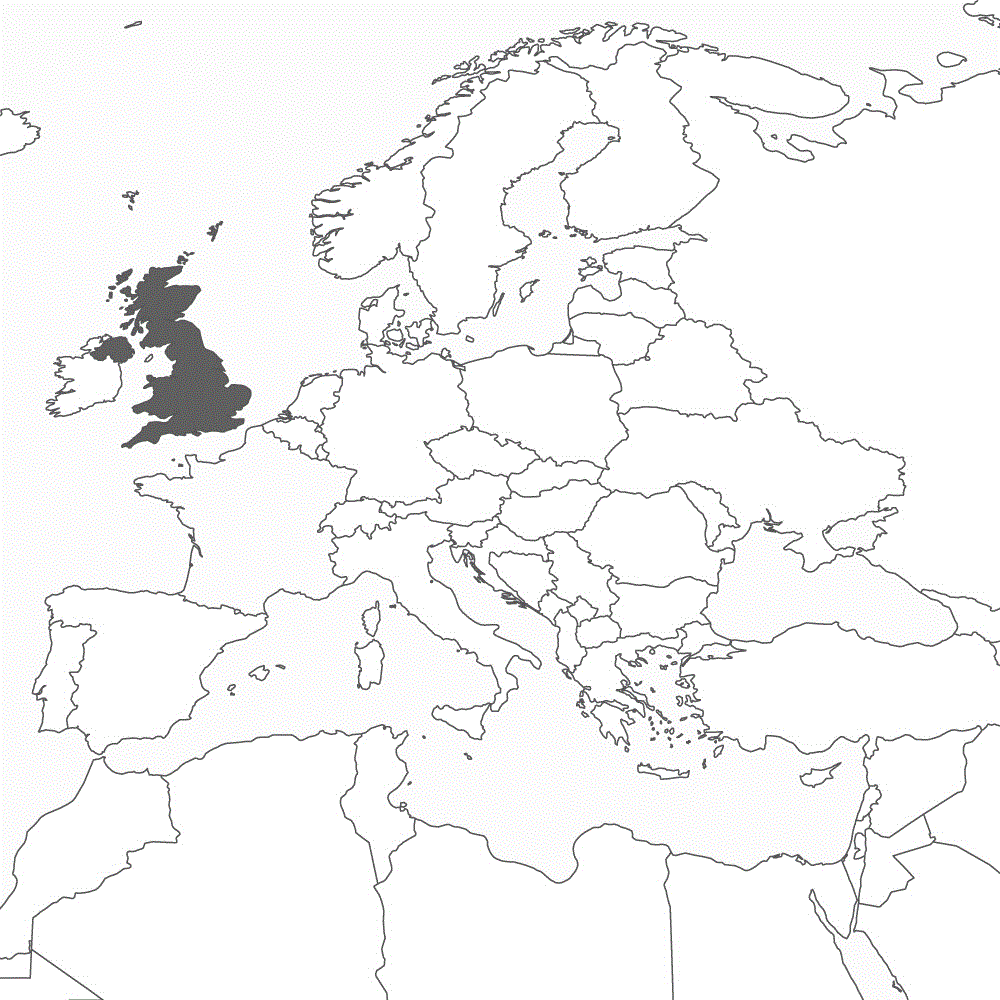
LONDON/PARIS/BRUSSELS (our own report) – A new movement against the unprecedented militarisation across Europe is gaining momentum as international protests widen and anti-war conferences set the resistance agenda. On 14 June, some 12,000 people took to the street in Brussels under the banner ‘Welfare, not Warfare!’ in response to massive rearmament programmes. Social welfare systems are being dismantled across Europe to finance militarisation. The Brussels demonstration was followed on Saturday by a major international anti-war conference in London, attended by nearly 3,000 people from Europe, North America and the Middle East. The discussion highlighted the West’s brutal war policies and the dramatic collapse of healthcare, education and pensions. “Austerity and militarisation” are “two sides of the same coin”, declared the president of the British food industry union, the BFAWU. Further Europe-wide protests are planned for the coming autumn, including a day of action by dockworkers. But the upturn in protest has been accompanied by increased repression. Journalists, for example, are being targeted with EU sanctions on the grounds that they are allegedly collaborating with an enemy power – Russia. In this way, the EU is putting in place a flexible system of punishment that operates outside the rule of law in order to safeguard its war policy from criticism. Read more
‘A leader in military aviation’
Berlin is set on making Germany a leading aviation nation. Its aerospace industry is focusing on military aviation and drone production. Franco-German cooperation on fighter jets is over.
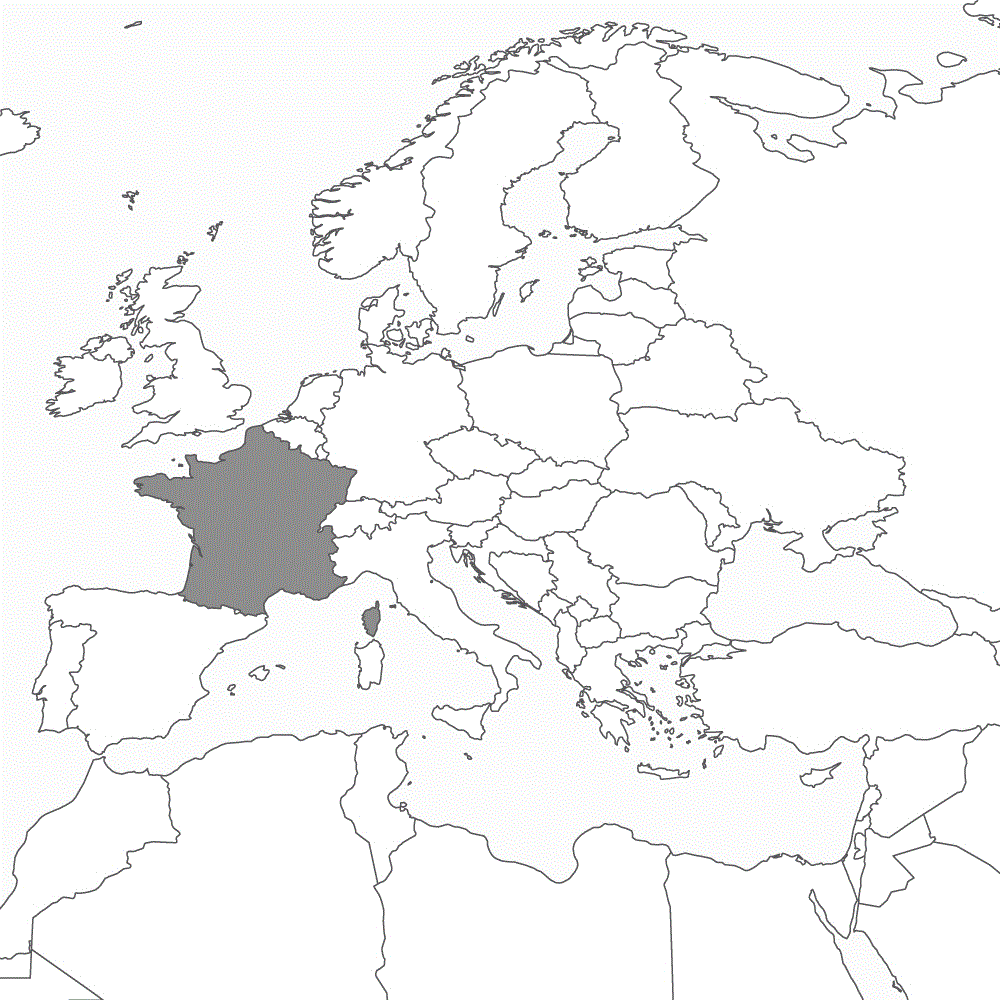
BERLIN/PARIS (own report) – Over the next fifteen years, Germany is set to become an internationally leading aviation nation. The German government is pushing for the aerospace industry to take leading role, above all, in the military sector. This is spelled out in a new aviation strategy recently adopted by the Federal Government. The strategy document emphasises the value of developing independent European and German aerospace capabilities. Crucially, the approach taken is, for the first time, centred on closer collaboration between civil and military aviation development. Policymakers are putting resources into the goal of rapidly advancing German drone capabilities. The plan is ambitious: Germany should in future be “a European leader” – “in the research, development and production of cutting-edge military aviation technologies.” With this independent strategic thrust in mind, Chancellor Friedrich Merz announced at the start of last week that the longstanding project to build a Franco-German sixth-generation fighter jet (Future Combat Air System, FCAS) had finally been terminated. The French conglomerate Dassault had held the industrial and technological lead in that project. Eight German companies are now set to take its place. Working alongside (European) Airbus, they include most importantly Hensoldt and Diehl Defence. Read more
Civilians in War (III)
Government, Bundeswehr and civilian organisations push for civil structures to be part of war preparations – under the banner of ‘civil defence’. New repressive powers are planned even before a ‘state of tension’ declaration.

BERLIN (our own report) – In the event of war, conscientious objectors are to be integrated into civilian support for troop movements and other military operations. And wider population should be enabled to independently “cope with extreme or protracted emergency situations”, says the German Fire Services Association in a position paper. The German government seeks even closer integration of civilian disaster relief and protection organisations in war planning – specifically for a future military confrontation with Russia. This is evident from a recent paper on the key points of civil defence issued by the Federal Interior Ministry. According to Federal Defence Minister Boris Pistorius and Federal Interior Minister Alexander Dobrindt, that paper contains “nothing less than the biggest drive for modernisation of civil protection and civil defence in decades.” Ten billion euros have been earmarked for the implementation of these plans. Civil disaster relief workers must now get used to the idea that they may be called up by the Bundeswehr to provide support services in a war scenario. Read more
Learning from Ukraine (II)
Berlin arms conference brings together German drone start-up executives and Ukrainian fighters who venerate Nazi collaborators. The aim: close cooperation on advancing high-tech warfare.
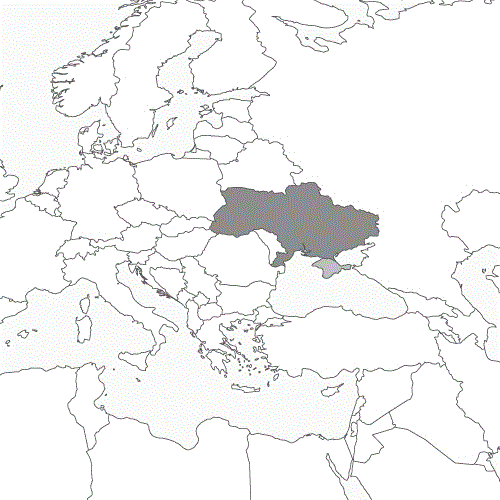
BERLIN/KYIV (our own report) – At an arms conference in Berlin on Monday, representatives of German drone start-ups and military personnel from Ukrainian units that revere Nazi collaborators came together to discuss future developments in high-tech warfare and weapon systems manufacturing. The New Age Defence conference was attended by some eight-hundred people. Participants included members of brigades in the Ukrainian National Guard that openly use Waffen-SS symbols and celebrate members of the Organisation of Ukrainian Nationalists (OUN), a fascist organisation of Ukrainian Nazi collaborators active preceding, during and immediately after World War Two. German arms companies are working closely with the Ukrainian military, including these ultra-right battle-hardened elements, in order to draw directly on frontline experience with weaponry. These companies are rapidly developing and upgrading their UxS products on the battlefield. UxS is the abbreviation for Unmanned Systems, with the x standing for all the diverse system categories, namely in the air (drones), on land (robots) or at sea (sea drones). The conference organisers of New Age Defence have described their objective as bringing together arms manufacturers, armed forces and policymakers, and blending Ukrainian frontline experience with German industrial know-how. What is important here is not so much the production of huge numbers of weapons as the creation of production capacities. In the event of war, these capacities can then be released to turn out the advanced military hardware needed at that stage of warfare evolution. Read more
SpaceX’s record-breaking IPO and its impacts
The valuation of Musk’s record-breaking IPO threatens to drain capital from Germany and the EU. SpaceX’s subsidiary Starlink may drive out terrestrial network operators like Deutsche Telekom. Berlin plans a German satellite equivalent.
WASHINGTON/BERLIN (our own report) – The initial public offering of Elon Musk’s SpaceX threatens to create serious problems for the German and EU economies. The record-breaking flotation, scheduled for 12 June, is expected to raise $75 billion dollars and boost the company’s market value to a massive $1.75 trillion. Currently, SpaceX is still incurring heavy losses, but has high hopes of making future profits. It is mobilising unprecedented sums of money by rolling out new AI-related technologies such as solar-powered data centres based in space. The design of Musk’s IPO is somewhat unusual. The company is offering German and other European investors particularly favourable access, and this is triggering concerns about a potential flight of capital from Europe. SpaceX’s subsidiary Starlink, with its low signal latency, poses a threat to the conventional terrestrial mobile communications market. By investing in this segment, Starlink could outcompete companies like Deutsche Telekom and its subsidiary T-Mobile. Meanwhile, two German defence and technology companies, Rheinmetall and OHB, have been given the green light for their planned satellite joint venture. The idea is to create a sovereign German equivalent to Starlink by investing billions of euros out of Germany’s huge defence budget. Read more
„Taking forward the anti-war movement internationally”
An interview with Kate Hudson on the main drivers behind the current threat of war, the anti-war conference in London on 20 June, and the need to organise internationally against war.
LONDON german-foreign-policy.com spoke to anti-war activist Kate Hudson about the growing protests against militarisation in Europe and the upcoming international anti-war conference on 20 June. Kate Hudson has been chair (2003 to 2010), general secretary (2010 to 2024) and vice president (since 2024) of the Campaign for Nuclear Disarmament (CND) and an officer of the Stop the War Coalition since 2002. Hudson emphasises that the main threat to world peace currently lies not with Russia and China, but with the United States and its Western allies. The US is in economic decline and is fighting back with every means at its disposal. Furthermore, capitalism is in a deep crisis and has produced “an extreme model” embodied by “far-right figures” such as Donald Trump – a “political nightmare”, Hudson states. She insists that the anti-war movement must organise on an international level, just as those driving the militarisation – “state forces, capitalist forces and governments” – do. She advises that action must be taken at an early stage to counter the threat of Germany acquiring nuclear weapons. Read more
Double standards and their consequences
Berlin’s power politics has suffered a severe setback following Germany’s failed bid for a seat on the UN Security Council. Punished for obvious double standards in foreign policy?
BERLIN/NEW YORK (own report) – The failure of Germany’s bid for a non-permanent seat on the UN Security Council deals a severe blow to the German government’s global political ambitions. With just 104 votes, Germany trailed far behind the considerably smaller states of Portugal (134) and Austria (131) in Wednesday’s vote in New York. The double standards with which Berlin operates are widely regarded as one of the main reasons: while Germany sharply criticises opponents such as Russia for alleged or actual breaches of international law, and demands other states support sanctions, it turns a blind eye to, and is indeed seen as complicit in, crimes committed by close allies, not least Israel and the United States. In response to the debacle in the UN General Assembly even the Social Democrats (SPD), the junior partner in Germany’s ruling coalition, is now saying that in future “double standards must not be applied in international law”. The setback also indicates that the dominance of the major Western states in international politics is waning. Smaller countries like Austria and Portugal can expect to enjoy new sources of sympathy in future. The German government is hinting that it will not make another application until the 2035/36 term. In response to the diplomatic snub, calls from certain quarters in Germany can be heard demanding that the country’s contributions to the UN be reduced if it has no seat on the Security Council. Read more
GERMAN-FOREIGN-POLICY.com
Information on German Foreign Policy: News + Interviews + Analyses + Background