Playbook for mass murder
Critics blast Berlin and EU for failing to use leverage to end United Arab Emirates’ support for genocidal RSF militia. Empty words won’t stop the Sudan war.
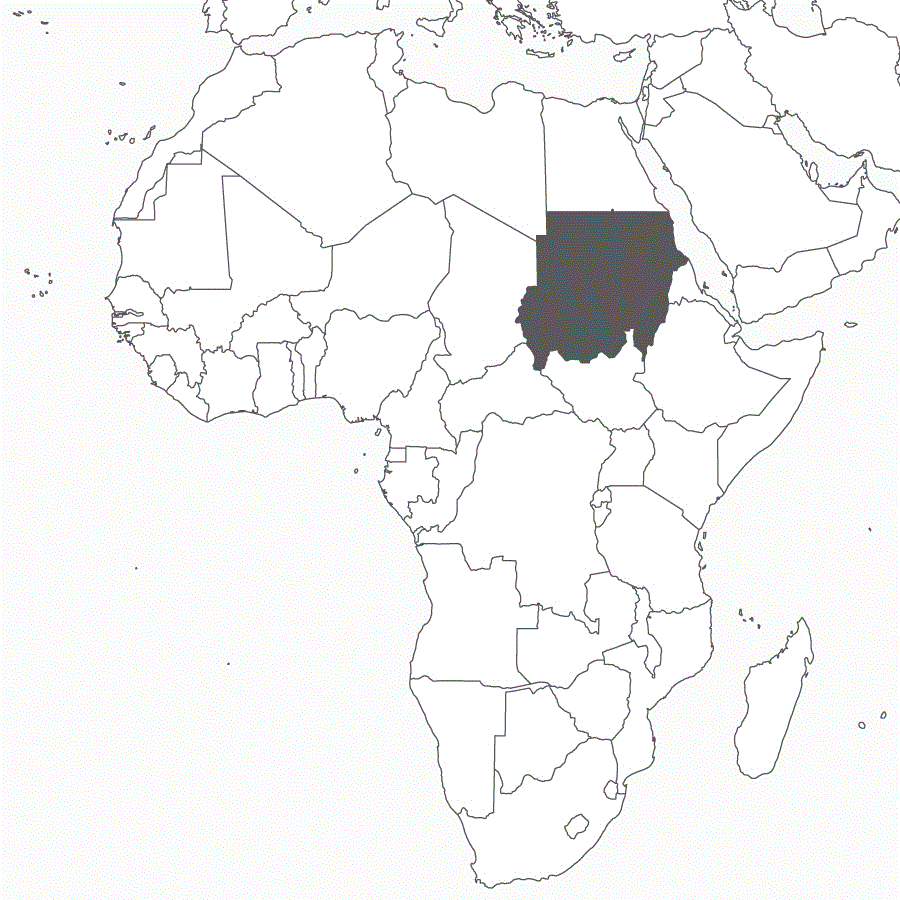
KHARTOUM/ABU DHABI/BERLIN (own report) – Human rights organisations and foreign policy experts are levelling strong criticism at Germany and the EU for their failure to act over the genocidal war being waged by the RSF militia in Sudan. Civilians are currently facing the threat of another massacre by the Rapid Support Forces. This militia, which has been fighting the regular Sudanese armed forces for more than three years, has a history of major human rights violations and is closing in on the town of Al Obeid, strategically situated between the Nile Valley and the western Sudanese region of Darfur. Previously, whilst seizing towns in Darfur, they had deliberately targeted and murdered sub-Saharan Africans. Most recently, during the capture of Al Fashir, they may have massacred between 60,000 and 100,000 people, selected for killing on the basis of their skin colour. Backed by money from the United Arab Emirates, the RSF is dependent on Abu Dhabi for its weapon supplies. The UAE has been supporting these militias for geostrategic reasons. Experts argue that European and North American countries are perfectly capable of exerting sufficient pressure on the Emirates to make them cease backing the RSF. This move could finally bring the war to an end. However, critics of those in power in Western Europe say they have effectively failed to act. They prioritise unhindered cooperation with the oil-rich Emirates over the prevention of genocidal massacres.
Biggest humanitarian catastrophe
Aid organisations have for years classified the situation in Sudan as the worst humanitarian catastrophe of our times. The death toll is unknown. Estimates of around 150,000 are often cited. These figures have, however, been circulating since 2024. In August 2025, the former US Special Envoy for Sudan, Tom Perriello, estimated that there had been more than 400,000 deaths.[1] Over 14 million people – out of a pre-war population of around 52 million – have already been displaced. Of these, a good four million have fled to other countries, mainly to neighbouring Chad and South Sudan, which are themselves desperately poor.[2] Almost 34 million people, around two-thirds of the population, are dependent on humanitarian aid. According to the World Food Programme, over 19 million Sudanese face acute hunger, with 825,000 children under the age of five suffering from severe malnutrition. More than 70 per cent of the country’s hospitals have been destroyed. Serious diseases are rife, including cholera, which has so far claimed the lives of at least 3,500 Sudanese.[3] Over half of all schools in Sudan have been wrecked. The number of children and young people who attend school only intermittently or not at all is estimated at 17 million. Sexual violence has also become rife.[4]
Genocidal massacres
In addition to responsibility for the already devastating humanitarian situation facing civilians, the Rapid Support Forces (RSF) have committed at least two genocidal massacres in the western Sudanese region of Darfur since April 2023, when the war began after the militia unleashed attacks on the regular armed forces. The RSF has its origins in the Janjaweed militia. This auxiliary force, which emerged over two decades ago from the Arabic-speaking population of Darfur, committed genocide on sub-Saharan African population groups in the region between 2003 and 2005. It is a pattern that has repeated itself since the start of the current war. As early as June 2023, following the capture of Al Junaynah, the capital of Sudan’s West Darfur state, the RSF arbitrarily murdered members of the sub-Saharan African Masalit minority. Estimates put the death toll at up to 15,000. The RSF also carried out arbitrary killings of people with black skin following the capture of Al Fashir, the capital of North Darfur State, at the end of October 2025. Estimates of the death toll there range from as many as 60,000 [5] to possibly even 100,000.[6] According to a United Nations report, some survivors were blindfolded, bound and driven away to chants of “Slave, slave, slave!”[7]
Attack on El Obeid
Another barbaric massacre now appears to be imminent. This time, the likely victims are the inhabitants of El Obeid, the capital of North Kordofan State, and many refugees who have fled from elsewhere to the city. North Kordofan lies between the Nile Valley – home to the capital, Khartoum, which is largely controlled by the regular armed forces – and Darfur, which is now dominated by the RSF. UN reports indicate there are currently well over half a million people in El Obeid, which has been under siege by the RSF for a year and a half. In recent days, not only have the RSF units surrounding the city been reinforced, but artillery and drone attacks have been significantly stepped up. Observers expect an all-out assault to capture the city to be launched very soon. “We’ve seen this playbook before,” warned UN High Commissioner for Human Rights Volker Türk last week: “We know where it led then, and cannot allow a repeat.”[8] Türk recalled the massacres in Al Fashir, which the United Nations has since officially confirmed “bear the hallmarks of genocide”.[9] Among others, the UN Security Council echoed these dire warnings at the weekend. On Tuesday, Germany, France and five other European states called on the RSF to “halt its attack immediately”; they should now “de-escalate” and “uphold international law”.[10]
Weapons and mercenaries
Pious words of this kind from Europe and North America are now provoking outrage among human rights activists and causing dismay among foreign policy experts. Observers know that the RSF receives the bulk of the weapons with which it wages its campaign of war and ethnic cleansing from the United Arab Emirates. The UAE has always denied this link, but deliveries of weapons and ammunition from the Emirates to the RSF have been well documented since at least 2024. Military, financial and logistical support is public knowledge thanks to detailed reporting.[11] It is also known that military equipment from French and British manufacturers, among others, has been identified in the RSF’s combat zones. There are photographs showing, for example, RSF fighters with German G3 and G36 assault rifles.[12] It is widely understood that weapons from Europe find their way into Sudan via the Emirates. The UAE has even been found smuggling foreign mercenaries into Darfur. Only recently, Human Rights Watch documented how the Abu Dhabi-based mercenary firm, called Global Security Services Group (GSSG), gave special training to hundreds of Colombian mercenaries and then transferred them to Darfur where they have been fighting in the ranks of the RSF. Some of these mercenaries are said to have even been involved in the RSF’s capture of Al Fashir.[13]
Hypocritical statements
Without long-term support from Abu Dhabi– including the money stream from the UAE’s purchase of “blood gold” from Darfur – the militia could not persist with its civil war for long. This is a widely shared view among analysts. For years now, activists have been calling on European and North American governments to exert pressure on the Emirates to cut off arms supplies to the RSF. Last week the US think-tank Council on Foreign Relations (CFR) reiterated that if the UAE were to pay a price for their role or face “some consequence that could change the incentives”, they would likely reconsider their arms supplies.[14] However, Western governments cannot yet bring themselves to exert any such pressure because they would rather not jeopardise their close, profitable and strategically highly advantageous cooperation with the UAE. “They will, however, be sure to issue statements of concern”, says the CFR analysis – in other words, hypocritically washing their hands of the matter. This is precisely what the official statement by the seven European states is intended to do.[15] As Human Rights Watch very recently noted, rather than exerting pressure on the Emirates, the EU’s concerns are “relegated to wholly ineffective bilateral human rights dialogues.” In doing so, it was knowingly squandering the opportunity to prevent genocidal massacres and promote a resolution to Sudan’s disastrous civil war.[16]
Geostrategic interests
Berlin and Brussel’s close cooperation with the United Arab Emirates has not been impaired by their partner’s support for the RSF. Behind this alliance lie clear economic and geostrategic interests. Just as the UAE was first prompted to support the genocidal RSF fighters by its geostrategic interests, so too is Germany’s lack of action guided by its own interests. ‘german-foreign-policy.com’ will continue to cover on the story.
[1] Nicholas Kristof: Where There’s No Debate About Genocide – and No Response, Either. nytimes.com 30.08.2025. See Die Berliner Sudan-Konferenz.
[2] Crisis in Sudan: What is happening and how to help. rescue.org 14.04.2026.
[3] The tragedy of the Sudan war as reflected in the numbers for 2025. dabangasudan.org 24.12.2025.
[4] Report details widespread use of sexual violence in Sudan war. news.un.org 23.06.2026.
[5] Mark Townsend: RSF massacres left Sudanese city ‘a slaughterhouse’, satellite images show. theguardian.com 05.12.2025.
[6] Gideon Rachman: Transcript: Sudan – inside the world’s worst humanitarian crisis. ft.com 15.01.2026.
[7] Sudan: Hallmarks of Genocide in El-Fasher. Report of the independent international fact-finding mission for the Sudan. 17 February 2026.
[8] Sudan: Imminent offensive on El Obeid must be halted – Türk warns of catastrophic impact on civilians. ohchr.org 18.06.2026.
[9] Sudan: Hallmarks of Genocide in El-Fasher. Report of the independent international fact-finding mission for the Sudan. 17 February 2026.
[10] Gemeinsame Erklärung zur Lage in El Obeid. auswaertiges-amt.de 23.06.2026.
[11] Oscar Rickett: How the UAE kept the Sudan war raging. middleeasteye.net 25.01.2024.
[12] Roman Deckert: Germany’s Hand in Sudan’s War. rosalux.de 18.08.2025.
[13] Sudan: Colombians Linked to Atrocities Trained in UAE Bases. hrw.org 25.05.2026.
[14] Michelle Gavin: Failure to Act in Sudan (Again). cfr.org 23.06.2026.
[15] Gemeinsame Erklärung zur Lage in El Obeid. auswaertiges-amt.de 23.06.2026.
[16] Joey Shea: Why Isn’t the EU Calling Out the UAE for Its Role in the Sudan Crisis? hrw.org 18.06.2026.