


The costs of war
The war in Iran is disrupting oil and gas supplies from the Persian Gulf; the war in Ukraine is halting Russian diesel exports and reducing natural gas supplies. Germany, like other countries, faces astronomical prices and shortages.

BERLIN/WASHINGTON (our own report) – American energy experts are warning of a full-scale global energy crisis with prices for crude oil and natural gas skyrocketing. According to the US oil industry, there was enough capacity in the first six months of Washington’s war on Iran to compensate to some extent for the shortfalls caused by the blockade of the Strait of Hormuz. On the one hand, various Western states could draw on their strategic reserves; on the other, China has significantly reduced its imports, thereby easing demand pressures. But neither of these steps is likely to be sustainable. So further hikes in oil and gas prices have to be expected. Another critical factor is that Ukraine has managed to severely damage a number of Russian refineries with its drone attacks. This is leading to a diesel shortage: Russia, previously the world’s second-largest exporter, has completely halted diesel exports. While natural gas storage facilities in Germany and the EU are at their lowest levels ever for this time of year, Berlin and Brussels continue to insist on a total phase-out of Russian liquefied natural gas imports by early 2027. Most recent data shows that Russian supplies still account for 19 per cent of the EU’s liquefied natural gas imports. Read more
‘We won’t survive a war in Europe’
Interview with Ulrike Eifler on the emergence of a Europe-wide anti-war movement and the role of trade unions.

german-foreign-policy.com spoke to Ulrike Eifler about current developments in the anti-war movement in Europe and the role of trade unions within this movement. Eifler, who works in the Würzburg secretariat of the IG Metall union, has been campaigning for years for trade unions to pursue a resolute peace policy. There have recently been two union-backed anti-war conferences, in Paris (October 2025) and London (June 2026), which in her assessment have already contributed significantly to “building a Europe-wide movement against war”. They have, she says, succeeded in raising awareness within the trade unions of the need to counter war and militarisation. On the one hand, the exorbitant costs of militarisation lead directly to massive cutbacks in social spending; and, on the other, war itself is fundamentally “incompatible” with the progress achieved by the labour movement, not least the right to strike. Indeed, war threatens “the very existence of free trade unions”. As for “job security”, Eifler argues that employment must be “based on civilian peaceful production”, not “on murderous war production”. Looking at the many protests planned for the coming autumn, she warns that these activities against militarisation and social cuts should not be too fragmented. She urges all anti-war forces to pull together in combatting the warmongers. Read more
War exercises in Greenland (III)
Seeking to strengthen influence over Greenland, the EU pledges new funds to Nuuk for raw materials projects. With German participation, NATO expands its military exercises on the island.
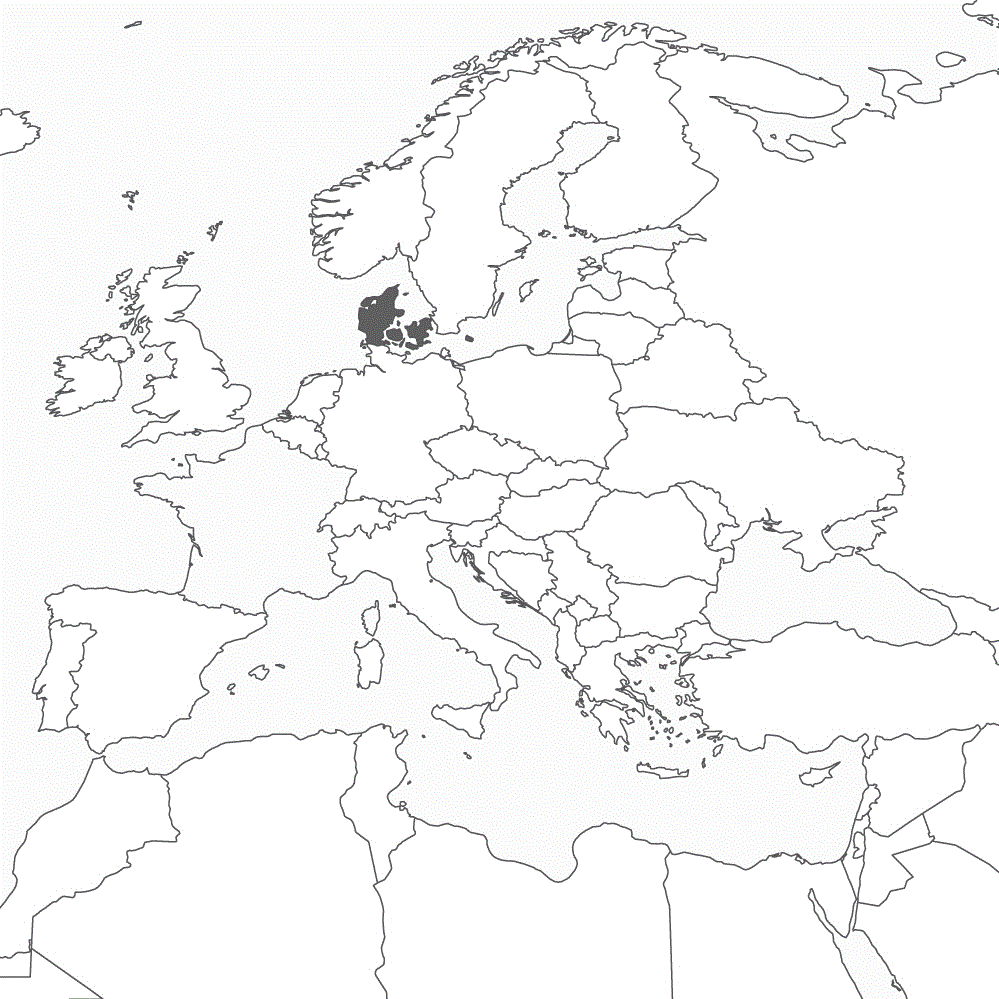
BRUSSELS/NUUK (our own report) – The European Union is consolidating its position in Greenland in a quiet power struggle with the US. Several European NATO member states, including Germany, have again launched military manoeuvres on the island. European Commission President Ursula von der Leyen was in Nuuk on Sunday and Monday to announce a funding pledge of 200 million euros, primarily for raw materials and infrastructure projects. Work on new infrastructure is needed to enable Greenland to transport raw materials out of the country. At the same time, a NATO manoeuvre began on Monday in which eleven European NATO member states are rehearsing operations on Greenlandic territory without any involvement whatsoever from American armed forces. The Bundeswehr is participating with military observers and logistical support. European efforts to exert influence include the signing of a new partnership agreement between the EU and Greenland. The background to these developments is the Trump administration’s as yet unrelenting push to annex Greenland. Trump is once again having maps published in which the island is shown as part of the US. Meanwhile a US oil company is now transporting drilling equipment to Greenland without authorisation from Nuuk, Danish autonomous territory’s seat of government. Read more
The deprived have voted
The AfD’s election victory in Saxony-Anhalt follows a Europe-wide trend: without a credible left-wing alternative, voters with no prospects in impoverished regions are turning to the far right.
MAGDEBURG/BUCHAREST/MANCHESTER/GRAZ (our own report) – For the first time in the history of the Federal Republic of Germany, a far-right party has secured over 40 per cent of the vote in a state election. In yesterday’s state election in Saxony-Anhalt, the Alternative for Germany (AfD) came first by a wide margin, with 43.8 per cent of the vote. In terms of seats in the Landtag, they have only narrowly missed the majority required to form a single-party government. With 39 out of a total of 83 parliamentary seats, the AfD has fallen just three seats short of an absolute majority. The right-wing surge reflects a trend that can also be observed across Europe: populations in deindustrialised, impoverished and structurally marginalised regions see no prospects for themselves and are turning against the ruling elites. But where there is no strong left-wing alternative commanding credibility amongst the disadvantaged communities, these voters will shift to the right. A clear example is Romania, where the far right dominates the poorer regions beyond the capital Bucharest. In the UK, too, there are plenty of run-down working-class neighbourhoods where people have moved sharply to the far right. Saxony-Anhalt is now following suit. An example of what bucks the trend can be found in Graz, Austria’s second-largest city, with its communist mayor. Read more
Russia’s red lines
The debate surrounding the drone attack on Leipzig Airport has again raised the question of Russia’s red lines in the Ukraine war.
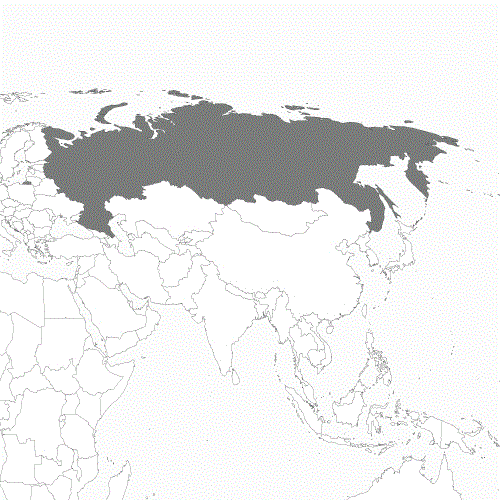
MOSCOW/BERLIN/LONDON (our own report) – The debate surrounding the drone attack on Leipzig Airport has once again raised the question of Russia’s red lines with regard to the Ukraine war. In recent years, Moscow has repeatedly warned Western powers not to cross its red lines. Chief among the moves considered unacceptable by the Kremlin is the willingness of Western powers to supply long-range missiles to Ukraine, enabling strikes targets deep into Russian territory. Russia says in this case it reserves the right to respond. Meanwhile, targets in the Russian heartland are being struck by long-range drones of British manufacture. Drones of this type are also being produced in Germany explicitly for export to Kiev. A Russian government adviser recently confirmed that there “sooner or later, there might be not only verbal but maybe some visible reaction from Russia towards the UK.” Cyber-attacks or “semi-military” measures were, he said, quite conceivable. The targets could be chosen asymmetrically. Should it be proven that the perpetrators at Leipzig Airport were actually working for Russian authorities, the incident could then be understood as such a Russian response to its red lines being crossed. And Germany would find itself one step further into war. Read more
An autumn of protest
Germany and Europe face an autumn of protest against war and the arms build-up. Rheinmetall wants to turn the Kassel area into a ‘Defence Hub North Hesse’ – just one case of the unfolding militarisation.
KASSEL/COLOGNE (our own report) – Some two hundred gatherings took place yesterday, Tuesday, to mark the start of the Second World War. They serve as a starting signal for the protests against militarisation and war planned this autumn. Protest events of all kinds have been announced in numerous other European countries, including Germany, until the end of the year. They are all directed against the continent-wide massive arms build-up and the dismantling of social welfare systems directly linked to it. People in Germany are increasingly alarmed by concrete preparations for war. Anti-militarisation mobilisations will include school strikes, actions by dockworkers and large-scale demonstrations. Yesterday, Tuesday, a week of action against the unchecked escalation of weapons production began in Cologne under the slogan ‘Disarm Rheinmetall’, aimed at curbing Germany’s largest arms manufacturer. The militarisation drive is reshaping the Federal Republic, as seen for instance in last week’s announcement by Rheinmetall of its plans for the city of Kassel. Working in cooperation with the Hesse state government, Rheinmetall said it would be turning the Kassel region into a ‘Defence Hub North Hesse’. Until now, Kassel has been largely known as a peaceful museum city that hosts the ‘documenta’ art exhibitions. Read more
GERMAN-FOREIGN-POLICY.com
Information on German Foreign Policy: News + Interviews + Analyses + Background