


Romania’s far right
Interview with Vladimir Borțun on the rapid rise of the Romanian far right and what the dominant position of foreign companies, including German ones, in Romania has to do with it.
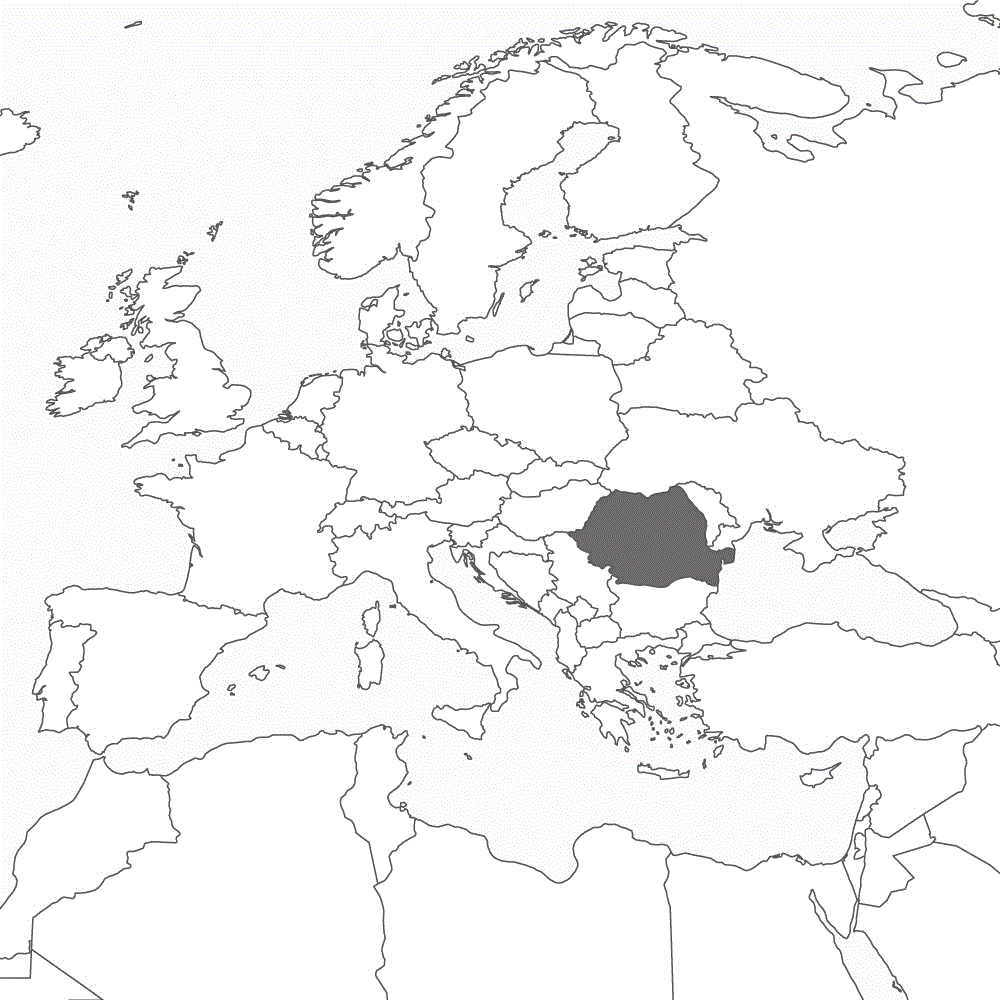
LONDON german-foreign-policy.com spoke with Vladimir Borțun about the rapid rise of the Romanian far right and what it has to do with the dominant position of foreign companies, including German ones, in Romania. Borțun is a political scientist and teaches at St John's College, Oxford University. He points out that the steady advance of foreign companies in Romania is not reducing poverty in the country, but is now putting pressure on growing sections of the local petty bourgeoisie. This class supports the far-right party AUR (Alianța pentru Unirea Românilor, Alliance for the Union of Romanians), whose president George Simion came very close to winning the recent presidential election with 46.4 per cent of the vote. In polls, AUR is currently in first place with almost 40 per cent, well ahead of the social democrats of PSD, which is in second place with 20 per cent. In the European Parliament, the AUR belongs to the European Conservatives and Reformists (ECR) – alongside the Fratelli d'Italia (FdI) of Italian Prime Minister Giorgia Meloni and the Polish PiS party, whose candidate Karol Nawrocki has been President of Poland since 6 August. Read more
The struggle for digital sovereignty (II)
Germany and France launch new initiative to reduce digital dependence on US: summit held amidst think-tank warnings of Washington weaponising vulnerabilities.
BERLIN/PARIS/BRUSSELS (own report) – At a ‘Summit on European Digital Sovereignty’ last week, several EU heads of state and government discussed measures to reduce Europe’s digital dependence on the United States. The summit was officially convened by Germany and France. A position paper entitled “Declaration for European Digital Sovereignty” was then issued. It is considered the most comprehensive attempt to date in the European Union to formulate a common understanding of digital sovereignty. Shortly before, the meeting, the influential Berlin-based SWP think-tank (German Institute for International and Security Affairs) had published an analysis highlighting the EU’s dependence on the US in cyber security. The author highlights three scenarios in which the US could leverage this dependence as a weapon against Europe. One scenario envisages Washington forcing concessions in the field of foreign and defence policy. However, addressing issues of Europe’s weak digital sovereignty is not new. The EU bloc has already taken initiatives in this direction. One project for use control over data, called Gaia-X, was considered by many to have failed, but is currently being revived. Read more
Wrangle over the 28-point plan
Germany, France and the UK seek to change key elements of the 28-point ceasefire plan in Geneva talks with the US – not least to promote their arms industries.
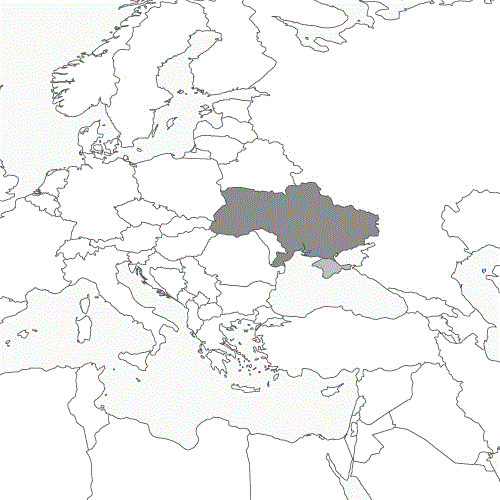
BERLIN/WASHINGTON (own report) – Germany, France and the United Kingdom are seeking to comprehensively alter core elements of the 28-point plan for a Ukraine ceasefire at talks with the United States in Geneva. On the one hand, the European intervention is about how exactly the Russian foreign assets frozen in the EU will be used. On the other, it is about loosening any restrictions imposed on the future strength of Ukrainian armed forces. While in official statements Berlin and Brussels claim to be promoting Ukraine’s interests, what is clearly at stake are the interests of Germany and the EU. The EU plan to use frozen Russian assets to arm Ukraine would mean more weapons exports from European producers as the bloc further expands its defence industries. The 28-point plan provides, however, for the funds to be spent on economic reconstruction in Ukraine. The American plan also contains restrictions on the size and capacity of Ukrainian forces. This point is also likely to conflict with the aspirations of several European states for profitable arms exports to Kiev. If Berlin and Brussels succeed in shaping the 28-point plan to fit their demands it is expected to fail. The war would then grind on. Read more
Creeping industrial decline
As Germany strengthens economic ties with the United Arab Emirates, the UAE corporate takeover of a major German company marks a power shift. The UAE supports the genocidal RSF militia in Sudan.
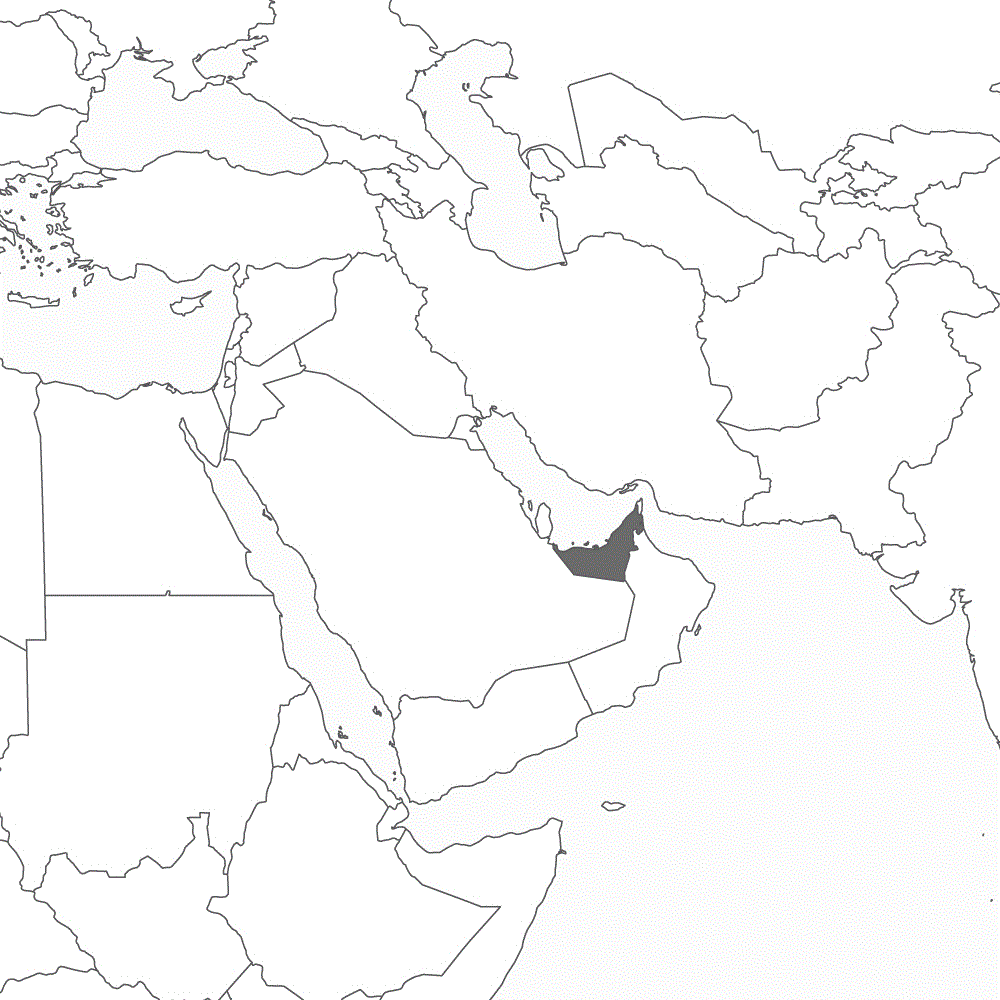
ABU DHABI/BERLIN (own report) – Holding intensive talks in Abu Dhabi, German Economics Minister Katherina Reiche has agreed closer relations with the United Arab Emirates – despite the role played by the UAE as the main supporter of the genocidal RSF militia in Sudan. The talks were partly about future plans for German access to green hydrogen. The Emirates are in the process of becoming one of the most important hydrogen producers. But Reiche also negotiated the imminent Emerati acquisition of the former DAX-listed company Covestro by the Emirati group Adnoc. This is to be green-lighted by supervisory authorities. Whereas the Emirates used to invest in Germany in ways that lifted German companies out of crisis by offering an infusion of cash, this time things are quite different. Covestro, a legacy German company (formerly Bayer MaterialScience) making plastics, is being integrated into an Emirati group with the aim of making the latter a world player. The take-over illustrates how profoundly the global balance of power is shifting. Berlin currently has to “come cap in hand” to the rising power of Abu Dhabi, according to comments made in Reiche’s delegation. In fact, the United Arab Emirates has long been self-confidently pursuing an independent foreign policy – made possible in part by cooperation with Germany. Read more
The state of tension
Mainstream media outlets drive a debate on declaring a ‘state of tension’ – this precursor to a ‘state of defence’ enables a clamp-down on basic rights.

BERLIN (own report) – Leading German media outlets are pushing a discussion on the need to declare a ‘state of tension’, a preliminary stage leading to a ‘state of defence’. On Wednesday, the CDU’s foreign and military policy expert Roderich Kiesewetter sought to justify the demand for a ‘state of tension’ to be imposed in Germany for the first time on the widely watched current affairs output of the public broadcasting network ARD. The hawkish Kiesewetter had already raised this talking point at the end of 2024. The ‘state of tension’ serves, as expressly defined by the Bundeswehr, “the purpose of mobilisation”. It provides for considerable restrictions right across society. Not least, it can trigger the immediate enforcement of compulsory military service for all men aged 18 and over. It also opens the door to compulsory recruitment and secondment of civilian personnel – such as doctors – to care for the military, and to forcing private companies to produce military goods. Concrete plans of this kind for a war scenario have long been in preparation in the healthcare sector and elsewhere. Healthcare providers would, for example, have to introduce a “reverse triage” system to deal with a surge in patient volume from the military. This might mean lightly injured Bundeswehr personnel being prioritised over seriously injured civilians in hospital treatment. Read more
New EU intelligence service proposed
European Commission President von der Leyen plans a new EU spy service. It would fall under her remit and rival the existing intelligence cell at the Foreign Affairs chief.
BRUSSELS/BERLIN (own report) – European Commission President Ursula von der Leyen is planning to create a new EU spy service in open competition with the Union’s existing intelligence centre. Reports say the new intelligence unit is to come under the auspices of the Commission’s service body, the Secretariat-General, and thus report directly to von der Leyen. The IntCen (Intelligence Analysis Centre) intelligence unit, which has already been in existence for years, falls under the remit of High Representative of the Union for Foreign Affairs Kaja Kallas. Observers suspect that von der Leyen wants to use the new service to further strengthen her power at Kallas’ expense. However, there is widespread scepticism as to its practical role. Bigger member states in particular may not like to see the emergence of a strong CIA-style EU intelligence service. They have so far preferred the use of their own national agencies and have little interest in intelligence sharing with a potential competitor. There have been calls for the establishment of an EU spy service since the 1990s, partly because various EU states found themselves cut off from information provided by US intelligence services during the Yugoslav Wars. Fears are growing about intelligence-sharing problems worsening under US President Donald Trump. Read more
Boycotting their own summit
Numerous EU heads of state and government, including German Chancellor Merz, chose at short notice to stay away from their own summit with the Latin American alliance CELAC – for fear of reprisals from the Trump administration.
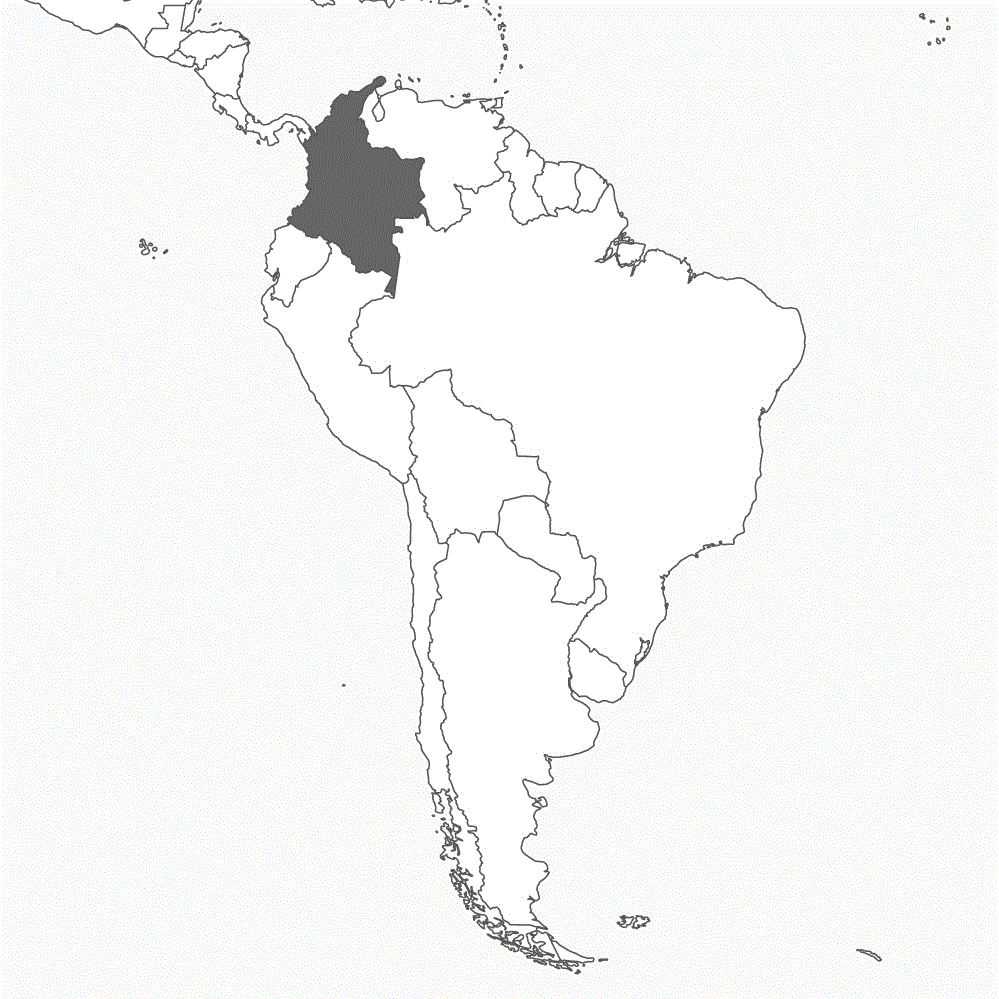
SANTA MARTA/BERLIN/WASHINGTON (own report) – In what is a huge affront to Latin American leaders, numerous EU heads of state and government, including Chancellor Friedrich Merz, torpedoed the summit arranged between the EU and the CELAC alliance on Sunday. The EU had previously attached great importance to the meeting as Europe seeks to regain some of its dwindling influence in the region and counter China’s growing presence. Statements made by the EU just a few days earlier praised “the strength and vitality of the partnership” with the subcontinent. Yet shortly before the summit Merz – along with French President Emmanuel Macron, European Commission President Ursula von der Leyen and other EU heads of state and government – cancelled their participation. The background to this decision is the US campaign of violence in the Caribbean. The Trump administration has repeatedly sunk boats and murdered dozens of people. When Colombian President Gustavo Petro, who has hosted the EU-CELAC summit, openly criticised extrajudicial killings, the United States slapped sanctions on him and Colombia. A number of senior EU officials and leaders of member states have chosen to boycott Petro and wreck their own summit. Driving this act of anticipatory obedience is the fear of reprisals from the Trump administration. Read more
India under Pressure
India and the EU are intensifying their efforts to conclude the long-planned free trade agreement. India has just extended its defense agreement with the US, while maintaining its cooperation with Russia.
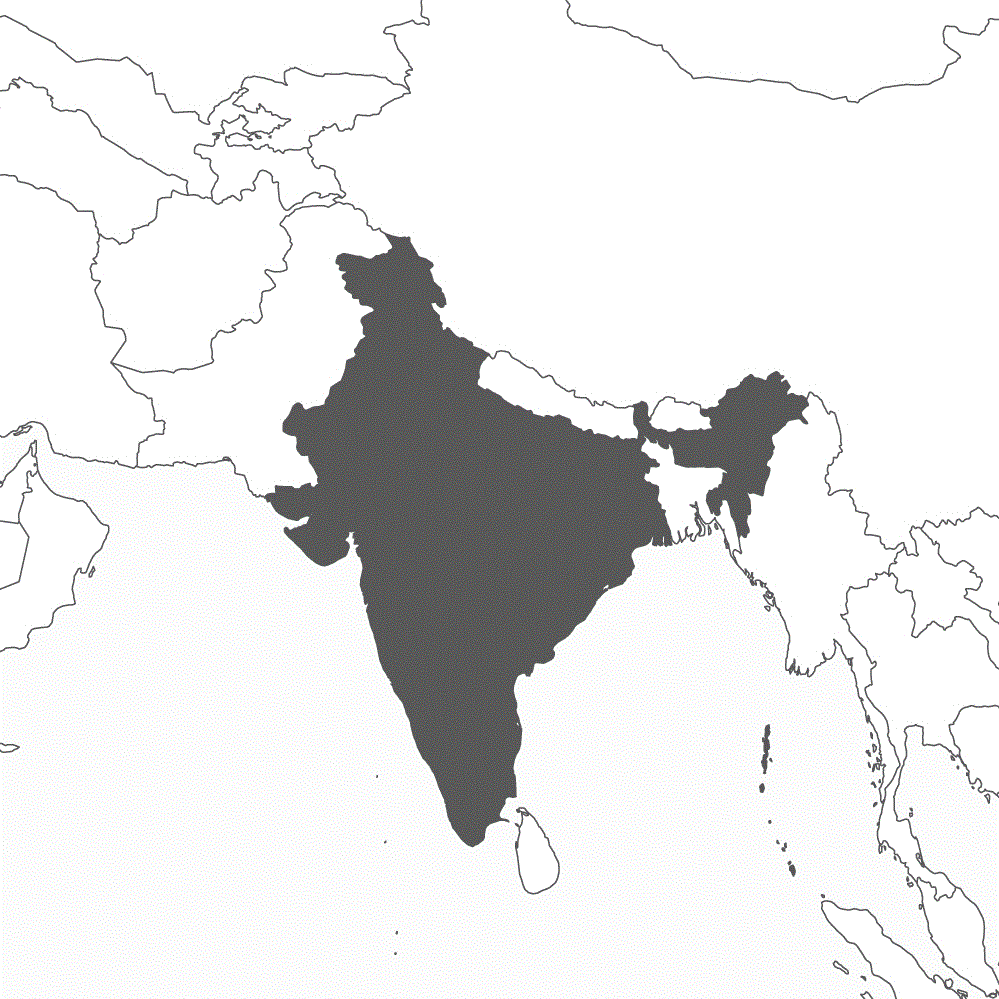
BRUSSELS/NEW DELHI/WASHINGTON/MOSCOW (own report) – A high-level EU delegation pressed ahead with negotiations in New Delhi on the long-planned EU-India free trade agreement this week. Most points of contention appear to have been resolved in the meantime; disputes remained regarding EU tariffs on imports from India resulting from the EU regulations on Carbon Border Adjustment Mechanism (CBAM). India accuses the EU of merely seeking to protect its own industry under the guise of environmental protection while granting US-goods preferential treatment. While the EU is limiting itself to trade issues, the US has consolidated its significantly stronger position in India by further extending its defense agreement with the country. The Indian-US agreement has been extended at a time, when India has made new acquisitions of Russian military equipment and was celebrating the 25th anniversary of its strategic partnership with Moscow. US President Donald Trump is seeking to undermine Indian-Russian relations with sanctions against Russian oil companies from which leading Indian companies have been procuring oil. Read more
The battle for digital sovereignty
The debate on Germany's and the EU's “digital sovereignty” among foreign policy experts remains controversial. Some believe it is no longer possible, while others argue that German military technology startups continue forging ahead.
BERLIN (own report) – The German foreign policy establishment is pursuing the debate on Germany’s and the EU’s “digital sovereignty,” as the basis for genuine independence from the United States. According to a recent special issue of the journal “Internationale Politik,” published by the German Council on Foreign Relations (DGAP), “at present, the structural power in digital technology clearly lies outside Europe,” namely in the USA and China. “US internet companies are so powerful” that “European companies and administrations“ would probably “have to shut down” should the US government “decide to impose an embargo,” according to another article. There, however, is a consensus in the debate that the efforts made so far by the German government and the EU Commission to escape technological dependence, particularly on the United States, have failed. Whereas one author concludes that Berlin and Brussels have now “resigned themselves to a post-sovereign position,” others believe that the battle for tech-sovereignty is still being waged, for example, by young military technology startups in Germany. Read more
GERMAN-FOREIGN-POLICY.com
Information on German Foreign Policy: News + Interviews + Analyses + Background