


The new alliance strategy
The EU and Japan announce closer cooperation to secure supply chains and boost defence industries. They want greater independence from China (rare earths) and from the US (defence and military).
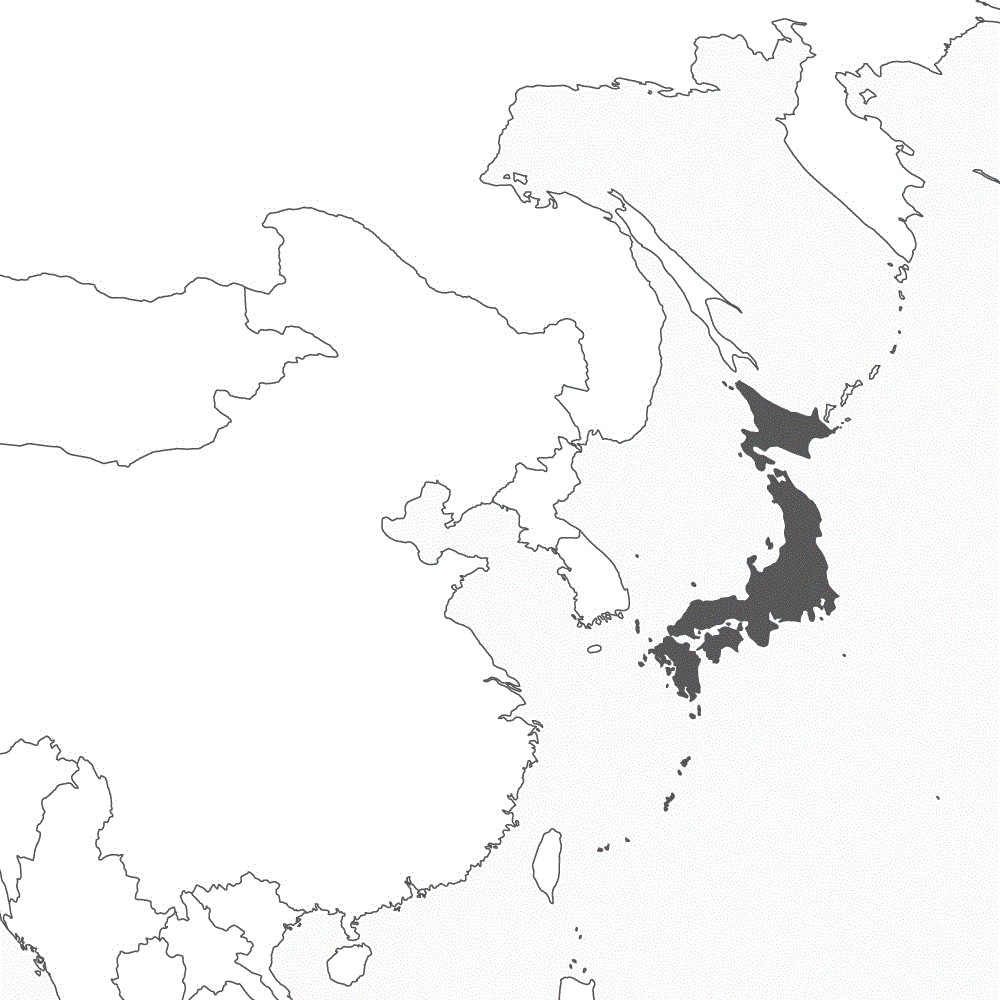
TOKYO/BRUSSELS (own report) – The EU and Japan are seeking to intensify their cooperation. A key motive is to gain greater independence from both China and the United States. This was the outcome of the latest EU-Japan summit held yesterday in Tokyo, with both sides looking for ways of becoming less reliant on China for rare earths and of generally achieving a greater degree of economic independence in many areas. They are also pushing for a return to a “stable” economic environment – clearly a response to the highly unpredictable Trump administration with its policy of imposing punitive tariffs even on close allies. Arms production was also at the centre of talks. The EU and Japan are aiming for closer cooperation between their weapons manufacturers as part of a move to rapidly enlarge their “defence industry base”. The EU is taking a similar approach in talks with a number of countries. Partnerships are emerging with the United Kingdom, Canada, South Korea and others. The EU has launched arms production initiatives under build-up schemes under the Security Action for Europe (SAFE) programme. Arms producers can be given loans of up to 150 billion euros on favourable terms. In future, even non-EU allies can, to a certain extent, be offered benefits to ramp up their arms industry. Government advisers in Berlin are talking about a new “alliance strategy” – without the United States. Read more
“It’s Military Keynesianism”
Interview with Andrew Feinstein on Germany’s role in the international arms trade, on the reason why there is a new wave of militarisation in Europe and on German arms exports to Israel.
LONDON german-foreign-policy.com spoke with Andrew Feinstein about the role of German arms manufacturers in the international arms trade, about the new wave of militarisation in Europe and about German arms exports to Israel. A former Member of Parliament for the African National Congress (ANC) in South Africa, Feinstein is Executive Director of Shadow World Investigations, a non-profit organisation which undertakes investigations into grand corruption, corporate malfeasance and militarism with a special focus on the global arms trade. Feinstein has authored or edited books like “The Shadow World: Inside the Global Arms Trade” (London 2011), “Indefensible: The Seven Myths That Sustain the Global Arms Trade” (London 2017) and “Monstrous Anger of the Guns. How the Global Arms Trade is Ruining the World and What We Can Do About It” (together with Rhona Michie and Paul Rogers, London 2024). Read more
Western exceptionalism
EU refuses to act against Israel despite its blatant war crimes in the Gaza Stip. Elsewhere, criticism is loud and clear: in the Global South, among former diplomats and in Israel itself.
BERLIN/TEL AVIV (own report) – The European Union continues to refuse any action against Israel in response to its brutal warfare in the Gaza Strip, even after the most recent plans for deporting and incarcerating the Palestinian population. The latest decision to do nothing was affirmed by EU foreign ministers at their meeting on 16 July. They argued that a promise of a short-term expansion of Israeli aid deliveries into Gaza was sufficient grounds for blocking the demands of a few EU countries, including Spain, to at least suspend the EU’s Association Agreement with Israel. Germany in particular has been a strong advocate of blocking any practical measures against Israel’s far-right government. And Berlin can rely on support from the right-wing governments of Italy and Hungary. Yet the voices of criticism and active protest against Israel’s war on Gaza are growing louder. Even a former Israeli prime minister, Ehud Olmert, is saying that the planned enclosed “humanitarian city” to be created by Israel on the rubble of Gaza, in which some 600,000 Palestinians are to be kept as a first step, will in fact be “a concentration camp”. Meanwhile, a gathering of thirty or so countries in Bogotá is seeking to introduce concrete measures against Israel. This “emergency summit” is calling out the West’s “exceptionalism” expressed in its decision to ignore international law. Read more
Fallen in the trap (II)
European Commission President von der Leyen spurns countermeasures against Trump’s latest tariff threats – having already deliberately relinquished leverage in the trade dispute.
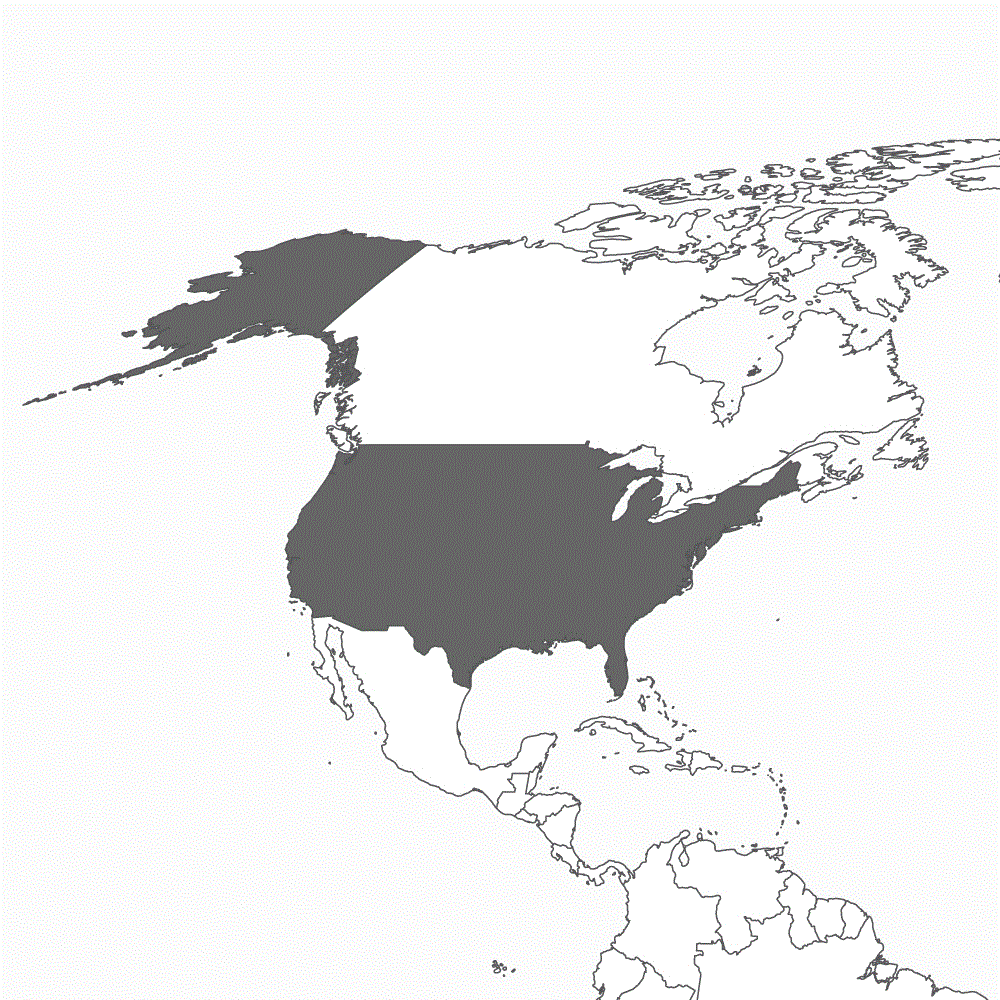
WASHINGTON/BRUSSELS (own report) – The EU is still not responding with countermeasures to the latest tariff threats from US President Donald Trump. Indeed, Brussels is acting to block demands for an effective counter-offensive coming from France, the European Parliament and other quarters. In response to Trump’s latest announcement that he would impose tariffs of 30 per cent on all imports from the EU from 1 August, Commission President Ursula von der Leyen announced that Brussels would be “extending the suspension of our countermeasures until early August”. Von der Leyen had already ensured that a package of retaliatory tariffs on imports from the US worth some 21 billion US dollars would not be implemented. In adopting this passive stance she took into account the demands of the German government. Berlin wants to avoid an escalation of the conflict at all costs in order not to jeopardise German industry’s business relations with the US. Germany’s trade with the US far exceeds its trade any other country. Von der Leyen has even stepped back deliberately from planning other ways of giving the EU leverage, not least the introduction of EU digital taxes and expanding trade relations with China. Trump is now ruthlessly exploiting the resulting dependence. Read more
The road to the bomb
Where is the debate over German or European nuclear armament heading? A German atom bomb cannot be ruled out, but experts in Berlin advise initial caution.
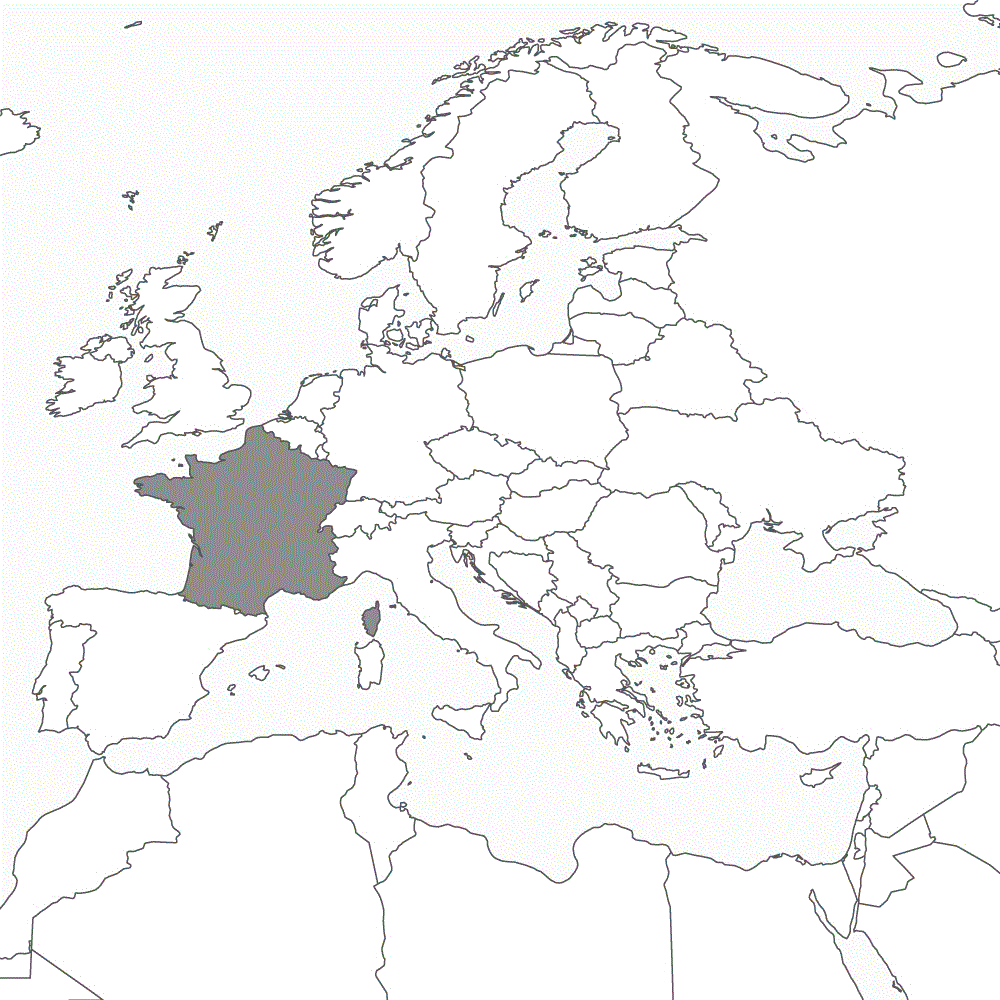
BERLIN/PARIS (own report) – Foreign policy experts in Berlin are advising caution when it comes to pursuing independent nuclear armament for Germany or Europe. Simply placing oneself under the French nuclear umbrella is problematic, says an analysis in the latest issue of the journal Internationale Politik, published by the German Council on Foreign Relations (DGAP). France’s independent nuclear strike force, the Force de Frappe, is focused on achieving deterrence by threatening the complete destruction of Russian decision-making centres. But France lacks tactical nuclear weapons, so cannot, according to the German Institute for International and Security Affairs (SWP) respond adequately to a Russian attack on Eastern Europe with these weapons. Moves by Berlin or Brussels to openly seek immediate procurement of a German or European bomb would trigger fierce resistance. And a number of other states would be encouraged to arm themselves with nuclear weapons. This is why Berlin’s think-tanks are arguing that the best approach is to secure the US nuclear umbrella for a while and, in the meantime, quietly develop Germany’s own nuclear capabilities without causing too much of a stir. In the US, foreign policy hawks are now openly discussing a nuclear first strike against China. Read more
Closing ranks in Germany
As global power struggles escalate, leaders in German politics and business are calling on employers to help build the country’s military capabilities.

BERLIN (own report) – The German government is pushing for a closer partnership with the private sector to expand the country’s military reserve. As Chancellor Friedrich Merz said at an event organised by the Federation of German Industries (BDI), employers “must and should” enable their employees to serve as reservists – even if this creates some difficulties for their companies. The German Armed Forces have, for years, been systematically establishing “reservist partnerships” with German companies. In the context of what is openly referred to as “preparations for a possible war against Russia”, Berlin is looking to reservists primarily for “homeland security” tasks. The idea is that, in the event of war, the full-time professional soldiers would mainly be deployed to the eastern front. The Bundeswehr has already begun integrating reservists into its large-scale manoeuvres. Lots of businesses in Germany have signed cooperation agreements with the army in the sphere of homeland security. They include big corporations like Lufthansa and Amazon, but also small and medium-sized enterprises. The Federal Employment Agency (BA), responsible for benefits and job placements etc., is a key player in the scheme. Looking far beyond arrangements to simplify staff releases for reservist service, the BDI industrialists are now calling for close cooperation between state and industry in the arms sector. Read more
Soft power curtailed
A recent analysis warns of a steady loss of influence in the Global South for Western countries due to their dramatic cuts in development aid.
BERLIN (own report) – A new analysis by the Kiel Institute for the World Economy (IfW) warns that current cuts in development aid will lead to a loss of power and influence in the Global South for Germany and other Western countries. Development assistance always produces economic and political advantages for the donor country, argues the IfW paper. So if it is significantly reduced – as most Western countries are currently doing – then a reduction in the “global influence” of the transatlantic powers is only to be expected. In addition to fewer trade opportunities, disengagement will also bring about a loss of geostrategic influence. After all, it is often forgotten that recipient governments frequently show their gratitude for aid through political concessions. Back in 2013, the then German Development Minister Dirk Niebel (FDP) stated that, “with every euro spent on development cooperation two euros will flow back to us in the long term.” On the other hand, as the IfW frankly admits, the growth incentives for the recipients that result from development aid are generally “modest”. It remains unclear as to how Western countries intend to counteract this loss of influence in the wake of their drastic aid cuts. Read more
The ‘Cyber Dome’
Germany announces a ‘cyber and security pact’ with Israel, including cooperation on ‘cyberdefence’ and a closer intelligence partnership. Meanwhile reports of shocking IDF war crimes continue.
BERLIN/TEL AVIV (own report) – Germany is expanding its military, cyber and intelligence cooperation with Israel. Federal Interior Minister Alexander Dobrindt announced a “cyber and security pact” with its close ally over the weekend. The agreement is to include cooperation on “cyberdefence” and anti-drone systems as well as intensified intelligence cooperation. Israel’s capabilities in the field of cyber warfare are considered outstanding. They were already on displayed over fifteen years ago with a sensational cyber sabotage strike on Iran’s nuclear programme. Today, those sophisticated capabilities include the controlling of military operations using artificial intelligence (AI), first tested on a large scale in Israel’s war with Iran. Berlin can build on its long-standing intensive military cooperation with the Israel Defense Forces (IDF) and exploit its close linkages in the field of armaments. This even deeper alliance for repressive expertise and military development is being pursued by the German government at a time when new allegations of war crimes levelled against the IDF are coming to light. It also helps to explain the background to Germany’s harsh domestic repression of supporters of the Palestinians. Read more
GERMAN-FOREIGN-POLICY.com
Information on German Foreign Policy: News + Interviews + Analyses + Background