


The road to the bomb (II)
Calls for Germany to build its own nuclear bomb grow louder as Merz talks up a new ‘power politics’ for the EU. A Bundeswehr brigadier general wants tactical nuclear weapons.

BERLIN (own report) – Calls for the construction of a German nuclear bomb accompanied Chancellor Friedrich Merz’s call yesterday for the European Union to stand up for itself with a new “power politics”. The EU must finally “learn to speak the language of power politics” and “become a European power”, Merz declared in his government’s foreign policy statement made in the context of an escalating struggle with the United States under Trump’s leadership. Also on Thursday, former Foreign Minister Josef Fischer, a Green party grandee, joined other voices speaking out in favour of “European nuclear armament”. Following a plea by a brigadier general at the German Armed Forces Command and Staff College for Germany’s own atomic weaponry, questions about feasibility are also under discussion. A long-standing expert at the Jülich Research Centre, a nuclear physics hub, has been quoted as saying that the Gronau uranium enrichment plant could easily produce enough weapons-grade material for “around 340 warheads”. However, CDU politician Roderich Kiesewetter has to concede that such a step would require renegotiating the Two Plus Four Treaty, which in turn would bring reparations issues from the Second World War back onto the agenda. Read more
In search of alternatives (II)
EU free trade agreement with India is to offer alternatives to business with the US. With Europe in trouble as Trump’s extortionate tariffs bite, experts advise greater autonomy from the US.
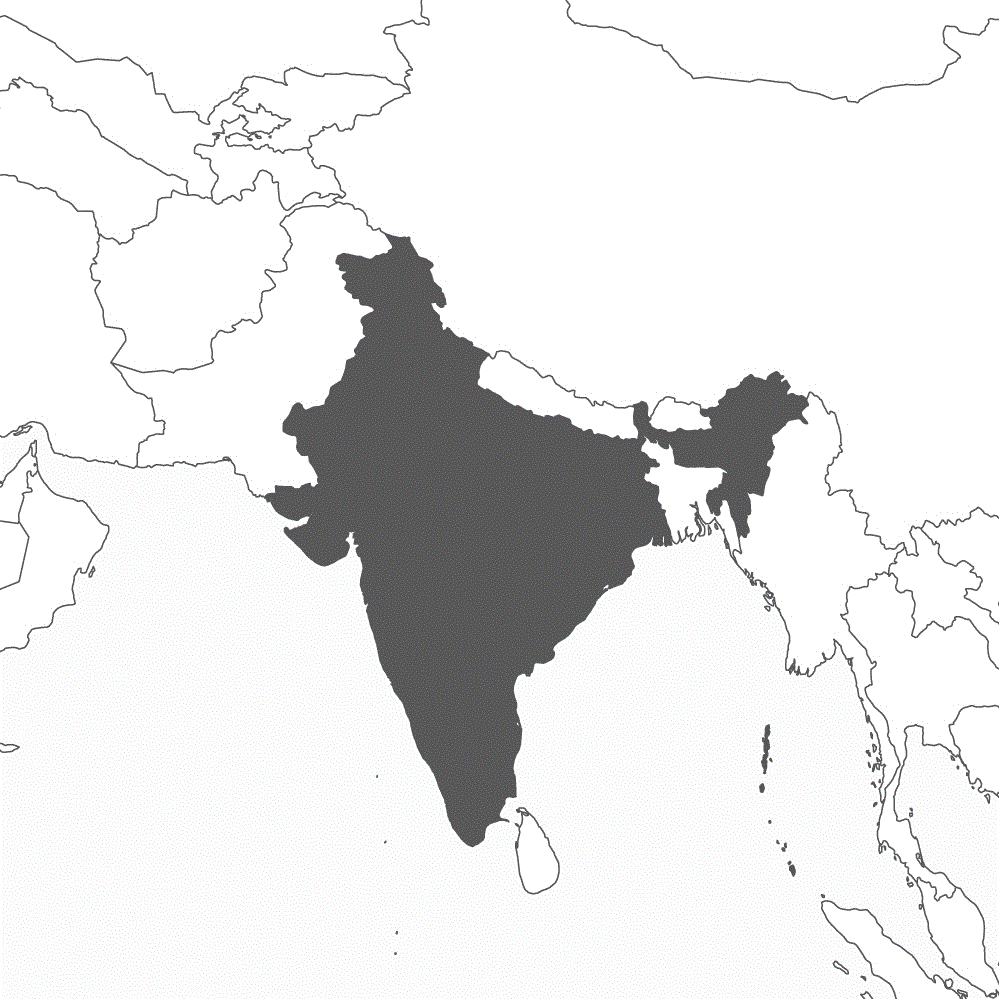
NEW DELHI/BRUSSELS/BERLIN (own report) – The free trade agreement between the EU and India signed on Tuesday is intended to offer both sides some relief from their tariff-related losses from US trade. There is mutual desperation to reduce economic dependence on the United States. Estimates by a German think-tank, the Kiel Institute for the World Economy (IfW), show that the India deal can only partially offset the losses already caused by President Trump’s tariffs. However, it does provide some relief for important industries in both India and the EU, not least the Indian textile sector and Germany’s automotive and engineering industries. Potentially, the trade deal will – to a small extent – reduce the Trump administration’s scope for exerting economic pressure on both the EU and India. In Berlin, government advisers are encouraging efforts to achieve greater economic independence from the US. The new posture flows from fundamental strategic considerations. Another influential think-tank, the German Institute for International and Security Affairs (SWP) agrees that “dependence on the US must be significantly reduced” as a general principle The analysts argue that if these steps are not taken, Germany will slide into a state of permanent and subordination to the United States under increasingly abject conditions, as seen in the disastrous customs deal imposed on the European Union last summer. Read more
The new US military strategy
The new US military strategy still assigns European NATO countries a central role in containing Russia. But it is silent on the politics of force now triggering European opposition.
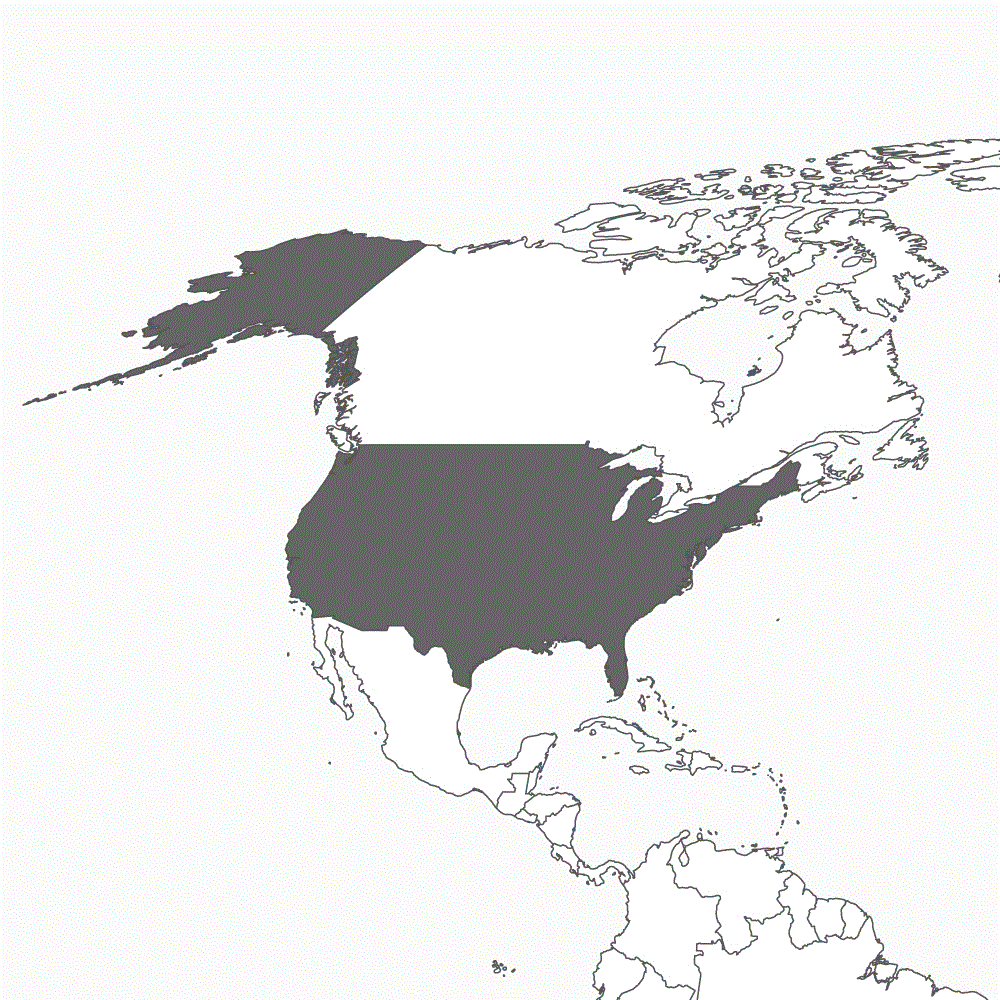
WASHINGTON/BERLIN (own report) – The United States’ new National Defense Strategy, released by the Department of War at the end of last week, continues to assign the NATO countries of Europe a central role when it comes to “containing” Russia in the future. The strategy paper says Moscow will remain “a persistent but manageable threat to NATO’s eastern members for the foreseeable future.” In Washington’s view, “Europe” should have the ongoing task of keeping Russia in check. This will, it argues, be easily achievable, since “European NATO dwarfs Russian in economic scale, population, and, thus, latent military power.” The paper has a strong focus on the long-term US power struggle with China, but argues for a lowering of the temperature. The People’s Republic is, according to analysts, already superior to the US in terms of high-tech armaments, at least in certain fields. As its military budget soars, the US is pushing ahead with a major rearmament programme. It is also now focused on bringing the “Western Hemisphere” under its military control. The new strategy paper does not address the Trump administration’s policy of force towards Europe. This aggressive posture is prompting some European NATO countries to shift away from Washington. Read more
US billionaires’ drive for world power
The German government does not rule out joining the ‘Board of Peace’.* The Gaza reconstruction body, under Trump’s full command, is envisaged as Washington’s UN replacement.
WASHINGTON/BERLIN (own report) – The German government is keeping its options open* regarding participation in the ‘Board of Peace’, a US-sponsored body with the official remit of overseeing reconstruction in the Gaza Strip. It is to be led by US President Donald Trump, who has awarded himself dictatorial powers. The Board is widely held to actually be a way of supplanting the United Nations. There have been unanimous reports that Trump will present the new body on Wednesday at the World Economic Forum in Davos, announcing some sixty or so states chosen by him for admission as members. With regard to the task of overseeing Gaza reconstruction, the Palestinians themselves are only accorded practical tasks at the level of local administration. Political control is exclusively reserved for a mix of foreign governments and billionaires. No wonder there is talk of a new mandate regime, this time led not from London but from Washington. The role of chairperson on the ‘Board of Peace’ is essentially a lifetime position reserved for Trump personally. He has powers to expel members at will and veto any decisions he doesn’t like. The Trump administration says, with obvious reference to the United Nations, the new body should replace “institutions” that have “too often failed”. France has already rejected the invitation to participate as a member state, but Germany has not.* Read more
Germany’s food power
German corporations control almost every link in the global food chain. They promote an agro-industrial production model with devastating impacts on humans, animals and the environment. But protests are growing.
BERLIN/BRUSSELS (own report) – A broad alliance of small-scale farmers, environmental initiatives and consumer protection groups are uniting under the slogan “Wir haben es satt” (We've had enough). They mobilised for a demonstration in Berlin last Saturday. Their protests are directed in part against the conditions in the global food industry, where German corporations play a dominant role in almost all areas. From the production of seeds and pesticides to veterinary medicines and food retailing, we find Germany-based companies nearly everywhere in the top ten largest players worldwide. Almost all food-related industries are run by oligopolies. They squeeze farmers’ margins and degrade them to the role of “price takers”. More and more farmers find themselves unable to compete and cope with worsening conditions. In Germany, as elsewhere, small-scale farms are going out of business. Their numbers are shrinking year on year by around 2,600. What is more, the agro-industrial production model is fuelling environmental damage and climate change. A change of direction is systematically blocked by the influential big agro lobby. Worse still, we are now confronted with a rollback of existing rules and protections. The EU is preparing to undermine a slew of directives on health and environmental protection by introducing “simplification packages”. Read more
In search of alternatives
Merz in India: Germany’s Chancellor wants to strengthen economic ties (against China), expand arms links (against Russia), and build cooperation with New Delhi (as a partial alternative to the US).
NEW DELHI/BERLIN (own report) – Germany’s power struggles with China, Russia and, to limited extent, the United States form the context of Chancellor Friedrich Merz’s current talks in India. Merz is keen to strengthen German trade with India and promote German investment in the Indian economy. On the one hand, this move is intended to create an alternative to German business with China and to strengthen New Delhi’s standing vis-à-vis Beijing. On the other hand, Berlin is promoting German arms exports, not only to increase sales for Germany’s arms manufacturers but also to reduce the share of Russian military equipment in use by the Indian armed forces. So far, however, the West has failed to break Moscow’s influence in New Delhi – not even on a military level. Both countries continue to conduct joint military exercises, most recently in October 2025 in India (‘Indra-2025’). Merz and Indian Prime Minister Narendra Modi are now negotiating a deal to supply German submarines worth seven billion euros. Efforts to achieving deeper economic relations are intended to make both countries less dependent on the United States now that Washington is seriously damaging both Germany and India with its tariffs and other repressive measures. Read more
A hitman and his accomplice
The German government remains silent as Trump ramps up his violent global rampage. Trump: “I don’t need international law,” and "only my own morality” can limit military interventions. Are Cuba and Iran next in line?
WASHINGTON/BERLIN (own report) – The German government remains largely silent on the Trump administration’s violent global rampage. As Washington commits an increasing number of crimes against foreign states, Bonn remains silent and even signals partial approval. The US president made it clear last week that he does not consider himself bound by international law, only by his “own morality”. Trump made this statement after initiating military strikes on Venezuela and the abduction of its president. He is now threatening an oil blockade against Cuba and a second war of aggression against Iran. As for Cuba, Trump would find it amusing to appoint US Secretary of State Marco Rubio as Cuban president – thus turning the country into a US protectorate. At the same time, he is calling for a massive increase in the United States’ military budget – up by two-thirds to 1.5 trillion US dollars. That would amount to around 55 per cent of all global military spending in 2024. Washington’s unrestrained acts of aggression against foreign countries are the equivalent, on the international level, of those frequent incidents of mass killings across the United States by weaponised individuals running amok and causing consternation and horror. Yet Berlin still won’t call it out. The German government continues to describe the situation in Venezuela as legally “complex”. Indeed, Foreign Minister Johann Wadephul is now calling for the West to “stand together” against Iran. Read more
Party of the new order
Senior AfD foreign affairs spokespersons endorse US violence against Venezuela. The far-right party widens the common ground with conservatives as it eyes a potential AfD-CDU/CSU coalition ‘aligning Germany with a new order’.
BERLIN/WASHINGTON (own report) – Leading AfD foreign policy figures are endorsing the Trump administration’s policy of military force against Venezuela. By backing the line adopted by senior Christian Democrats, including Chancellor Friedrich Merz himself, the far-right ‘Alternative für Deutschland’ is widening the common ground shared by the parties and enabling a future coalition. AfD leaders had already demonstrated a clear desire for closer transatlantic cooperation in their many visits to the United States. They have repeatedly met with figures from the Trump administration and the MAGA movement. The AfD understands that support for US policy is indispensable to any role in a future German government. Back in the autumn we saw members of the CDU, CSU and AfD, along with conservative and far-right members of the European Parliament from other countries, voting together to bring down the so-called “cordon sanitaire”. A serious precedent was thus set by the joint push to dispense with any “firewall” against extremism in European politics. The Trump administration’s new National Security Strategy explicitly promotes the inclusion of far-right parties in government coalitions across Europe. The AfD, with its acceptance of the Washington’s blatant policy of violence against Venezuela, can now distinguish itself as a party that, in the words of an expert from the German Council on Foreign Relations (DGAP), is “aligning the country and the continent to a new order”. Read more
Colonial ambitions
Chancellor Merz sees nothing wrong with US warfare against Venezuela, even expressing satisfaction at President Maduro’s abduction. African governments have denounced Washington’s “colonial ambitions”.
BERLIN/WASHINGTON/CARACAS (our own report) – The German government has started the new year with a declaration of political and ideological bankruptcy. While Chancellor Friedrich Merz has been loudly insisting on sanctions against Russia for its “war of aggression” against Ukraine, he sees nothing reprehensible in the US war of aggression against Venezuela and the abduction of its elected president. Merz claims the “legal assessment” of the US invasion is “complex”. With its weasel words the German government, already facing international criticism for double standards, is losing even more credibility worldwide. Berlin has further isolated itself from the countries of the Global South. African countries, among others, have issued sharply critical, and factually correct, statements in response to the US strikes on Venezuela. They condemn the violations of international law. As the Ghanaian Foreign Ministry, for example, points out, President Trump’s announcement that the US would “run” Venezuela until further notice is “reminiscent of the colonial and imperialist era” and that “such colonial ambitions should have no place” in the modern era. Berlin, by contrast, has unhesitatingly sided with Washington. Read more
GERMAN-FOREIGN-POLICY.com
Information on German Foreign Policy: News + Interviews + Analyses + Background