


Romania’s far right
Interview with Vladimir Borțun on the rapid rise of the Romanian far right and what the dominant position of foreign companies, including German ones, in Romania has to do with it.
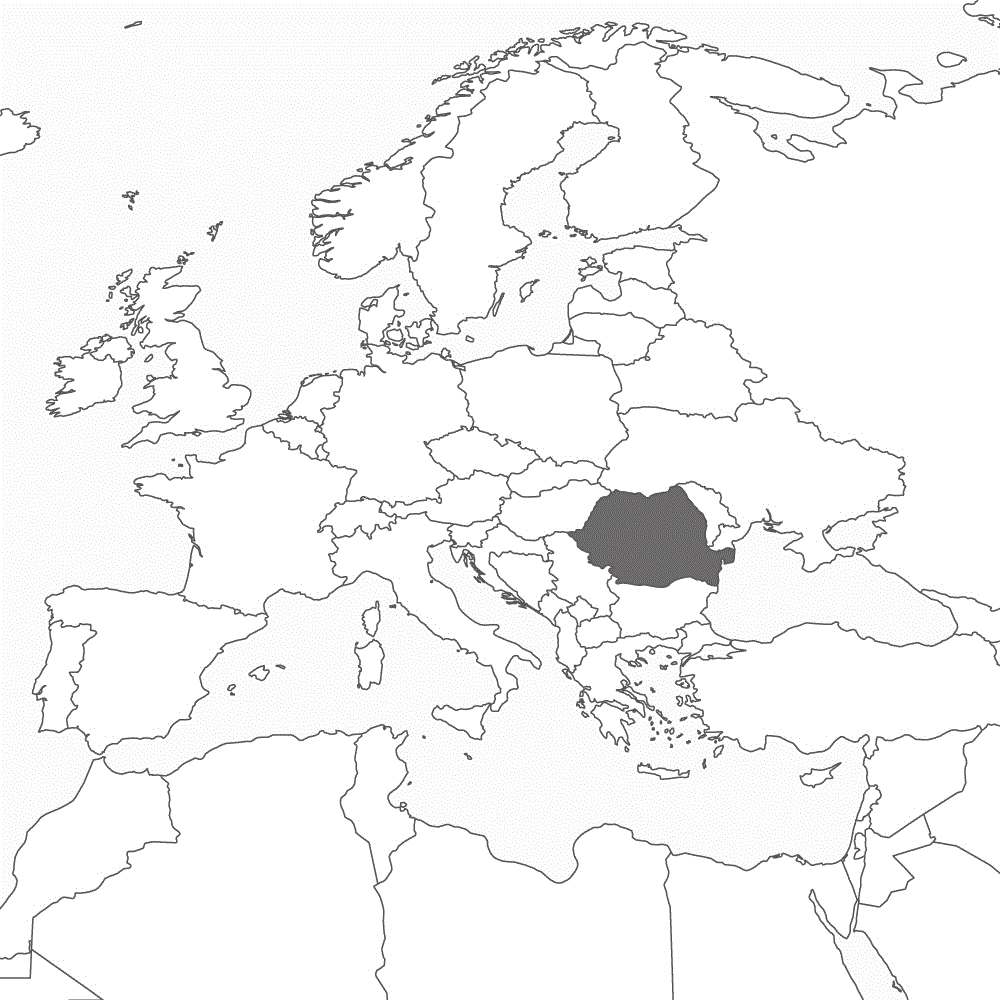
LONDON german-foreign-policy.com spoke with Vladimir Borțun about the rapid rise of the Romanian far right and what it has to do with the dominant position of foreign companies, including German ones, in Romania. Borțun is a political scientist and teaches at St John's College, Oxford University. He points out that the steady advance of foreign companies in Romania is not reducing poverty in the country, but is now putting pressure on growing sections of the local petty bourgeoisie. This class supports the far-right party AUR (Alianța pentru Unirea Românilor, Alliance for the Union of Romanians), whose president George Simion came very close to winning the recent presidential election with 46.4 per cent of the vote. In polls, AUR is currently in first place with almost 40 per cent, well ahead of the social democrats of PSD, which is in second place with 20 per cent. In the European Parliament, the AUR belongs to the European Conservatives and Reformists (ECR) – alongside the Fratelli d'Italia (FdI) of Italian Prime Minister Giorgia Meloni and the Polish PiS party, whose candidate Karol Nawrocki has been President of Poland since 6 August. Read more
‘A reliable partner of the EU’
Romanians protest machinations of the Western-backed political elite. The ‘wrong’ candidate won and is barred from standing in the presidential re-run: too pro-Russian.
BUCHAREST/BRUSSELS (own report) – Romania is seeing a growing protest against dubious interventions in the country’s presidential election. The political establishment, supported by Brussels and Berlin, is accused of blatant manipulation. Manipulation began last November in response to the unexpected first-round victory of a presidential candidate regarded as pro-Russian. After strong disapproval signalled by EU leaders and an openly critical intervention by the then US administration under President Joe Biden, Romania’s Constitutional Court declared the election null and void. Now, the NATO-sceptical candidate, an independent politician from the far right, has been barred from standing in the presidential re-run in May. He won the first round at the end of November partly on a peace and anti-corruption ticket, gaining the support of many Romanians who considered corruption to be rife across the Romanian political establishment. The public was already highly critical of their annulment, but the stratagem to exclude a popular candidate is now driving more voters to the extreme right. Such machinations were also evident in neighbouring Moldova at the end of 2024. Pro-Western political forces in one of the poorest countries in Europe won the presidential election by a whisker, thanks to irregularities in voting arrangements for the many Moldovans living abroad: 231 polling stations were set up in Western countries, compared to only two in the whole of Russia. Read more
GERMAN-FOREIGN-POLICY.com
Information on German Foreign Policy: News + Interviews + Analyses + Background