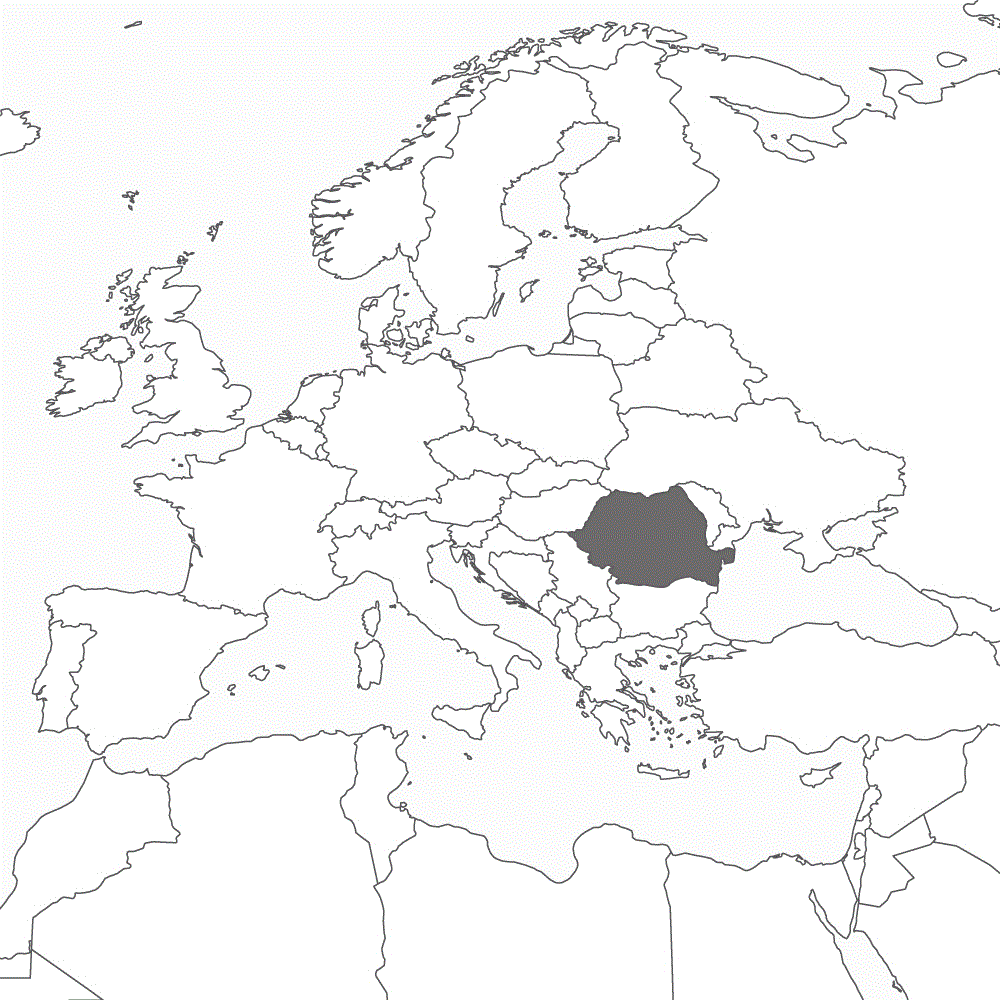
Romania’s far right
Interview with Vladimir Borțun on the rapid rise of the Romanian far right and what the dominant position of foreign companies, including German ones, in Romania has to do with it.
LONDON german-foreign-policy.com spoke with Vladimir Borțun about the rapid rise of the Romanian far right and what it has to do with the dominant position of foreign companies, including German ones, in Romania. Borțun is a political scientist and teaches at St John's College, Oxford University. He points out that the steady advance of foreign companies in Romania is not reducing poverty in the country, but is now putting pressure on growing sections of the local petty bourgeoisie. This class supports the far-right party AUR (Alianța pentru Unirea Românilor, Alliance for the Union of Romanians), whose president George Simion came very close to winning the recent presidential election with 46.4 per cent of the vote. In polls, AUR is currently in first place with almost 40 per cent, well ahead of the social democrats of PSD, which is in second place with 20 per cent. In the European Parliament, the AUR belongs to the European Conservatives and Reformists (ECR) – alongside the Fratelli d'Italia (FdI) of Italian Prime Minister Giorgia Meloni and the Polish PiS party, whose candidate Karol Nawrocki has been President of Poland since 6 August.
german-foreign-policy.com: Romania has become an important investment location for foreign capital in recent decades. German companies have invested a lot there as well. Nevertheless, Romania is still the second poorest country in the EU. Why is that?
Vladimir Borțun: We have to start with what happened in Romania in the early 1990s. There was the usual shock therapy that happened all across the region. It might not have been as brutal in Romania as it was in Poland or in Russia, but it still happened. In the first five years of capitalist restoration, the process of deindustrialisation kickstarted. We saw a drop in jobs in industry from 42 per cent to 30 per cent of the whole work force. We saw a drop in exports of over 60 per cent. About a quarter of the GDP was lost. This laid the basis for a peripheral neoliberal model that was subsequently built upon several important pillars. One of them was a precarious work force. I would mention the reform of the labour law in 2011 which deprived the working class of some of its most basic tools to fight for its rights and wages. For example, it made it very hard to establish trade unions in the private sector and to engage in collective bargaining.
Another pillar of the newly imposed neoliberal model was the privatisation of most state assets. Some of Romania’s biggest companies were privatised – sometimes, by the way, bought by state companies from other countries which even by neoliberal standards wasn’t an actual privatisation. Romania’s oil, for example, is mostly owned by the state oil company of Kazakhstan. Think of the free market argument that you need to privatise because the free market is more efficient in running companies and distributing resources – it doesn’t make sense once you sell your industry to state companies of other countries. But anyway. In order to attract foreign investment the growth of precariousnessof the work force went on. Taxation was lowered by introducing a flat tax on income. Today, Romania is one of only two countries in the EU that don’t have progressive taxation; Hungary is the second. The corporate tax is 16 per cent, one of the lowest in the EU.
german-foreign-policy.com: So, the precarious situation of the Romanian people has to do with the government in Bucharest trying to satisfy the interests of foreign companies?
Vladimir Borțun: Indeed. All these measures were meant to attract foreign direct investment. We talk a lot about deindustrialisation in the 1990s but in fact foreign direct investment has led to reindustrialisation later on although to a very uneven one. To give you an example of the regional imbalances: The capital region, Bucharest, attracted 64 per cent of foreign direct investment, whereas the northeast region – the poorest in Romania which is on the border with Ukraine and the Republic of Moldova and has the highest emigration rate – attracted 2.6 per cent. The other regions were not doing much better. The southwest region – also a very poor region, mostly rural – attracted around 3 per cent. Bucharest is, in GDP terms, an island of wealth. It has around 150 per cent of the average GDP per capita in the EU; its GDP is higher than that of the whole country of Serbia. But then there are former industrial towns, especially smaller towns that were built around certain industries that have been completely dilapidated – economically, socially, culturally, demographically, in every regard. Romania has the largest diaspora in Europe, around five million people of a total population of around 20 million. I remember statistics from a few years ago; then, only the Syrian diaspora was bigger.
There has been relatively decent GDP growth over the last decade or so – not very good in the last few years, but we had a period of sustained GDP growth before. But this growth has been accumulated at the top. It hasn’t translated into significantly better living standards for ordinary people. Around 45 per cent of Romania’s population still live either in poverty or on the verge of poverty. The minimum wage, despite repeated increases in recent years, is still falling under what would be necessary to provide a decent living standard for a family. All this is rooted in the neoliberal economic model which has been cemented by the integration of Romania into the EU – the institutional architecture of the EU is designed to facilitate the exploitation of peripheral countries by the core countries. The three biggest investors in Romania are Germany, Austria and France – by the way, exactly the same countries in the same order like 100 years ago. Big capital from these countries has monopolised large sectors of the economy, particularly in heavy industry, in car manufacturing – Renault, for example, has taken over Romania’s main car industry plant, Dacia; Ford has a factory in the city of Craiova.
There’s a large software industry; Romania is one of the biggest exporters of software by revenue in the world. This is a sector where domestic capital is trying to compete with foreign capital. It’s different in banking. Over 60 per cent of the banking sector is foreign owned – a fact which is very important as we know the banking sector is the spine of the capitalist system. This has led to a situation where foreign banks are making a lot of profit in Romania which is one of the most profitable countries for them – but then, all this profit is transferred back to their home countries. It’s not invested in the Romanian economy. The loans to Romanian businesses are quite disadvantageous. This is a key factor in what the far right is about. You can see this also in Poland where ex-comprador bankers – Polish heads of subsidiaries of foreign banks operating in Poland – realised after a number of years that their mother companies have no interest in supporting the Polish economy to grow. So, they rebelled and joined the right wing party PiS. An example is Mateusz Morawiecki who was chairman of Bank Zachodni when Banco Santander took of it. Later, he left, joined PiS and became Prime Minister. It’s similar with the Romanian far right party AUR.
german-foreign-policy.com: Talking about AUR: What kind of people are they?
Vladimir Borțun: To understand what AUR is and what it stands for, it makes sense to first have a look at the mainstream parties in Romania. There are three of them. The Social Democratic Party (Partidul Social Democrat, PSD) has been the main governing party after 1989. They are largely the successor party of the Communist Party. They have tended to be the main polital vehicle of domestic capital, particularly of those capitalists who are connected to state resources, to contracts with the state. There is a nexus between the bureaucratic state apparatus and some domestic capitalists, not only on the national but also on the regional and the local level. Those domestic capitalists are the PSD ecosystem. But the PSD also needs to win elections, which is why they have to make some concessions to the poorer sections of society. So, they’ve increased the minimum wage, the pensions. This gets them a higher support in the rural communities, among the elderly and among the poorer and less educated people.
Then, the second party is the National Liberal Party (Partidul Național Liberal, PNL), the historical party of the centre-right in Romania. They have tended to be a combination of other networks of domestic capitalists and bureaucrats in those regions where they are able to compete with the PSD. But traditionally, they also have been the party of foreign capital and of the comprador bourgeoisie, the part of the bourgeoisie that is linked to foreign capital. And then, there is the third party, the Save Romania Party (Uniunea Salvați România, USR) which is a liberal, actually a very neoliberal, economically pretty right wing party. It is partly rooted in protest movements against corruption from the early to mid 2010s. It was established by the current president, Nicușor Dan, back in 2016. It appeals mostly to the urban educated middle classes, most of whom are part of the comprador professional-managerial bourgeoisie – corporate people who represent foreign capital, who work in corporations, in banks and in the whole ecosystem that goes with it. USR tends to be very successful in Bucharest, in Cluj, Romania’s second largest city, and in Timișoara. The mayor of Timișoara is the current president of USR, Dominic Fritz, a German citizen. He happened to meet a Romanian woman in Germany, they fell in love, they married; this is how he came to Timișoara.
german-foreign-policy.com: So, the three mainstream parties represent different factions of capital?
Vladimir Borțun: Yes, which means that Romania doesn’t have a proper party of the left. The PSD, despite its increases in minimum wage and pensions, has facilitated the precarisation of the work force; although they’ve been in power for years, they didn’t touch the flat tax on income, they never tried to introduce progressive taxation, for example. On cultural issues they are very conservative as well, very orthodox – religion is a big part of Romanian civil society and politics. In the absence of a proper left alternative, the vacuum to capitalize on people’s disillusionment with the mainstream parties has been filled by AUR. Established in 2019, AUR stands for Alliance for the Union of Romanians (Alianța pentru Unirea Românilor). With its name, it has been directly from the beginning appealing to the diaspora in the sense that Romanians in the diaspora should be reunited with the home country by making Romania a country where they can return.
At the same time, AUR’s name refers to the fact that the leader of the party and some other members of its leadership have long been campaigning for the reunification of Romania and Moldova. This is one of their long running themes although they don’t talk much about it now. The party leader, George Simion, used to be a football ultra who was organising fans to support the national team. He was a member of the fan group Honor et Patria; that’s where he made the name for himself. But then, he became known for his activism for the reunification with Moldova. According to many people, he did this with the help of some sections of the secret services.
german-foreign-policy.com: The secret services?
Vladimir Borțun: You know, in Romania, the deep state is oversized and overly powerful in comparison to most other European countries. The previous communist apparatus of intelligence services, the Securitate, was overly bloated. After 1989, it spilled over in various different agencies that were newly created. In Romania, there are seven different intelligence services. There is the Romanian intelligence service, the foreign intelligence agency, the intelligence agencies of the police and of the army; even the presidential administration has a secret service, too. They get a higher share of the GDP than in most other countries. Only the US allocates more money to the secret services. The Romanian secret services are politically well imbedded. Even many journalists have been revealed to have been working under cover for them. The influence of the secret services is very widespread in Romania.
Some people argue that the more nationalistic sections of the deep state have created or have helped to create the AUR. I wouldn’t reduce the establishment of the party to this, but it may well be part of the story. Călin Georgescu, the far right presidential candidate at the end of 2024 who was banned from the election in 2025 and replaced by Simion, not a member of AUR but close to the party – he is said to be a man of the services. AUR has a pretty standard populist far right ideology, very nationalistic, with the nation being defined in ethnic, nativist terms. AUR agitates against immigrants coming to Romania as cheap labour which is a phenomenon that has increased in the last few years, many of them coming from Asian countries. They live a very precarious life, work as construction workers, for example, and are now harassed by AUR.
german-foreign-policy.com: AUR is said to be pro-Russian.
Vladimir Borțun: AUR is not very supportive of Ukraine in the war against Russia, that’s true, and it is capitalizing on that because the political mainstream is enthusiastic in terms of fighting Russia alongside the EU and, under Biden, the US. People are put off by this – who wants to die in a war? AUR is exploiting that fear. They are eurosceptic, too, but they don’t want to leave the EU. They don’t want to leave NATO either; in fact, they are big fans of NATO and of the Trump administration. They’ve been called Moscow puppets, puppets of Putin, but they are much more aligned with Trump, they have good connections with the US far right. They were also very sceptical of Covid, they were anti-vaxxers, they won a lot of support during the pandemic. Of course, they campaign against LGBT rights, too; they call them neomarxism, cultural marxism, they even came up with an extravagant theoretical innovation: sexo-marxism.
Their political economy is more interesting, though. Basically, they put forward a combination of neoliberal measures. For example, they want people who are on benefits – you don’t live a good life if you live on Romania’s very meagre benefits – to lose financial support by the state if they refuse job offers. AUR doesn’t want progressive taxation either; the party doesn’t talk about increasing wages. Its whole eonomic agenda revolves around supporting small and medium enterprises (SME), for example by making banks giving more advantageous loans to them, by imposing state control over certain strategic key sectors like the energy sector – although not an entire renationalisation, they just want 51 percent state control, similar to what Viktor Orbán did in Hungary. They want to give state subsidies to the farmers, they want to give tax cuts to the construction sector, and this is significant because this corresponds directly to the character of the party – AUR is the party of the petty bourgeoisie.
german-foreign-policy.com: Does that also apply to the party members themselves?
Vladimir Borțun: I’ve been looking into the background of AUR members of parliament in the years from 2020 to 2024. I found that 64 per cent of them have some connection to domestic capital. A third of them are owners or some kind of shareholders of SMEs, some own farmland, some are landlords, or they work in management positions for domestic capitalists. They feel overburdened by taxes, by regulations, by increases of the minimum wage that they struggle to pay; this is easier for big corporations. They feel that the Romanian state is under the grip of foreign corporations and that the mainstream parties are not helping them. They are not wrong; all of this true. It’s true as well, for example, that big corporations underdeclare their profits and that they channel them into tax havens, Cyprus for example.
So, the SME owners which support AUR feel that they need to regain control over the state in order to defend their interests. There are three big sectors in which Romanian capital is still dominant: construction, real estate and hospitality. But this is decreasingly so because over the last decade, foreign direct investment especially in real estate and in construction has trebled. The SME owners feel that foreign capitalists are expanding even into those sectors that they are still hegemonic in. To be sure – they are not the big constructors and developers because those Romanian capitalists are already connected to the mainstream parties. This is an emerging medium layer of construction, real estate and hospitality who feels that it needs to have some kind of political power. Some of them are economically emergent but their economic ascendancy hasn’t yet translated into political power. Political economist Samuel Rogers who wrote a book on Orbán used a nice expression: capitalists without the right kind of capital. They are capitalists who don’t have political capital.
german-foreign-policy.com: And now, AUR has become their political instrument?
Vladimir Borțun: They use AUR to gain political capital, to safeguard their interests. Some of them even are in leadership positions, the deputy leader of AUR, for example, who owns several construction companies. Farmers are not a big section in AUR, but AUR is working with the main business association of farmers who have been hit hard by environmental regulations, by EU regulations in general. The farmers are angry that supermarkets who are mostly foreign owned – German or French –, don’t use their products, they import foreign products to Romania. So, one of AUR’s policies is to force supermarkets to use local products from a radius of 50 kilometres. In Romania, agricultural workers make up for 20 per cent of the work force. For a European country in the 21. century, this is huge. Poland is second with 10 per cent, France counts only 4 per cent. The farmers have been hit hard by the war in Ukraine because the EU temporarily lifted the restrictions on Ukrainian agricultural products. Hungary and Poland imposed unilateral bans on Ukrainian products to protect their farmers. Romania didn’t do that, so Romanian farmers were affected. AUR said they would change that. In June, the EU reintroduced restrictions on agricultural imports from Ukraine, so this is not a big topic anymore, but it was.
Finally, a section of the power bloc AUR is trying to build consists of – similar to the case of Poland – what I call disillusioned compradors. People who have served foreign capital for a number of years and then, for a variety of reasons, become disillusioned. Some of them might feel that there is a limit to their career advancement in foreign capital structures because foreign corporations in Romania never hire a Romanian to be at the top. They always bring somebody else from their home turf. This frustrates Romanian compradors immensely. So, they defect to the national bourgeois project AUR is representing. Others are patriotic and feel like foreign capital is squeezing Romania out instead of investing in the country. The banks are not strengthening Romania’s economy, they don’t give proper credits to national SMEs. This is the case, for example, of Georgescus wife, Cristela Georgescu, who plays an important role in his political career. She worked as vice president of the Romanian branch of Citibank, the US financial giant. Then, in the aftermath of the financial crisis when Citibank reduced its operations in Eastern Europe she was let off.
And then of course, at the bottom, there are people who vote for AUR as well, precarious workers, self employed people, diaspora people – it’s like a protest vote. AUR appeals to their national pride. Many of them work abroad in horrible conditions, earning very low wages; they face discrimination, exclusion – and then, AUR comes and says “you’re gold”. AUR is a Romanian word which means “gold”. “You’re the gold of the country”, they say, “and we want to bring the gold back home”. This appeals to many poor people in the diaspora emotionally. Policywise, though, there is not much AUR has to offer these people.
german-foreign-policy.com: Western media report – if they report on Romania at all – that after Simion’s defeat in the elections and with the new government in power, the danger of the far right is over. Are they right?
Vladimir Borțun: No. The new government is basically a government of national unity, made of the three mainstream parties, PSD, PNL and USR. Romania has a big deficit by EU standards of nearly 10 per cent of the GDP. The government wants to reduce it. It implements a programme of brutal austerity, starting by cutting scholarships for students. In Romania, for many kids in poor families, scholarships are a lifeline, so the attack on the scholarships was an attack on the most vulnerable people. It provoked a huge backlash in the general population. The government is already immensely unpopular. The new president, Nicușor Dan, who won against Simion, has backed the austerity measures. He’s very right wing – maybe not politically as far right as Simion, but he’s still far right when it comes to the economics. This is something we should rethink in our discourse: how we use the label “far right”. We are talking about sectors like education which already are the most underfunded in the EU. If you cut them even more you will impact the most vulnerable.
AUR is benefitting from this. The party is opposing the austerity measures. This is only opportunistic deception. AUR’s own programme plans to cut so many taxes on behalf of domestic capitalists and farmers that the party would have to resort to brutal austerity, too. But their opportunistic opposition to the government wins them votes. After being established in 2019, AUR won around 10 per cent in the election in 2020. In 2024, they already doubled their result to nearly 20 per cent. Now, polls put them at twice that figure: around 40 per cent. This must be one of the quickest rises of any party in Europe in recent memory.
german-foreign-policy.com: What could be done to counter the far right?
Vladimir Borțun: The rise of the far right makes the establishment of a left-wing party in Romania more urgent than ever. Such a party could meet with significant approval. There have been surveys in recent years that show that a huge part of the population would be supportive of taxing the rich, of state intervention in the economy, of state-led job creation, of more public investment in social housing, in health care, in education, in infrastructure. People would support left wing policies. But currently there’s no party to actually fight for it.