The new US military strategy
The new US military strategy still assigns European NATO countries a central role in containing Russia. But it is silent on the politics of force now triggering European opposition.
WASHINGTON/BERLIN (own report) – The United States’ new National Defense Strategy, released by the Department of War at the end of last week, continues to assign the NATO countries of Europe a central role when it comes to “containing” Russia in the future. The strategy paper says Moscow will remain “a persistent but manageable threat to NATO’s eastern members for the foreseeable future.” In Washington’s view, “Europe” should have the ongoing task of keeping Russia in check. This will, it argues, be easily achievable, since “European NATO dwarfs Russian in economic scale, population, and, thus, latent military power.” The paper has a strong focus on the long-term US power struggle with China, but argues for a lowering of the temperature. The People’s Republic is, according to analysts, already superior to the US in terms of high-tech armaments, at least in certain fields. As its military budget soars, the US is pushing ahead with a major rearmament programme. It is also now focused on bringing the “Western Hemisphere” under its military control. The new strategy paper does not address the Trump administration’s policy of force towards Europe. This aggressive posture is prompting some European NATO countries to shift away from Washington.
The world’s second most powerful country
Washington’s new National Defense Strategy, which was released at the end of last week, is an extension of the National Security Strategy published in December.[1] It again assigns key importance to the US power struggle against China. The new strategy paper admits that the People’s Republic has already become “the second most powerful country in the world” and, in overall power terms, closer to the US than any other state “since the 19th century”.[2] Washington identifies a decisive trend: countries bordering the “Indo-Pacific”, i.e. the wider Asia-Pacific region, will soon account for more than half of the global economy. If China, or another power, were to dominate the region it would, the paper claims, “effectively veto Americans’ access to the world’s economic centre of gravity.” The United States would not accept this outcome because of the “enduring implications for our nation’s economic prospects, including the ability to reindustrialise.” The task now, therefore, is to “deter China in the Asia-Pacific through strength, not confrontation” with a concentrated military presence across the region. However, “regime change or another existential struggle” is not, the paper states, currently on the agenda.
AI-controlled drone swarms
The story behind Washington’s provisional self-restraint is that China has succeeded in preparing its armed forces at a very high level for a possible defensive war with the United States. Back in the autumn, US Secretary of War Pete Hegseth had already admitted that the Pentagon’s latest war games, in which a war with China is played out on paper, had shown that “we lose every time”.[3] There has recently been considerable attention in the US media to the Chinese military’s apparently successful trials of state-of-the-art hardware, such as drones, and its use of artificial intelligence (AI). In November 2025 there were reports that, although the US had been clearly ahead of China for many years in terms of drone quality if not quantity, the People’s Republic had now caught up or even surpassed American technology “across the entire spectrum, from stealth drones capable of flying at the edge of space to cheap foldable quadcopters that fit in a soldier's backpack.”[4] Over the weekend, it was reported that China is now clearly ahead in the field of warfare with AI-controlled drone swarms, partly because it can produce cheap drones in much greater numbers and at a much lower cost.[5]
The next regime change operation
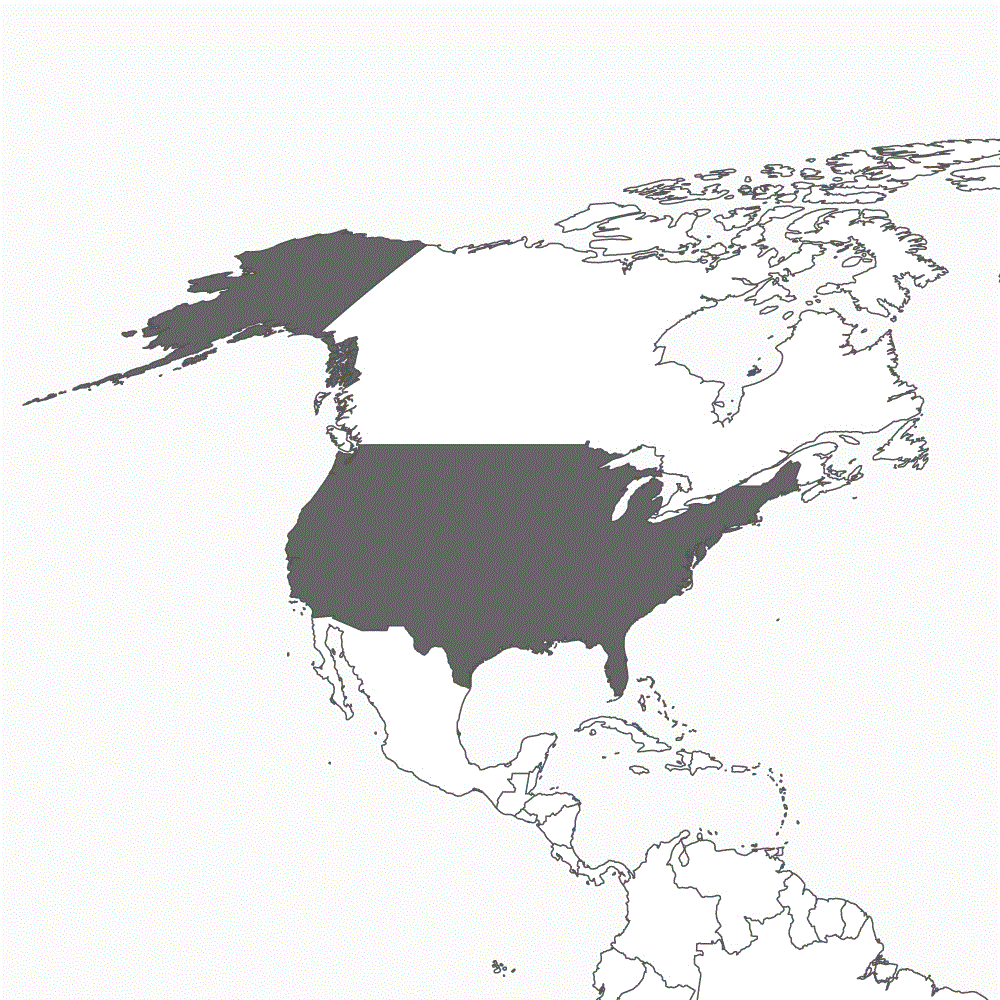
So in the Asia-Pacific region Washington is now limiting itself to amassing a military presence and generally seeking to dramatically upgrade its weaponry in response to China’s powerful defensive capabilities. President Trump plans to increase the US military budget by a whopping two-thirds, reaching a total of 1.5 trillion dollars. The focus of its offensive posture is now on the ‘Western Hemisphere’, i.e. North and South America, the Caribbean and Greenland. According to the National Defence Strategy, adversaries had gained too much influence in this region and could not only “threatens US access to key terrain throughout the hemisphere but were also undermining US interests in general and leaving “the Americas less stable and secure”. The focus is now on guaranteeing US military and commercial access to “key terrain, especially the Panama Canal, the Gulf of America, and Greenland”. The strategy paper says that Canada and “our partners in Central and South America” will have to “respect and do their part to defend our shared interests.” If they refused, US would be “ready to take focused, decisive action that concretely advances US interests.” In a next step towards complete subjugation of the Western Hemisphere, the Trump administration is plotting the overthrow of the government in Cuba by the end of the year.[6] War planners are specifically considering a complete naval blockade to prevent oil imports into the island nation.[7]
‘A manageable threat’
The new National Defense Strategy also makes some clear assessments of Russia and Europe. It states that Russia is “a persistent but manageable threat for the foreseeable future”, especially to the eastern NATO states. At the same time, Russia possesses weapons systems that it could use to strike the US. The latter threat could, the document claims, be prevented in future by American armed forces. The former threat would have to be dealt with by NATO members in Europe: “Fortunately our NATO allies are considerably more powerful than Russia – it is not even close.” The US strategists believe that “Moscow is in no position to make a bid for European hegemony,” not least because the countries of European NATO “dwarf Russia in economic scale, population, and, thus, latent military power.” The paper argues that the increase in the defence budgets of European NATO countries and their massive new armament programmes will ensure continued superiority. So the new US military strategy assigns European NATO countries the task of keeping Russia in check. At the same time, the Trump administration is pursuing a certain degree of tactical cooperation with Moscow to secure access to Ukraine’s raw materials.[8]
A policy of force and its consequences
The new military strategy does not address the question of American force being exerted on Europe. Washington’s aggressive stance is seen in its repeated threats to annex Greenland militarily, and the stream of hostile announcements to the effect that the countries of Europe will have to accept measures seriously damaging for their own economic interests in the face of drastic and arbitrary tariffs. At the World Economic Forum in Davos, there were some initial signs of resistance – voiced relatively clearly in the case of Canada, less clearly but still noticeably in the case of European leaders, including German Chancellor Merz (german-foreign-policy.com reported [9]). In Berlin’s foreign policy establishment a discussion has long since begun on the options and opportunities for a calibrated move away from the United States. german-foreign-policy.com will report on this shortly.
[1] See: Der neue Transatlantikpakt.
[2] Zitate hier und im Folgenden: Department of War: National Defense Strategy 2026. Washington, 23.01.2026.
[3] Overmatched. Why the U.S. Military Needs to Reinvent Itself. nytimes.com 08.12.2025.
[4] Jason French, Josh Chin, Jemal R. Brinson, Liza Lin: How American and Chinese Drone Arsenals Stack Up. wsj.com 14.11.2025.
[5] Josh Chin: China Trains AI-Controlled Weapons With Learning From Hawkes, Coyotes. wsj.com 24.01.2026.
[6] José de Córdoba, Vera Bergengruen, Deborah Acosta: The U.S. Is Actively Seeking Regime Change in Cuba by the End of the Year. wsj.com 22.01.2026.
[7] Ben Lefebvre, Eric Bazail-Eimil: Trump administration weighs naval blockade to halt Cuban oil imports. politico.com 23.01.2026.
[8] See: Die Bodenschätze der Ukraine.
[9] See: Bruch in der Weltordnung.