Boycotting their own summit
Numerous EU heads of state and government, including German Chancellor Merz, chose at short notice to stay away from their own summit with the Latin American alliance CELAC – for fear of reprisals from the Trump administration.
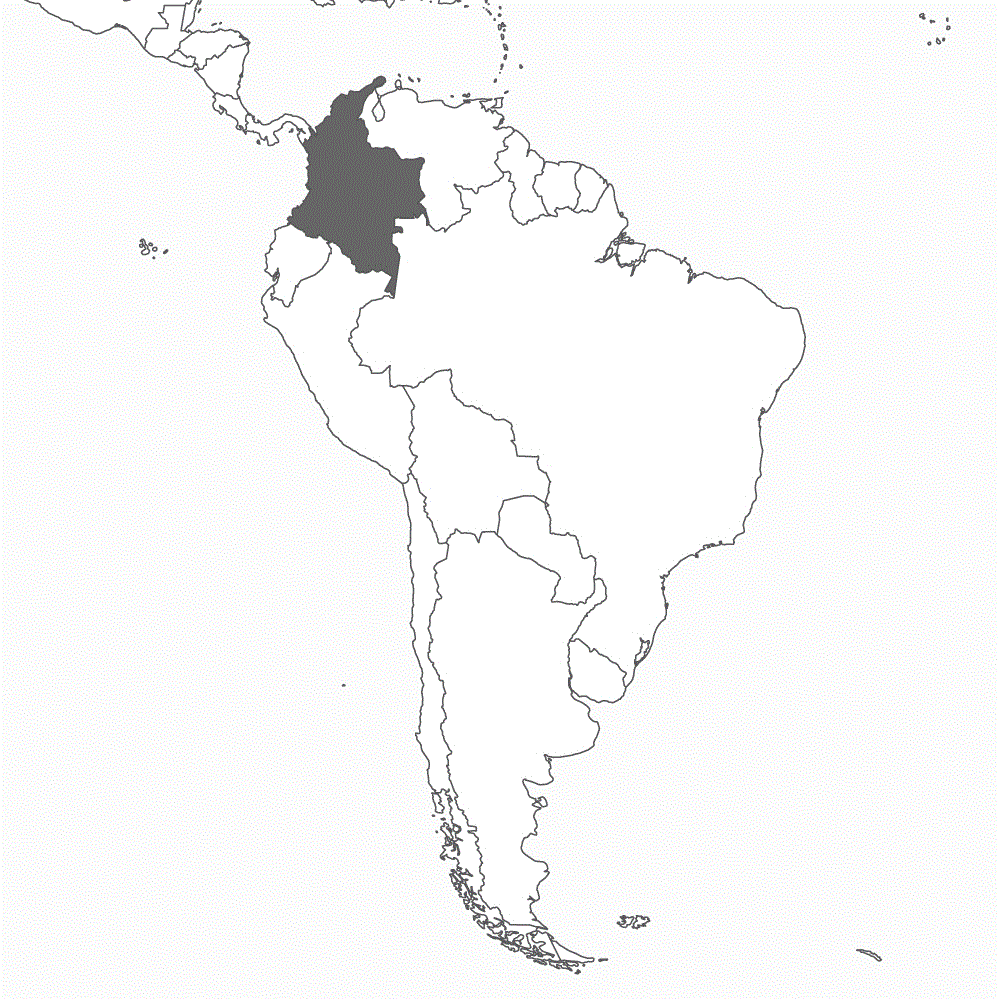
SANTA MARTA/BERLIN/WASHINGTON (own report) – In what is a huge affront to Latin American leaders, numerous EU heads of state and government, including Chancellor Friedrich Merz, torpedoed the summit arranged between the EU and the CELAC alliance on Sunday. The EU had previously attached great importance to the meeting as Europe seeks to regain some of its dwindling influence in the region and counter China’s growing presence. Statements made by the EU just a few days earlier praised “the strength and vitality of the partnership” with the subcontinent. Yet shortly before the summit Merz – along with French President Emmanuel Macron, European Commission President Ursula von der Leyen and other EU heads of state and government – cancelled their participation. The background to this decision is the US campaign of violence in the Caribbean. The Trump administration has repeatedly sunk boats and murdered dozens of people. When Colombian President Gustavo Petro, who has hosted the EU-CELAC summit, openly criticised extrajudicial killings, the United States slapped sanctions on him and Colombia. A number of senior EU officials and leaders of member states have chosen to boycott Petro and wreck their own summit. Driving this act of anticipatory obedience is the fear of reprisals from the Trump administration.
‘We’re back in Latin America’
Europe has been trying to reverse its loss of influence in Latin America and the Caribbean as China has gained economic strength across the region. After the founding of the Community of Latin American and Caribbean States in 2010, the EU held two summits with CELAC, in 2013 and 2015. However, these efforts to intensify cooperation on trade and investment have subsequently petered out. The EU did not attempt its next meeting until mid-2022. The momentum slackened as it became apparent that the CELAC member states could not be persuaded to participate in the sanctions regime of NATO states against Russia, despite massive pressure.[1] The EU’s renewed Latin America offensive brought yet more proclamations: the proud presentation, in June 2023, of a new strategy paper for regional cooperation;[2] and the Commission President von der Leyen’s announcement, in July 2023 after her trip to the region, that “Europe is back in Latin America”. Speaking at the 2023 EU-CELAC summit in Brussels, she said it was time “to take our strategic partnership to the next level.” The EU did at least succeed in increasing its trade in goods and services with CELAC economies by 45 per cent to some 395 billion US dollars over the period 2013 to 2024.[3] But by comparison, China alone doubled its trade in goods with CELAC to a whopping 515 billion US dollars over the same period.
‘Strong partnership’
The follow-up meeting after the third EU-CELAC summit in Brussels in July 2023 [4] took place yesterday, Sunday 9 November, in Santa Marta, Colombia. As usual, the EU announced the event with a great fanfare: Europe wanted to “strengthen the long-standing partnership” and “jointly address global challenges”.[5] European Council President António Costa was quoted as saying that the summit reaffirmed “the strength and vitality of the EU’s partnership with Latin America and the Caribbean.”[6] It was a “forward-looking alliance” rooted in “shared history and shared values”. Never mind that this „shared history” also consists of more than three centuries of colonial plundering of the subcontinent by European states. And the colonial presence continues to this day. France, the Netherlands and non-EU member the United Kingdom still hold various territories in Latin America and the Caribbean. Glossing over the colonial legacy across the greater region, Costa sought to contrast the EU against the United States: “While others may turn to tariffs and protectionism, we will choose more trade, more investment and more cooperation,” he declared.[7]
US campaign to overthrow the government
The EU-CELAC summit, at which António Costa arrived on Sunday, in Santa Marta, takes place against the backdrop of a US campaign to overthrow the government of Venezuela. Washington is openly threatening a war of aggression in violation of international law. After some earlier negotiations with Venezuelan President Nicolás Maduro, the Trump administration has decided to overthrow him. Trump has doubled the bounty for his capture from the 25 million US dollars already set by the Biden administration to 50 million. Trump has authorised covert CIA operations on Venezuelan territory that directly target Maduro.[8] The US has, in particular, begun attacking and destroying boats in the Caribbean that it claims are being used to smuggle drugs. At least eighteen boats have been sunk so far, killing at least 69 civilians. Execution of people without trial is murder. At least one survivor has been cleared of all narcotics-related charges by the judiciary of his country, Ecuador.[9] US media has frequently quoted military insiders who confirm that the campaign is not really aimed at drug traffickers but at overthrowing Maduro.
Panama model
The real intention is demonstrated by the latest major deployment of US forces in the Caribbean, including a number of warships. The US aircraft carrier Gerald R. Ford, considered the most modern in the American naval fleet, is expected off the Venezuelan coast this week. Observers have long been drawing comparisons with the preparations for the US invasion of Panama in 1989, when Washington deposed the Panamanian leader Manuel Noriega, a CIA asset who had fallen out of favour.[10] Trump is taking draconian measures against his critics. Colombia’s left-wing president, Gustavo Petro, had accused the US administration of carrying out an attack in violation of international law in his country’s territorial waters in at least one case. Petro stated correctly that the crimes euphemistically referred to as “extrajudicial executions” were murders. Trump responded by imposing sanctions on the Colombian president and announcing that he would immediately suspend all aid to Colombia.[11] The measures are already beginning to hurt Colombians. It is reported that, a few days ago, the authorities in Cape Verde refused to refuel an aircraft in which Petro was travelling to Saudi Arabia, after the pilot had made a scheduled refuelling stop in the island nation.[12]
‘Shared values’
It was against this background that the fourth EU-CELAC summit took place yesterday, Sunday, in Santa Marta on Colombia’s Caribbean coast. It is not only President Petro who is under pressure. The US politics of force are affecting the population of Santa Marta and nearby towns. Local fishermen no longer dare to make their usual trips out to sea because they fear being killed by the US military while doing their job.[13] Not only the Colombian government but also the country’s civilian population would welcome some, at least, symbolic support in this situation. This, however, will not be forthcoming from EU leaders and major member states. To avoid having to appear alongside President Petro, a victim of arbitrary US sanctions for speaking out, German Chancellor Friedrich Merz, French President Emmanuel Macron, Italian Prime Minister Giorgia Meloni, EU Commission President Ursula von der Leyen and various other EU heads of state and government cancelled their participation at short notice. When asked whether von der Leyen’s absence had anything to do with Trump’s politics of force, her spokesperson declined to comment.[14] Despite the submissive withdrawal from its own summit, the EU continues to talk about a “long-standing partnership” with Latin America and “shared values”.
[1] See: Die Lateinamerika-Offensive der EU.
[2] See: Die Lateinamerika-Offensive der EU (II).
[3] President Costa to travel to Latin America for COP30 and EU-CELAC summits. consilium.europa.eu 04.11.2025.
[4] See: Das BRICS-Bündnis als Alternative.
[5] EU-CELAC summit, 9 November 2025. consilium.europa.eu.
[6], [7] President Costa to travel to Latin America for COP30 and EU-CELAC summits. consilium.europa.eu 04.11.2025.
[8] Julian E. Barnes, Tyler Pager: Trump Administration Authorizes Covert C.I.A. Action in Venezuela. nytimes.com 15.10.2025.
[9] Vanessa Buschschlüter: Ecuador releases survivor of US strike on ‘drug sub’ in Caribbean. bbc.co.uk 21.10.2025.
[10] Tom Phillips: US military buildup off Venezuela coast stirs echos of 1989 Panama invasion. theguardian.com 06.11.2025.
[11] Julie Turkewitz: U.S. Imposes Sanctions on Colombia’s Leader, One of Trump’s Harshest Critics. nytimes.com 24.10.2025.
[12] Henry Foy, Anne-Sylvaine Chassany, Michael Stott: EU leaders to skip summit in Colombia after Trump sanctions. ft.com 04.11.2025.
[13] Marie-Kristin Boese, Anne Demmer: Ein Treffen überschattet von Trump. tagesschau.de 09.11.2025.
[14] Jorge Liboreiro: Europeans largely skip Latin American summit under Donald Trump’s shadow. euronews.com 08.11.2025.