Thrown off balance
Merz attends military parade to mark France’s Bastille Day, but tensions rise between Berlin and Paris. Germany goes it alone on rearmament that is outpacing France – with consequences.
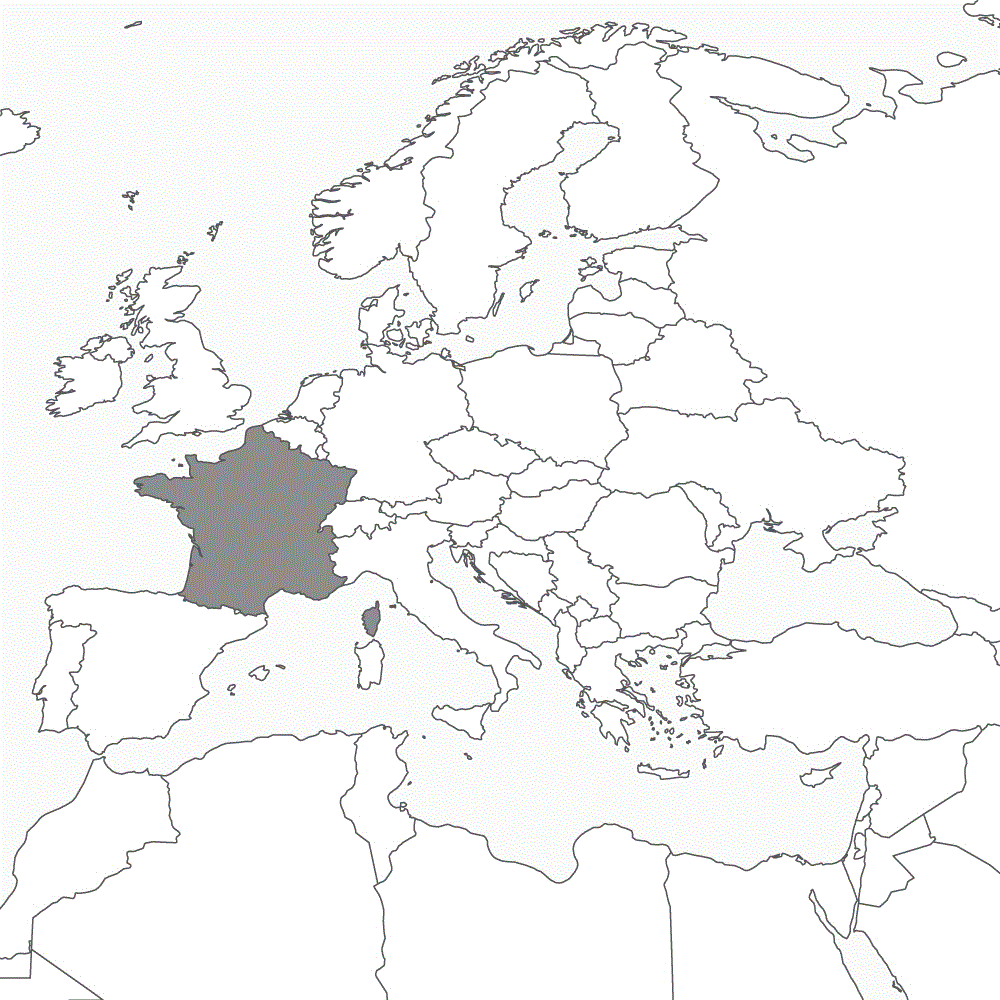
PARIS/BERLIN (our own report) – Rapidly growing tensions between Germany and France are overshadowing German Chancellor Friedrich Merz’s trip to Paris. He is attending France’s Bastille Day military parade on Tuesday. Leading this year’s ‘le 14 juillet’ parade are some five hundred soldiers from countries in the so-called ‘Coalition of the Willing’ actively supporting Ukraine. According to the Élysée Palace, the event is designed to symbolise not only “France’s strategic rearmament” but, above all, “Europe’s strategic awakening”. Yet, Macron’s invitation to Merz cannot hide the considerable resentment in Paris at Germany’s recent actions. Following the decision to withdraw from the joint programme to develop a sixth-generation fighter aircraft, Berlin has launched its own domestic fighter jet project. What’s more, the German side intends to push ahead with single-handedly developing the associated ‘combat cloud’ – rather than in collaboration with France, as had only recently been mooted. Indeed, Paris had already been side-lined in yet another project: the development of a European satellite network. Berlin is now working on its own ‘German Starlink’, which is likely to scupper an envisaged ‘European Starlink’. The latter had long been planned, with France set to play a key role. Experts warn that Germany’s unilateral militarisation drive is throwing the European Union strategically off balance.
‘Europe’s awakening’
Chancellor Friedrich Merz arrived in Paris yesterday, Monday, to join a gathering of the ‘Coalition of the Willing’ in support of Ukraine. And today, on Tuesday 14th July, he is invited by President Emmanuel Macron to attend the traditional military parade to mark France’s national Bastille Day. The last German leader to do so was Chancellor Angela Merkel in 2019. According to a statement issued in advance by the Élysée Palace, around five-hundred soldiers from member states of the so-called ‘Coalition of the Willing’ are leading the military parade this time, along with twenty-five Ukrainian soldiers. There is also a huge flypast by nearly a hundred-and-thirty warplanes and helicopters, some of which contain Ukrainian aircrews, including Ukrainian co-pilots in two Mirage fighters. The military parade is meant as a “powerful symbol” of a “Europe” that is “aware of the dangers of the world and of the need to take its destiny into its own hands,” runs the Élysée Palace press release.[1] The display is designed to demonstrate that Europe possesses “strong armed forces” which are “capable” at any time of “being the first to intervene in a conflict”. The parade will showcase not only “France’s strategic rearmament” but, above all, “Europe’s strategic awakening”.
National, not European
While Merz watches the parade, some serious Franco-German disputes are smouldering below the surface. Once again, they have come to a head in the defence industry. The atmosphere first changed with the German government’s decision to pull out of the joint development of a sixth-generation fighter jet, a project launched back in 2017. Berlin now wants to produce a fighter jet on a national basis, possibly with inputs from Spain and Sweden.[2] The procurement centres on a consortium set up by Airbus Defence & Space called ‘Team Gen 6’, which comprises MTU, Hensoldt, MBDA Deutschland, Diehl Defence, Rohde & Schwarz, Liebherr and Autoflug.[3] Germany is initially in a position to finance the immensely expensive jet through its unprecedented programme of public borrowing. France, on the other hand, cannot afford to go it alone in the way Germany seeks to do. The French government is already carrying immense debt.[4] As Berlin’s solo venture takes shape, it has sparked considerable unease in Paris – further exacerbated by the realisation that almost all the other binational defence projects have either stalled or failed outright.[5] This Friday, new projects are to be presented at the Franco-German Defence and Security Council at Nörvenich Air Base in an attempt to allay fears.
Germany’s next go-it-alone
Meanwhile, the next German solo venture is already taking shape. And it is likely to derail yet another Franco-German defence project. This one centres on the procurement of a ‘combat cloud’, which is the digital network that was – as part of the large-scale project to create a Future Combat Air System (FCAS) – intended to link the sixth-generation fighter jet with satellites, drones, drone swarms, and possibly ground-based combat elements. With the demise of the joint fighter jet development programme, both Berlin and Paris initially responded positively to the idea of at least pressing ahead with the joint development of the associated drone solutions and, specifically, the combat cloud.[6] It may have been a face-saving exercise but did represent an important cross-European initiative. At the end of June, research by Politico revealed that Berlin had quietly killed off this project, too, and replaced it with a purely national initiative. According to the report, Germany’s defence ministry is preparing a contract with the Munich-based defence company Helsing for the development of a “core software-and-test architecture”. The project runs under the name Combat Fighter System Nucleus (CFSN).[7] In addition to providing complex software, Helsing is to supply, amongst other components, ground control stations and two experimental un-crewed fighter jets. Delivery will ostensibly only be for testing purposes, but one paper describes it already as a backbone for future networked air warfare. The deal is reported to be worth 580 million euros. There is evidently no coordination with France on its realisation.
Contract without oversight
As Politico reports, a whole series of peculiar circumstances surround the planned contract award to Helsing. Firstly, it is remarkable that the contract is being awarded to a single company – all the more so given that the CFSN is classified as a warfare “backbone”. Originally, the German defence ministry had intended to commission several companies in an effort to minimise risks.[8] True, Helsing will award subcontracts to MBDA Deutschland, Hensoldt and Rohde & Schwarz, but it will bear sole responsibility. Secondly, there is to be no normal tendering process in line with EU procurement rules. This very expensive contract is being directly awarded through a negotiated procedure. Security interests are cited as grounds for such discretionary contracting. The ministry does not – according to Die Welt, which also cites Politico – wish to have “the second phase of the contract approved separately by parliament again in 2027.”[9] It remains entirely unclear why the Bundestag is to be bypassed. According to Die Welt and Politico, the contract does not provide for the acquisition of a finished product; rather, Helsing will “be reimbursed for the costs of experimental work”.[10] Such ambiguities are all the more problematic because the defence industry is notorious for costs spiralling out of control as projects progress.
Status quo breaking down
This latest decision to go it alone on the ‘combat cloud’ carries all the more weight because it aligns with the failure of the sixth-generation fighter jet and has been preceded by other Germany-only decisions on defence projects. Of particular significance is the fact that the German government has now decided to launch a network of German low-earth-orbit satellites into space that will establish a ‘German Starlink’. The EU had previously sought to create a ‘European Starlink’ through its IRIS2 project, in which the French space industry had hoped to secure lucrative contracts.[11] The ‘German Starlink’ now puts a question mark over the future of IRIS2. In drone production, too, Germany is pursuing a national approach wherever possible. All this must be understood in connection with the unprecedented increase in German defence spending. By contrast, France finds itself in a serious pre-existing debt crisis and cannot even begin to match such spending levels.[12] German militarisation is increasingly jeopardising the strategic balance of power in Europe. “Since the end of the Cold War,” a “historical status quo” had prevailed on the European continent, explains Paul Maurice of the Institut français des relations internationales (IFRI). Essentially it meant “Germany holds the economic power, France the military and strategic power.”[13] Since the start of the war in Ukraine, the status quo has “begun to break down”. Now, he says, Berlin is leaving Paris further and further behind. In France, the debate on this issue has already begun. What the future holds is uncertain.
[1] Le défilé du 14-Juillet sera ouvert par 500 soldats étrangers de la coalition des volontaires. lemonde.fr 09.07.2026.
[2] See: ‘A leader in military aviation’.
[3] Aaron Kirchfeld, Sylvia Pfeifer, Laura Pitel: Airbus plans German-led alliance to replace doomed fighter jet. ft.com 09.06.2026.
[4] See: Deutschlands Rüstungsdurchmarsch.
[5] See: Scheitern ohne Ende.
[6] Marco Seliger: Nach dem FCAS-Debakel steht Deutschland vor der Frage, wie es weitergeht. Neue Zürcher Zeitung 14.06.2026.
[7], [8] Chris Lunday: Germany bets on €580M software after fighter jet split with France. politico.eu 25.06.2026.
[9], [10] Chris Lunday: Nach dem FCAS-Aus setzt Deutschland auf Helsing – So sieht der neue Plan aus. welt.de 29.06.2026.
[11] See: Transatlantische Weltraumrivalen and Das deutsche Starlink.
[12] See: Deutschlands Rüstungsdurchmarsch.
[13] Elsa Conesa, Philippe Jacqué : En Europe, la crainte du retour de l’Allemagne comme puissance militaire. lemonde.fr 08.06.2026.