Deporting into war
Germany steps up deportations to Afghanistan despite the human rights situation and a war with Pakistan – as border disputes dating back to the colonial era resurface.
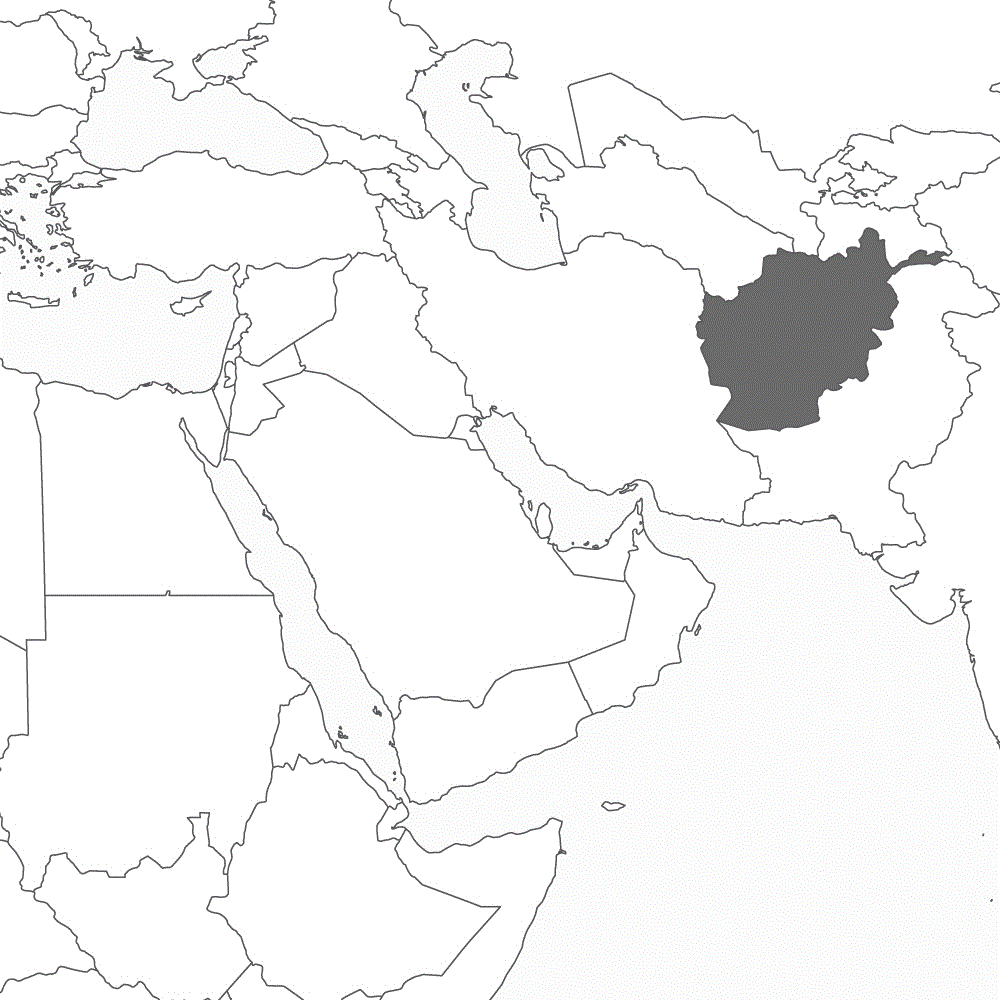
BERLIN/KABUL/ISLAMABAD (own report) – The German government is deporting Afghans to Kabul in defiance of warnings about the dire human rights situation they will face. It is also ignoring the recurring flare-ups in military hostilities between Afghanistan and Pakistan. At the end of February, Berlin pushed ahead with its third deportation flight. The direct flight to the Afghan capital and was arranged after months of negotiations between German authorities and the Taliban. The negotiating process began with the diplomatic accreditation of two Taliban officials. They were appointed to the Afghan Consulate General in Bonn last October. This was immediately followed by two German officials visiting Kabul. At the same time, the German government is moving forward with its plan to end, “as far as possible”, the acceptance of refugees who served as Afghan local staff, primarily with the Bundeswehr. As for deportations, the most recent took place on the very day that the conflict between Afghanistan and Pakistan escalated into war. The Pakistani Air Force attacked targets in Kabul and elsewhere. Islamabad accuses Afghanistan of deploying terrorist groups against Pakistan and claims that India is weaponising the Afghan Taliban as proxies in the long-running conflict between the two countries.
The third round of deportations
On 26 February, Germany deported twenty Afghan citizens with a criminal record, sending them back to Afghanistan.[1] This was already the third such operation, after Berlin had initially suspended deportations to the country following the Taliban’s takeover in 2021. It is reported that a charter flight carrying twenty Afghan males flew directly from Leipzig/Halle Airport to Kabul. In a statement published on the same day, Federal Interior Minister Alexander Dobrindt insisted that “the deportation of criminals” was “a central pillar … of the federal government’s migration policy”. An “agreement” concluded with the Taliban on this matter had, he said, established “a reliable basis for direct and permanent deportations to Afghanistan”.[2] As the Interior Minister stated, the operation on 26 February was the “first charter flight under this agreement on regular repatriations” directly to Afghanistan. The deportation was the first to be organised by Berlin and the authorities in Kabul without the mediation of a third country such as Qatar.
New priorities
The policy of stepping up deportations comes at a time when the German government is revoking its own admission commitments made for those Afghans who, prior to the Taliban’s takeover of power, had worked as local staff for German organisations. Yet local staff, especially those assisting the Bundeswehr, are considered to be at particular risk.[3] Germany’s commitments to helpers had been formalised in October 2022 with the Federal Resettlement Programme for Afghanistan. The scheme’s aim was to ensure an orderly process for what had initially been a spontaneous influx. By August 2023, more than 30,000 Afghans had arrived in Germany. However, with the election of the current coalition between the Christian Democrats and Social Democrats the government moved quickly to wind up the programme “as far as possible”. It has since revoked almost half of the commitments made to more than 2,300 Afghans who are currently stranded in Pakistan.[4] The German Interior Ministry justifies this renegation on the grounds that the commitments were non-binding “declarations of intent” and were subject to security checks.[5] It has also stated that Germany no longer has any political interest in admitting the former local staff. In response, more than 500 Afghans are now taking legal action to enforce the commitments – and most cases have so far been successful in their appeals.
On the path to normalisation
The deportation of Afghan citizens without the mediation of third countries is the result of months of direct negotiations between the German authorities and the Taliban. Important steps in this direction were taken last October when Germany accredited two Taliban representatives to be installed in the Afghan Consulate General in Bonn.[6] Government spokesperson Stefan Kornelius said they are in Germany to assist in coordinating the deportation flights. This move led to all the previous non-Taliban staff at the consulate resigning in protest. The accreditations, they pointed out, posed a “serious threat” to the safety of Afghans living in Germany because the Taliban would have access to sensitive documents and information. Shortly after the accreditation, two officials from the Federal Police Department of the Federal Ministry of the Interior flew to Kabul to press ahead with practical arrangements for future deportations. The German delegation met with representatives of the Afghan Interior Ministry and the Foreign Affairs Ministry, as well as the airport authorities in Kabul, to discuss the technical and administrative aspects of the deportations.[7]
War breaks out
The most recent deportation flight took place on the very day that Pakistan declared “open war” on Afghanistan. The fighting marks the second conflict between the two former allies within the past five months.[8] The latest escalation began after Pakistan carried out attacks on Afghan territory on 21 February. Islamabad said they were directed against “terrorist camps and hideouts”. The target was the militant group Tehrik-e-Taliban Pakistan (TTP), an offshoot of the Afghan Taliban founded in 2007 during the United States’ so-called “war on terror”. The Pakistan government justified the strikes by citing recent attacks in the country claimed to have been launched from Afghan territory. In response, Afghanistan attacked Pakistani military checkpoints along the border during the night of 26 February. Pakistan then retaliated with Operation Ghasab Lil-Hak (Righteous Wrath), launching air strikes against major cities such as Kabul and Kandahar, as well as the Bagram airbase. “Our patience has run out,” declared Pakistan’s Defence Minister Khawaja Asif, “there is now open war between us.” The fighting continued to the end of last week.
Long-standing border conflict
According to reports from Islamabad, 415 Taliban fighters had already been killed and over 580 wounded by 1 March. Kabul, for its part, claims that its forces had killed 110 Pakistani soldiers and captured 27 Pakistani military posts. Both sides suffered heavy losses during the previous military conflict, which had begun when Pakistan carried out several air strikes on targets in Afghanistan in October. These were also primarily aimed at the TPP. Islamabad claims that Afghanistan is using the TPP as a proxy in the conflict over the so-called Durand Line, which forms the border between the two countries. Kabul regards it as the result of an agreement signed under duress in 1893 between the then ruler of the Afghan Kingdom, Abdur Rahman Khan, and the British colonial rulers in India. So the Taliban do not recognise this imperialist legacy. The Afghan view is that the “actual” border runs much further east, almost at the Indus River, which flows through the middle of Pakistan.
Conflict with India
Islamabad accuses the Afghan Taliban of acting as India’s proxy against Pakistan. During the recent conflict, Pakistani Defence Minister Khawaja Asif said New Delhi was “waging a low-intensity war against Pakistan” from Afghanistan, saying that India was “pulling the strings.” A spokesperson for the Indian Ministry of External Affairs dismissed this as “yet another attempt by Pakistan” to shift its internal problems onto the outside world.[9] Observers note that the escalation of the conflict between Pakistan and Afghanistan in October 2025 coincided with a visit by Afghan Foreign Minister, Amir Khan Muttaqi, to India, where he met with the Indian Foreign Minister, Subrahmanyam Jaishankar.[10] Although India refrained from officially recognising the Taliban’s authority in Afghanistan, it did announce during Muttaqi’s visit that it would upgrade its diplomatic presence. India’s technical mission, which had been operating in Kabul since June 2022, now has the status of an embassy. A month later, Islamabad was rocked by a suicide attack that killed at least twelve people.[11] Defence Minister Asif described the attack at the time as “one of the worst examples of state-sponsored terrorism by Indian authorities in the region” and declared Pakistan’s readiness to conduct military operations on two fronts simultaneously – against both Afghanistan and India. This is the security context in which Berlin has recently deported Afghans and intends to continue deporting them.
[1] Santos, Ana P.: Germany deports 20 Afghan nationals convicted of crimes back to Afghanistan. infomigrants.net 27.02.2026.
[2] Pressemitteilung: 20 Straftäter nach Kabul ausgeflogen. Bundesministerium des Innern. bmi.bund.de 26.02.2026.
[3] Mellersh, Natasha: Germany stands firm on revoked Afghan promises amid lawsuits and taliban crackdowns. infomigrants.net 03.03.2026.
[4] See: Deutschlands Abschiebepartnerschaft mit den Taliban.
[5] Thomas Ludwig: Afghanen-Aufnahme: Schwarz-Rot widerruft fast jede zweite Zusage aus der Ampel-Zeit. noz.de 20.01.2026.
[6] See: Deutschlands Abschiebepartnerschaft mit den Taliban.
[7] Berlin confirms talks with Taliban on Afghan deportations. afint.com 07.10.2025.
[8], [9] Malik, Satyajeet: Vom Schwelbrand zum Luftkrieg. junge Welt 07.03.2026.
[10] Raykhona Abdullayeva, Aziza Mukhammedova: What‘s behind India’s Political Rapprochement with the Taliban? thediplomat.com 19.11.2025.
[11] Asif Shahzad, Saeed Shah: Suicide bombing in Pakistan capital kills 12, raises regional tension. reuters.com 11.11.2025.