At the Short End of the Stick
Germany’s Minister of Foreign Affairs cancels his long-scheduled trip to China, because, following all sorts of attacks on Beijing, he was not given the desired meetings. The EU is facing shortages of China-produced rare earths and chips.
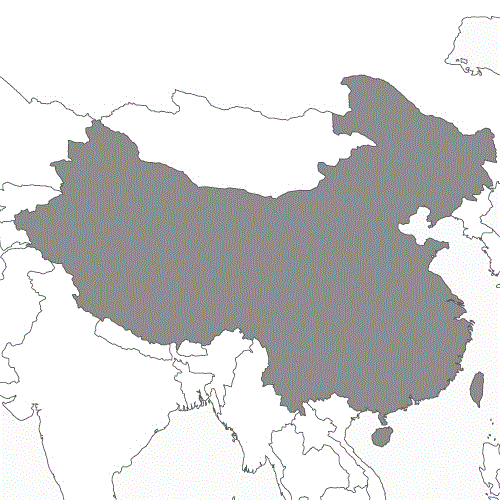
BERLIN/BEIJING (Own report) – Germany’s cancelation of Foreign Minister Johann Wadephul’s long-scheduled trip to China dims hopes of a possible halt to the spiral of sanctions between the EU and the People's Republic of China. The EU has recently imposed sanctions on Chinese enterprises on several occasions and is threatening further sanctions. Germany has begun to qualitatively expand its cooperation with Taiwan – to include offers for weapons supplies, normally reserved solely for sovereign countries. Beijing has reacted to the EU’s attacks with stringent restrictions on rare earths exports and has granted Foreign Minister Wadephul only a meeting with his Chinese counterpart, Wang Yi. Wadephul, who had wanted to have various other talks during his visit, has now postponed his trip indefinitely. This also postpones a solution to Brussels and Beijing’s conflicts. It is occurring at a time when the USA hopes to reach a sort of truce in its trade war with China this week. Moreover, in this escalating dispute, the EU – with its industry currently threatened by an acute shortage of rare earths and semiconductors – is likely to find itself at the short end of the stick.
Verbal Attacks
Over the past few weeks, Foreign Minister Wadephul has significantly intensified his verbal attacks against the People's Republic of China – each time in the presence of a Japanese audience, which, due to tensions between Beijing and Tokyo, has added weight to his statements. In August, for example, following talks with his Japanese counterpart, he implicitly accused the People's Republic of China of complicity in the Ukraine war, saying that without China’s support for the Russian war machine, “the war of aggression against Ukraine would not be possible.”[1] He claimed that Beijing was “repeatedly threatening more or less openly to unilaterally change the status quo and redraw borders to its advantage.” This is not true. Not China but Taiwan’s separatist government is threatening to change the status of the island. The People's Republic has a different legal interpretation of the borders in the South China Sea from Berlin, which is reflected in Wadephul’s statement.[2] Two weeks ago, Wadephul repeated these accusations at the Japanese-German Center in Berlin and went so far as to allege that China’s plea for the preservation of the “multilateral institutional world” was merely a “narrative.”[3] In reality, the international institutions are currently being deliberately undermined by Berlin’s most important non-European ally – the USA.
Taiwan’s National Anthem
Aside from verbal attacks, Germany has begun not only to quantitatively but also qualitatively expand its cooperation with Taiwan, thereby effectively disrupting the status quo of the island. Recently, for example, Karsten Tietz, the new Director General of the German Institute Taipei, claimed in a conversation with Taiwan’s Foreign Minister Lin Chia-lung that Germany and Taiwan find themselves “confronted with increasingly aggressive neighboring countries,” which has opened “wide-ranging opportunities for cooperation” with one another.[4] In September, it already became clear that this included cooperation also in the defense industry sector. For example, the German Trade Office Taipei and the Franco-German Airbus Corporation were represented for the first time at Taipei’s Aerospace and Defense Technology Exhibition. Whereas the German Trade Office Taipei said that innovations in the field of “security” were presented, Airbus explicitly confirmed that it was promoting more than the usual “commercial” products.[5] As a rule, military equipment is supplied to sovereign states; Taiwan, however, is not in that category. And yet, Taiwanese Deputy Foreign Minister Wu Chih-chung recently reported that at the October 3rd German National Holiday reception “the Taiwanese national anthem” was heard for the first time.[6]
New Sanctions
Whereas, with these measures, Germany signals its intention to increasingly treat Taiwan as a sovereign nation and thereby upset the status quo, the EU, for its part, is forging ahead with new economic reprisals against the People's Republic of China. Whereas the 50 percent tariffs on steel imports, imposed by Brussels in early October, impacted all countries equally – including, but not restricted to China – last Thursday, the EU imposed additional sanctions on companies in the People's Republic of China as part of its 19th sanctions package against Russia. These companies are exercising their rights not to allow a foreign power, the EU, dictate their commercial partners, and maintain their commercial ties within Russia. Last Thursday, EU heads of states and governments also approved a declaration implicitly referring to the dispute over China’s supplying rare earths to the EU. Beijing which has been subjected to all sorts of embargos by the USA and the EU, e.g., US semi-conductors, and EU chip production machines, has now reacted with controls on rare earths exports. Still unwilling to de-escalate the conflict, the EU states, are now calling on the commission in the above-mentioned declaration to prepare possible new economic coercive measures against China.[7]
“On the Defensive”
Germany and the EU are intensifying their political and economic attacks in the midst of a period of weakness. European enterprises, in many cases, have practically no alternative to rare earths supplies from China. They are currently in a situation similar to that of Chinese enterprises, when their chip industry had had no alternatives to products from the USA and the EU. Beijing’s proposals to mutually relax restrictions have so far fallen on deaf ears in the Europe. In addition, the conflict over The Netherlands-based Chinese-owned Nexperia chip plant is escalating. Under US pressure, The Hague took the unprecedented step of dismissing the Chinese CEO and placing Nexperia under the control of The Netherlands (german-foreign-policy.com reported.[8]) Beijing retaliated by banning the export of Nexperia semiconductors. This threatens serious shortages of semiconductors in Germany and the rest of the EU, which, among others, could seriously damage automotive and mechanical engineering production. The EU, obviously at the shorter end of the stick, is threatening sanctions “come hell or high water.” Late last week German Chancellor Friedrich Merz acknowledged, the EU “currently finds itself on the defensive, and we must get out of that position.“[9]
Before the Escalation
Beijing, unwilling in this situation, to tolerate Berlin’s attacks and Brussels’ threats of sanctions, apparently shortened the German Foreign Minister’s scheduled visit for the beginning of this week, approving only Wadephul’s meeting with his counterpart Wang Yi. It was announced that additional appointments requested by Wadephul could not be arranged. To spare the minister further embarrassment, the German foreign ministry cancelled the trip altogether.[10] However, this also postpones the possibility of settling the dispute over rare earths, semiconductors and sanctions – to the disadvantage of European industry, already threatened with an acute shortage of primary products. This is happening at a time when the United States has been vigorously forging ahead with its negotiations with China over the past few days, hoping to reach an agreement on a sort of truce in the trade war by Thursday.[11] If this succeeds, the EU will probably find itself embroiled alone in a spiral of sanctions with Beijing, in which, given the current situation, it will more than likely find itself at the short end of the stick.
[1] Scharfe Kritik Chinas an Äußerung Wadephuls. tagesschau.de 18.08.2025.
[2] Beijing can refer to the Treaty of Tianjin of 1885 in the territorial disputes in the South China Sea, wherein France, which at the time had no interest in the islands east of its colony of Vietnam, declared that they should be “assigned to China.”
[3] Speech by Foreign Minister Johann Wadephul on the 40th anniversary of the Japanese-German Center Berlin, “Germany and Japan – premium partners for freedom, security and prosperity” 14.10.2025
[4] Außenminister: Taiwan begrüßt engere Zusammenarbeit mit Deutschland. rti.org.tw 14.10.2025.
[5] Ben Blanchard: Europe emerges from the shadows at Taiwan’s largest defence show. uk.finance.yahoo.com 22.09.2025.
[6] „Wir waren noch nie so stark“. Frankfurter Allgemeine Zeitung 07.10.2025.
[7] European Council meeting (23 October 2025) – Conclusions. Brussels, 23.10.2025.
[8] See also Der Kampf um Nexperia.
[9] Jakob Hanke Vela, Leonard Frick: Regierungschefs drohen China wegen Exportblockade mit Sanktionen. handelsblatt.com 23.10.2025.
[10] Laura Pitel, Anne-Sylvaine Chassany: German foreign minister cancels China trip amid mounting tensions. ft.com 24.10.2025.
[11] Hannah Miao, Chun Han Wong: U.S., China Sound Confident Note After Trade Talks. wsj.com 26.10.2025.