Integrating the extreme right
A leading Berlin think-tank warns of increasing ‘integration’ of the extreme right into ‘the political system of the EU’. Far-right parties are involved in nine of 27 EU governments. Germany’s AfD could reach 30 per cent.
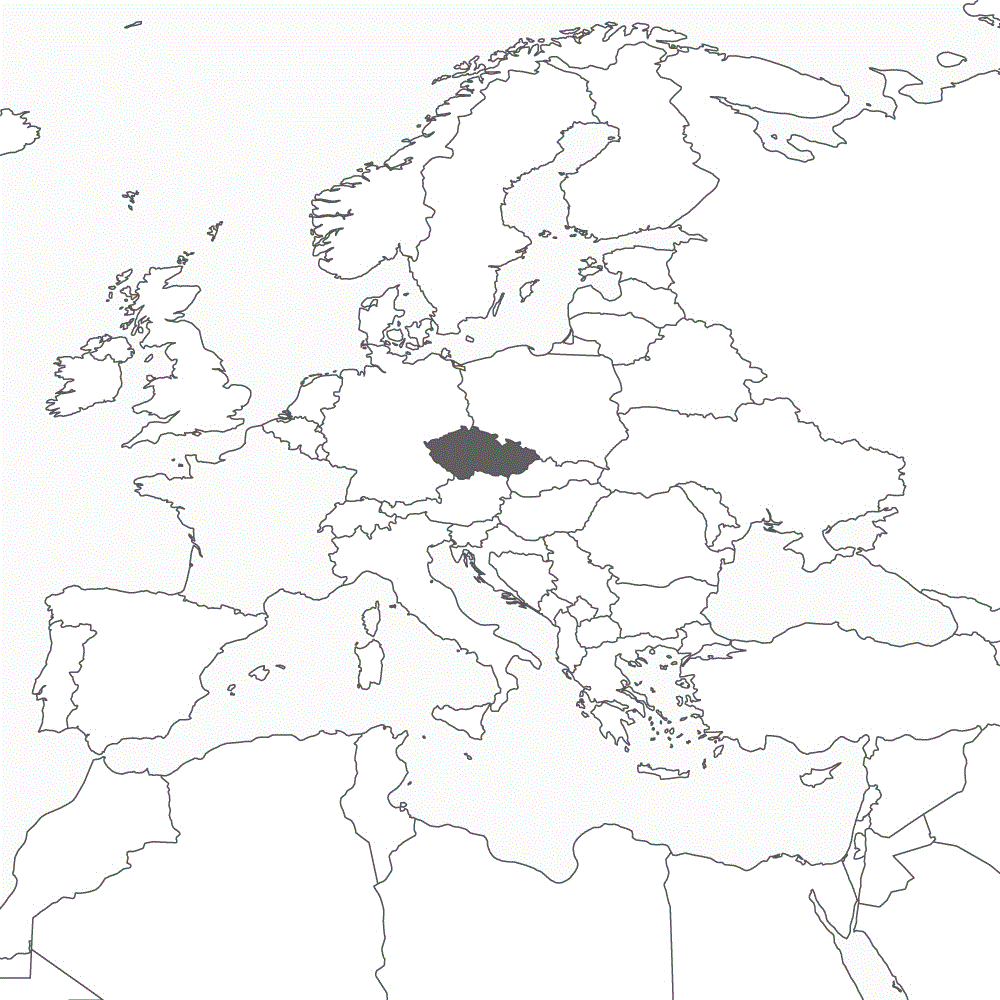
BERLIN/PRAGUE/PARIS (own report) – With the clear victory of another party from the EU-wide grouping Patriots for Europe (PfE) in parliamentary elections in the Czech Republic, the far right has further strengthened its influence in the European Union. Last week’s election saw billionaire Andrej Babiš’s ANO party became the strongest force with 34.5 per cent of the vote. In becoming prime minister, Babiš is able to rely on the support of two other far-right parties: another PfE member party and a party aligned with the Alliance of Sovereign Nations (ESN), to which the AfD also belongs. The leading force within the PfE is Marine Le Pen’s Rassemblement National (RN) in France. The RN has, since last week, provided two of the last six vice-presidents of the French National Assembly – thanks to agreements with the “centrist bloc” on which President Emmanuel Macron relies. Meanwhile, the PfE, the far-right ESN and the equally far-right European Conservatives and Reformists (ECR) are gaining strength and influence in the European Parliament, where they account for more than a quarter of the seats. The Berlin-based German Institute for International and Security Affairs (SWP) analyses this trend as a growing “integration” of the radical right into “the political system of the EU”. For its part, the AfD is achieving new record poll ratings in Germany.
Participating in governments
As the SWP notes, parties from the far-right spectrum are currently installed as heads of government in four EU states – Hungary, Italy, Belgium and the Czech Republic.[1] In four other countries, the far-right from part of a governing coalition, namely in Finland, Slovakia, Croatia and Bulgaria. In Sweden, the government is tolerated by the Sweden Democrats, who belong to the ECR. In the Netherlands, Geert Wilders’ Partij voor de Vrijheid (PVV) only recently left the government. This means that “one third of all member-state governments are either led or supported by far-right parties,” points out the SWP report.[2] A further shift to the right is to be expected and feared by the end of 2027. This is because “presidential elections are due in France, where the National Rally [Rassemblement National (RN)] is clearly in the lead.” Moreover, in Spain, Vox is aiming to participate in government in 2027; in Poland, another victory for Kaczyński’s far-right PiS (Prawo i Sprawiedliwość) is not unlikely in the 2027 parliamentary elections. The PiS already holds the presidency, although their leader Karol Nawrocki only has limited powers.
A grand coalition of the right
A further shift to the right is taking place in the European Parliament. Three far-right groups – ECR, PfE and ESN – already hold around 26 per cent of all seats. The SWP analysis notes that the ECR group of parties provides two vice-presidents of the European Parliament and the chairpersons of three committees, including those for the important EU budget and agriculture committees.[3] As for the PfE group, it is still “institutionally marginalised by the Parliament majority” note the SWP analysts: “They are not represented in the Bureau, nor do they hold any committee chairmanships.” However, in July it was given the post of rapporteur for the negotiations on the 2040 climate target. What is more, the EPP now cooperates not only with the ECR group but also with the PfE and even the ESN groupings to form an ultra-right majority in the European Parliament. This happened for the first time back in September 2024, when the European Parliament audaciously declared in a resolution that the loser of the Venezuelan presidential election on 28 July 2024 was the winner. For this, the EPP group was willing to rely on the votes of extreme right-wing members of the ECR, PfE and ESN groups.[4] The “Venezuela majority” arrangement has since come into play on several occasions, for example to water down the EU deforestation regulation in the interests of European business.
Common ground
To date, only two representatives of far-right parties belong to the European Commission – Olivér Várhelyi, who is close to Hungary’s Prime Minister Viktor Orbán (Fidesz) and holds the post of Commissioner for Health and Animal Welfare; and Raffaele Fitto, who is a member of Fratelli d’Italia (FdI) headed by Italy’s Prime Minister Giorgia Meloni. Fitto has been appointed a Commission Vice-President with responsibility for Cohesion and Reforms. The reason for this lack of representation at the top is that the two other countries with far-right heads of government – namely Belgium and the Czech Republic – have so far refrained from sending representatives of their parties into the Commission. But this does not have to remain the case. “Overall,” the SWP writes, “the integration of parts of the far right into the EU’s political system is already well advanced and continues to grow.”[5] The ECR-affiliated parties in particular “are now treated as normal political actors in many areas.” This normalisation is attributable to the EPP parties increasingly finding “common ground with the ECR, especially “on industrial and climate policy issues”. As the SWP notes, “Alternative majorities without centre-left parties are possible in the European Parliament only if the ECR agrees with the PfE. Yet a loosening of the cordon sanitaire against the far right is, however, getting hard to uphold in view of “the blurred dividing line between the ECR and the more radical or extreme forces”.
Arrangements
The steady integration of the far right at the national level can be observed in France and elsewhere. Last year, following the early parliamentary elections, RN members of parliament were excluded from vice-presidential posts in the National Assembly. This was reversed last week on the basis of agreements between the ‘centre bloc’, on which President Emmanuel Macron relies, and the RN. With Sébastien Chenu and Hélène Laporte, the RN now once again holds two of the six vice-presidential posts in parliament.[6] Shortly afterwards, the RN decided not to field its own candidates in the election of the chairpersons of the eight standing committees of parliament and to vote for candidates from the ‘centre bloc’. This arrangement enabled the bloc to keep out the left and take all the chairs except that of the finance committee, which is reserved for the opposition.[7] It remains to be seen whether further agreements between the conservative centre and the far-right RN will follow. Meanwhile, a recently published book citing sources close to Macron claims that when he dissolved parliament last year he was actually hoping for an RN victory. Macron had intended to appoint an RN prime minister and legitimise this move by claiming he wanted to unmask the RN leadership.[8]
Marching ahead
The latest shift to the right has come with parliamentary elections in the Czech Republic at the end of last week. The election was won by the ANO, a party founded by billionaire Andrej Babiš, which received 34.5 per cent of the vote, according to preliminary results. At EU level, the ANO aligns withe the far-right PfE group of parties. Observers currently assume that Babiš will be able to claim the post of prime minister, making him the second head of government from a PfE party, alongside Orbán. Observers also reckon Babiš will have an ANO government in power tolerated by two other far-right parties: one is the Motoristé sobě (Motorists for Themselves) party, which, like ANO, belongs to the PfE, and the other is the Svoboda a přímá demokracie (Freedom and Direct Democracy) party, which is organised within the ESN, i.e. the Europe-wide party group to which the AfD belongs. It had been reported in the run-up to elections that Czech President Petr Pavel had requested an expert opinion on whether the appointment of a prime minister could, constitutionally, be refused if criminal proceedings were pending against him.[9] This is namely a problem Babiš has. Of course, such machinations can backfire. In Romania they have brought unprecedented popular support for the extreme right (german-foreign-policy.com reported [10]).
Record poll ratings
Meanwhile, in Germany, the AfD is achieving record ratings in opinion polls. In a Forsa survey published on Tuesday last week, the far-right party reached 27 per cent for the first time, putting it three percentage points ahead of the conservative Union parties (CDU/CSU).[11] An INSA ‘Sunday trends’ poll (28 September) put the AfD at 26 per cent, again ahead of the Union parties (with 24 per cent). Rising AfD popularity combines with a slump in support for the governing coalition of CDU/CSU and SPD, which achieved its worst poll result since the federal election, recording a combined total of around 38 per cent.[12] One expert, the sociologist Matthias Quent, believes that if the AfD “mobilises its entire sympathiser base”, it could “reach over 30 per cent nationwide” in an election.[13]
[1] The party of Hungarian Prime Minister Viktor Orbán (Fidesz) is a member of the PfE group in the European Parliament. The parties of Italian Prime Minister Giorgia Meloni (Fratelli d’Italia, FdI), of Belgian Prime Minister Bart De Wever (Nieuw-Vlaamse Alliantie, N-VA) and of Czech Prime Minister Petr Fiala (Občanská demokratická strana, ODS) belong to the ECR faction.
[2], [3] Max Becker, Johanna Flach, Nicolai von Ondarza: Die schleichende Integration von Rechtsaußenparteien in Europa. SWP-Aktuell 2025/A 42. Berlin, 19.09.2025.
[4] See: Die Brandmauer bricht.
[5] Max Becker, Johanna Flach, Nicolai von Ondarza: Die schleichende Integration von Rechtsaußenparteien in Europa. SWP-Aktuell 2025/A 42. Berlin, 19.09.2025.
[6] Robin Richardot: A l’Assemblée nationale, l’élection des vice-présidents acte le retour du RN au bureau et les dissensions du NFP. lemonde.fr 02.10.2025.
[7] Robin Richardot: Aidé par le RN, le “socle commun” reprend la main sur les postes-clés de l’Assemblée nationale. lemonde.fr 03.10.2025.
[8] Guillaume Duval: Emmanuel Macron : plutôt le RN que le front républicain? nouvelobs.com 30.09.2025.
[9] Alexander Haneke: Warnungen aus der Prager Burg. Frankfurter Allgemeine Zeitung 02.10.2025.
[10] See: Rumäniens ‘Bekenntnis zu Europa’.
[11] AfD liegt laut Umfrage nun drei Punkte vor der Union. handelsblatt.com 30.09.2025.
[12] Schwarz-Rote Regierung so unbeliebt wie nie. bild.de 04.10.2025.
[13] Dietmar Neuerer: “Die Reformen werden keinen Unterschied für die Ergebnisse machen”. handelsblatt.com 05.10.2025.