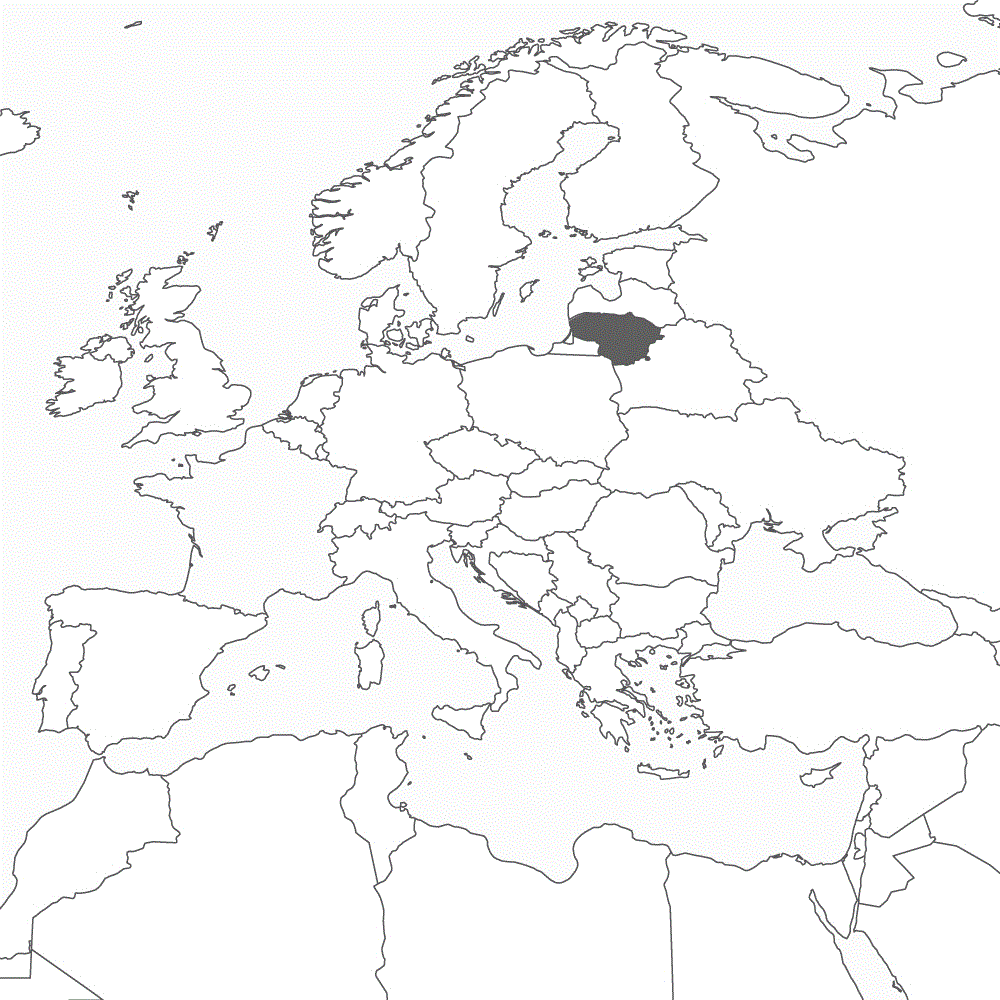
Scenario: War against Russia
Bundeswehr and NATO allies engage in the Quadriga exercises, rehearsing rapid deployment to Lithuania for a war in the Baltics and Special Forces operations along the Russian border.
BERLIN (own report) – While German Luftwaffe fighters are currently in the air over the Baltic Sea to intercept Russian military aircraft, the Bundeswehr is rehearsing a possible war against Russia in the region as part of its major Quadriga exercise series. The exercises, which span several weeks, bring together soldiers from several NATO countries. These forces, under German leadership, are training in a series of interconnected individual exercises for deployment to the Baltic and for warfare. The manoeuvre officially continues until the end of September. Responsibility for planning and implementation lies with Naval Command in Rostock. The Bundeswehr’s Operational Command is leading the activities of soldiers from 14 NATO countries, although German military personnel form the majority. Individual exercises include the amassing of troops in Germany, the transfer of combat units across the Baltic Sea using civilian ferries, and the logistical and medical support for troops on NATO’s eastern flank. The Bundeswehr is also drawing on reservists, civilian infrastructure, emergency services – such as police and fire services – and a variety of other civilian actors.
“What we can expect to face”
According to the Bundeswehr, the core Quadriga exercises comprise “several large-scale deployment and combat exercises”. Since August, some eight thousand German soldiers, along with around four hundred soldiers from allied countries, have been “testing and demonstrating the operational readiness, mobility, and sustainability of the German and allied armed forces under realistic conditions.”[1] The Bundeswehr is practising in the Baltics “under conditions of crisis and war”.[2] Quadriga is “not just a standard exercise,” explains Brigadier General David Markus, “It is essentially the scenario we are preparing for. And that sharpens my men and women’s awareness of what we can expect to face.”[3] According to the Bundeswehr, the “core objective” of the exercises is “to increase the Bundeswehr’s operational readiness.”[4] For this, the soldiers are to develop a range of military skills during the Quadriga: familiarising themselves more closely with the eastward routes by land, sea, or air; training for the securing of deployments by homeland security forces, which includes supersonic and low-level flights with Eurofighters; establishing medical rescue chains from warships via ports to the civilian health system; providing drone defences; supplying major combat units with fuel; deploying Special Forces (as part of Quadriga in Finland) and familiarising with a potential area for operations (Latvia). In order to make the trainings “as realistically as possible”, some Quadriga exercises are “free-wheeling roaming”, which means they take place outside of military training areas, often in the midst of civilian life.[5]
Gun smoke over the Baltic
According to the Bundeswehr, the core of Quadriga is “a large-scale relocation of armed forces” to Lithuania. It took the Bundeswehr’s army units two days to move via Poland to Lithuania by columns of land vehicles.[6] Some of their vehicles had already been passed on to the Navy for shipment across the Baltic Sea to Lithuania with the help of civilian ferries. The objective is described as “strengthening the military capabilities of the navies in the Baltic Sea.” In addition to the “strategic sea transport of land forces to Lithuania”, the Bundeswehr says it is also training for the first time in the role of escorting civilian merchant vessels. Multinational naval units initially assembled in Kiel, according to the Navy’s press release. They then set sail for the Baltic Sea in formation under German command. This occurred on 1st September, of all days, the anniversary of the German invasion of Poland in 1939.[7] The Bundeswehr press release reports in glowing terms that, “You can hear the hammering of the machine guns from the ships ahead, see the spray, and smell the gun smoke.” The redeployment manoeuvre is being escalated “to the point of engaging enemy warships. We are operation- and combat-ready – in other words, fully trained, fully armed, and fully ammunitioned,” explains Frigate Captain Max Berger. The “warships’ weapons could have an optimum impact on aggressors and destroy them,” claims the Bundeswehr.[8] “We have shown that we can deploy significant forces to Lithuania and the eastern flank within a few days,” concludes Bundeswehr Brigadier General Marco Eggert.
Operations area: the entire Baltic region
The Bundeswehr said it attached great importance to enabling “the troops to quickly find their way around the new and partly unfamiliar environment.” This was why Quadriga included exercises in which German soldiers were practising “again and again – nationally, internationally and in near-operational conditions – their skills, making use of civilian Lithuanian infrastructure.”[9] This year, the German army set up a “logistics network in the deployment country”, i.e. Lithuania, designed to supply the army units located there.[10] In doing so, the Bundeswehr was, it explained, demonstrating that it is “determined” to perform a long-term role as operationally deployed on NATO’s eastern flank. The support and logistic units make the “combat troops sustainable”.[11] The Bundeswehr added that its logistics relied “primarily on civilian infrastructure”, an option that had already been explored last year. Agreements were concluded with Lithuanian companies and local authorities to this end. Another part of Quadriga involves the activities of a “reconnaissance command” tasked with “exploring alternative deployment areas that could be made used of if required in a hot conflict scenario.” These reconnaissance operations would, it was reported, take a look at?? Latvia, “because the entire Baltic region is a potential operational area for Bundeswehr logistics.”[12]
Special Operations
In Finland, German soldiers participated in part of the Quadriga described by the Bundeswehr as “the largest Special Forces exercise on Finnish soil to date”. Finland is “a NATO frontline state”, a participating soldier from the Germany’s Special Forces Command (KSK) is quoted as saying. The Bundeswehr describes the exercise scenario as follows: information that is intelligence-based and therefore difficult to publicly verify indicates “an imminent attack by enemy forces in the Baltic region”. In response, the NATO states “immediately deploy Special Forces to the northern flank”. Once they arrive in the country of deployment, Special Forces – about whose foreign activities the German government is not required to inform the public – go into action: “They collect information about possible targets, deploy drones, sabotage enemy infrastructure such as airports or train stations, disable air defence systems, and in this way weaken the enemy’s combat strength before its further offensive against the Alliance.” In Germany, “reinforcement forces” then begin “deploying personnel and materiel. “Immediately combat-capable when war breaks out” is how the Bundeswehr formulates its ambition.[13]
Under German command
Quadriga 2025 is, following Quadriga 2024 [14] and Air Defender 2023 [15], the third consecutive annual large-scale war exercise with which Germany has emphasised its leadership ambitions within NATO. Although these large-scale multinational exercises are NATO exercises, they are planned and, importantly, led by the Federal Republic of Germany. “Quadriga is a central exercise series of the Bundeswehr and an expression of our defence capability,” says Vice Admiral Jan Christian Kaack, Inspector of the German Navy and this year’s commander of the exercise.[16] Quadriga is intended to train NATO troops for “short-notice” deployment of large [multinational] military units via ‘Hub Germany’. The training goes as far as “joint combat with networked weapons systems” under “German leadership”. It was not without intent that, at a media event attended by prominent speakers and organised as part of Quadriga 2025, the message was clear: Berlin hoped to “tangibly demonstrate” Germany’s “wide-ranging role as a hub and transit country in the heart of Europe”; and at the same time Germany wanted to underline its military leadership in NATO and the EU.[17] Quadriga is, the Bundeswehr says, “clear sign” of “military capability”.[18] Berlin’s signal is not only directed at Moscow, but also at its allies in NATO and the EU.
[1] Quadriga 2025 – Alle Einheiten erfolgreich verladen und einsatzbereit. Pressemitteilung der Deutschen Marine, 03.09.2025.
[2] Quadriga 2025 – Bundeswehr und NATO üben den Bündnisfall. Pressemitteilung der Deutschen Marine, 19.08.2025.
[3] Grand Eagle 2025: Panzergrenadiere in Litauen angekommen. soldat-und-technik.de 15.09.2025.
[4] Quadriga 2025 - Bundeswehr und NATO üben den Bündnisfall, Pressemitteilung der Marine 19.08.2025
[5] Quadriga 2025 – Bundeswehr und NATO üben den Bündnisfall. Pressemitteilung der Deutschen Marine, 19.08.2025.
[6] Quadriga 2025 – Alle Einheiten erfolgreich verladen und einsatzbereit. Pressemitteilung der Deutschen Marine, 03.09.2025.
[7] Marinemanöver Northern Coasts – Schwerpunkt der Übungsserie Quadriga 2025. Pressemitteilung der Deutschen Marine, 26.08.2025.
[8] Teilübung Northern Coasts: Einsatz- und kampfbereit in der Ostsee. bundeswehr.de 11.09.2025.
[9] See: Come a long way and From Kosovo to Lithuania.
[10], [11] Grand Eagle. bundeswehr.de.
[12] Brave Blue und Safety Fuel. bundeswehr.de.
[13] Silver Dagger. bundeswehr.de.
[14], [15] S. dazu Einflusskampf im Baltikum.
[16], [17] Quadriga 2025 – Einladung zum Media Day am 4. September 2025 in Rostock. Pressemitteilung der Deutschen Marine, 29.08.2025.
[18] Northern Coasts 2025. bundeswehr.de.