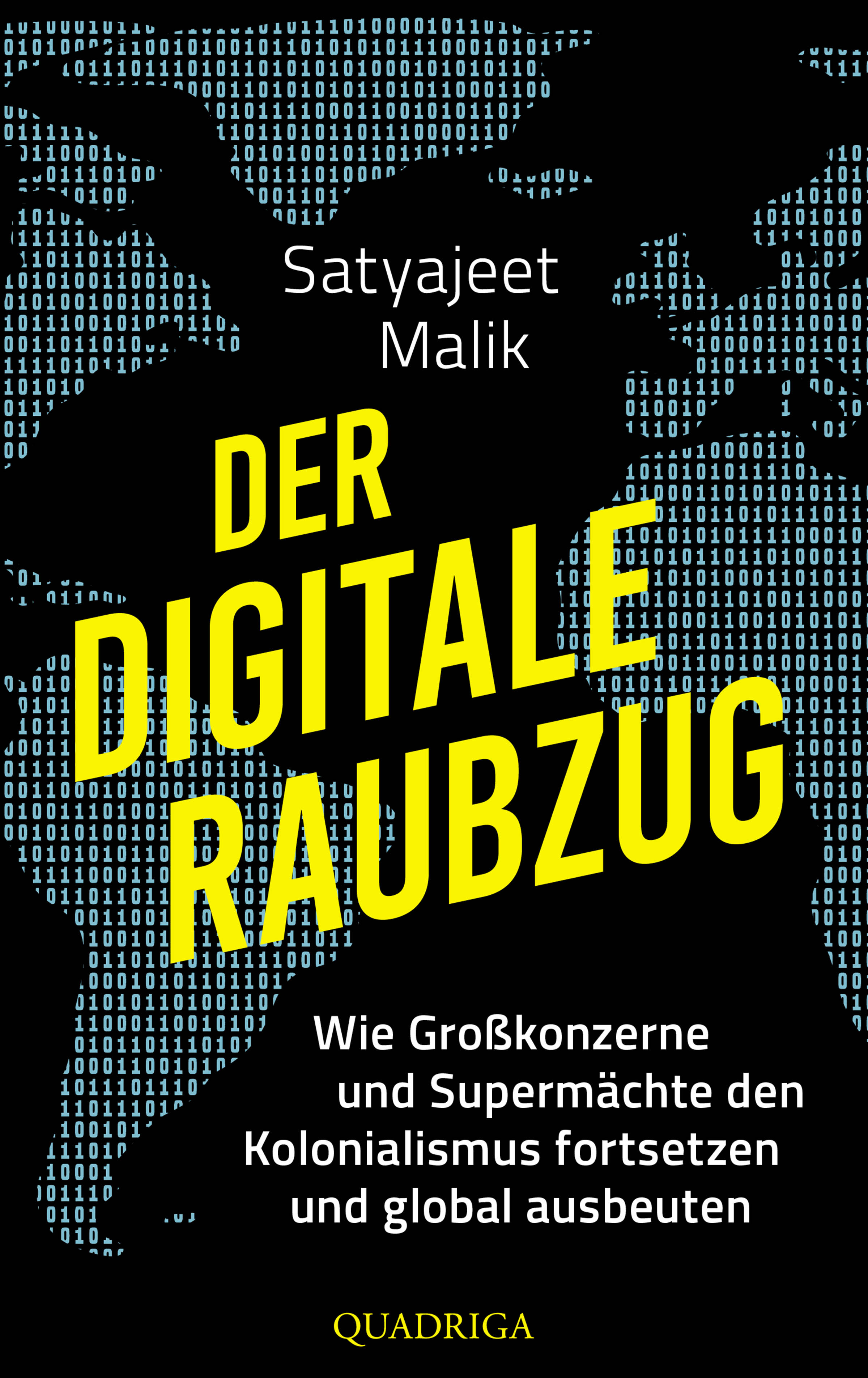
Digital colonialism, the phenomenon examined by Malik in his book, is defined by sociologists such as Michael Kwet as “the use of digital technology for the political, economic and social control of a foreign territory or nation”. There are countless examples of how this plays out. Malik explains the process through which Big Tech businesses not only help to drive sections of the population in poorer countries – especially smallholders – into debt through microloans; they also make money in countries such as India by sucking in and applying their users’ data without paying them anything in return. As for taxes, the tech companies find ways to avoid paying anything back into state budgets. The near monopoly of public discourse secured by platforms such as Facebook, X or Instagram gives these corporations strong “control over the political and social spheres in underdeveloped countries.” As Malik notes, they have “in some cases, control even over the entire flow of information online, including mass surveillance.” And, as seen in the case of Meta’s partnership with Reliance in India, they can under certain conditions even gain control over the entire food supply chain.
Malik advises against a superficial use of the term ‘colonialism’. It should not be reduced merely to a combination of racism and individual exploitation. Colonialism, he reminds us, drawing on the work of outstanding anti-colonial theorists such as Walter Rodney and Kwame Nkrumah, has always been a subtle economic relationship. In India, for example, it was characterised primarily by two mechanisms: on the one hand, the “conquest and destruction of the Indian domestic market” in order to create an Indian domestic market “for British industrial products”; and secondly, the “appropriation of surpluses, particularly agricultural ones,” in a way that forces Indian farmers to gear their crop production to the needs of the British colonial power. This means ignoring the needs of India’s own population. The fact that famines occurred in India more frequently after the onset of colonial rule than before was not bad luck but systemic. Up to a hundred million people fell victim to famine – not simply due to the callousness of individual despots, but as victims of a despicable economic system.
Malik provides a detailed historical overview of the origins and development of colonialism, not only in India but also in Kenya – a settler colony that differed structurally from India. The imperial project in India focused not on the influx of British settlers but on managing the subjugation of the indigenous population. Malik describes how, having ruined the economies of the colonies, colonialism gave way to neo-colonialism, which continued to keep the former colonies under the thumb of the West. Today, Malik notes, “existing colonial relationships of dependency, which were cultivated over centuries,” are being “strategically exploited once again”, this time in the context of a deep crisis of capitalism facing Western states. And it is precisely the digital platforms of Big Tech that have increasingly become a key tool for this purpose. Farmers in India are no longer being driven into poverty because a British colonial official is breathing down their necks; rather, they find themselves in digital dependency and debt. The profits and surpluses still flow to the West today, just as they did in the colonial era – albeit after a share for the local bourgeoisie (in this case Reliance) has been deducted. “In every historical phase,” Malik sums up, “capitalism has made use of the most advanced technologies of the time to assert its general interests.” And these are precisely the digital technologies in today’s world.
Satyajeet Malik: Der digitale Raubzug. Wie Großkonzerne und Supermächte den Kolonialismus fortsetzen und global ausbeuten. Quadriga Verlag. Cologne, 2026. 288 Seiten. 25.00 Euro.