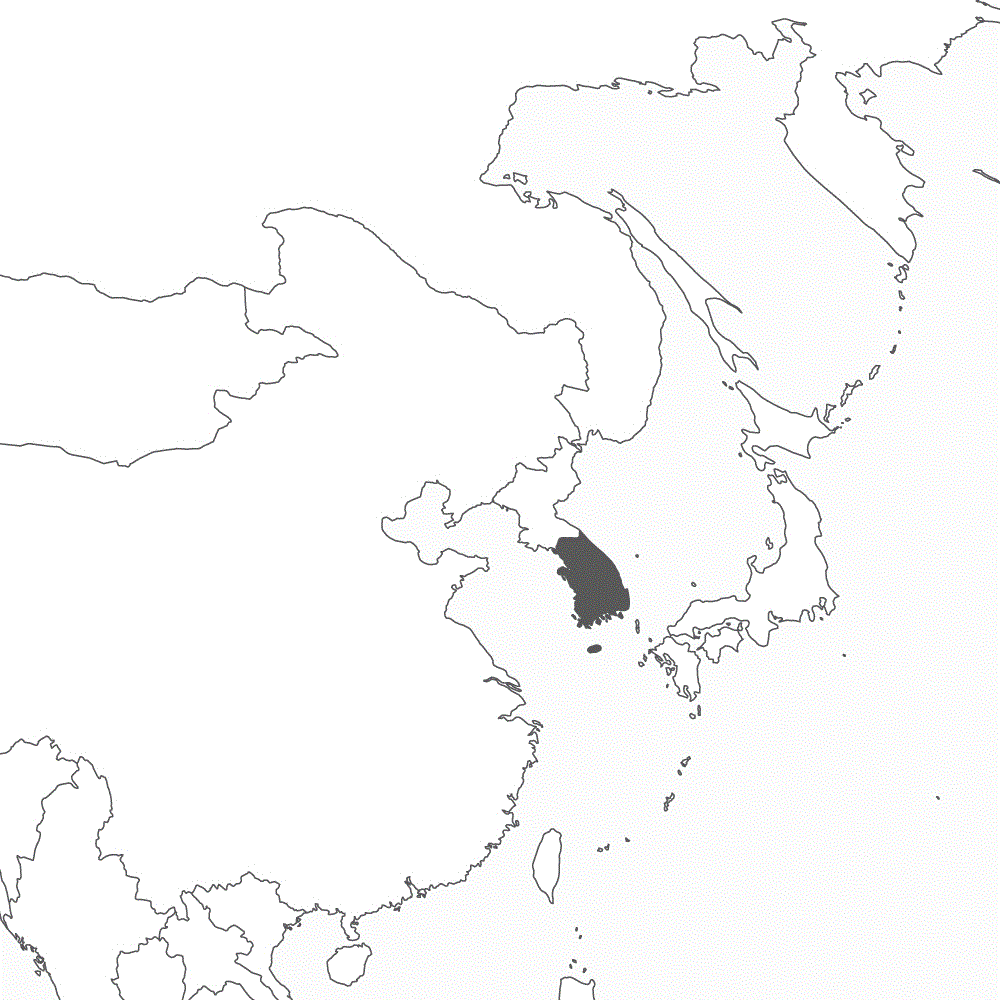
Bloc Formation in East Asia (II)
German Defense Minister Pistorious is visiting South Korea seeking to expand military cooperation – against China. South Korea’s arms industry successfully rivals Germany’s. Seoul is considering acquiring nuclear weapons.
SEOUL/BERLIN (own report) – On Thursday, Defense Minister Boris Pistorius is arriving in Seoul for talks on the expansion of military cooperation with South Korea. Since 2021, a certain degree of cooperation between the two countries’ armed forces has been emerging, within the context of the German Asia-Pacific maneuvers. Last year, the Bundeswehr’s General Inspector, Carsten Breuer visited the South Korean capital for extensive talks. The objective is to integrate Germany into the broad-based Asia-Pacific alliance system being forged since some time by the United States. Until now South Korea had been a major customer of weapons from German companies, however it is not sure if this will continue in the future. In the meantime, that country has developed its own powerful arms production capacity and has even begun to expand its exports – even into the German industries’ traditional markets for their war materials. Poland, for example, has begun to buy South Korean K2 Black Panther battle tanks, instead of German Leopard 2s. While Berlin is forging ahead with military cooperation, demands are growing louder in Seoul for the production of its own nuclear weapons.
Still Room for Improvement
Germany has generally good relations with South Korea. With a trade volume of around €34 billion, South Korea is Germany’s third-largest trading partner– behind China and Japan, and ahead of India – as well as its fifth-largest location for investments – behind China, Japan, India, and Singapore in Asia. Berlin and Seoul are striving to further intensify commerce between the two countries. Germany has its eye particularly on South Korea’s strong semiconductor branch. For both, the motive is to reduce future reliance on trade with China, on which South Korea is currently much more dependent than Germany. According to experts, there is still plenty of room for expansion of cooperation. The bilateral relations are “still not as developed as they could be,” according to an analysis late last year by the German Institute for International and Security Affairs (SWP).[1] At the same time, “Germany’s bilateral relations to South Korea, which, since quite some time, have been mainly motivated by economic interests,” have currently expanded “into new, non-traditional sectors.” “Geopolitical transformations” will make the bilateral relations “most likely still even much more important” in the future.
More Military Cooperation
According to SWP, The German-South Korean relations are, in fact, increasingly addressing “strategic and security-related issues.” According to the analysis, “the cooperation in cyber-security policy” has already been “expanded.”[2] Military cooperation is also being further developed. For example, the Frigate Bayern, the first German battleship to undertake an extensive Asia-Pacific cruise, in late 2021, made a port call to South Korea’s harbor Busan. It also joined the “Coalition of the Willing,” organized by the United States, to monitor UN-imposed sanctions on North Korea.[3] The frigate Baden-Württemberg and the Frankfurt am Main task force supply vessel, which are currently on maneuvers in the Asia-Pacific region will soon do the same. Of course, Berlin is contemplating a much more intensive cooperation. In June of last year, the Bundeswehr’s General Inspector, Carsten Breuer also visited Seoul for talks with Joint Chiefs of Staff Chairman Gen. Kim Seung-kyum. They discussed how to expand the “scope of bilateral cooperation,” it was reported afterwards.[4] Today, Thursday, Germany’s Minister of Defense, Boris Pistorius is awaited in South Korea for more talks on the intensification of cooperation.
One of the Most Important Weapons Customers
The planned military cooperation can build on the long-standing close relationship at the arms industrial level. For nearly two decades, South Korea has been one of the most important customers of German arms products. In the five-year period between 2019 and 2023, Germany was Seoul’s second largest arms supplier after the United States. German arms manufacturers sold mainly tanks, battleships, small arms and munition to South Korea. Since 2009, 214-class submarines are being produced under license by Hyundai and Daewoo with some parts – especially Siemens electric motors –still being imported from Germany. Attempts to convince Seoul to buy the Eurofighter combat aircraft were unsuccessful. South Korea bought the F-15 and F-35 US models instead. It must be kept in mind, according to the Bonn International Center for Conversion (bicc) that South Korea has long had “one of the most efficient shipbuilding industries in the world” and to a growing extent “the Korean Navy is being furnished battleships” manufactured by Korean companies themselves.[5] Some consider Korea’s KF-21 Boramae fogjter ket superior to the Rafale and Eurofighter.[6]
New Rival
While it is questionable whether South Korea will remain a largescale customer of German weaponry in the long run, the South Korean arms industry itself is expanding – even though not yet into Germany itself, but onto traditional markets of German arms manufacturers. Poland, for example, signed a contract in July 2022 to buy nearly 1,000 K2 Black Panther battle tanks, 650 K9 armored howitzers and 48 FA-50 fighter jets– all manufactured in South Korea. The total price is estimated to be in the range of around US $13.7 billion.[7] One reason why Warsaw did not opt to buy the EU’s top dog – the German Leopard 2 – was Berlin and Paris’ refusal to allow Polish arms manufacturers participate in the development and production of the latest generation Franco-German battle tank – the Main Ground Combat System, (MGCS). South Korea arms companies have also expanded their exports to other countries. Their exports rose from an annual US $2 – 3 billion by the late 2010s to US $17.2 billion in 2022, and this year, it is expected to reach US $20 billion.[8] This indicates that the South Korean sector has developed into a serious rival for the German arms industry.
Nuclear Power South Korea?
Germany’s efforts to strengthen its military cooperation with ‘South Korea is taking place at a time when Washington is comprehensively integrating Seoul into its anti-China Asian-Pacific alliance system. On Sunday, the defense ministers of the USA, Japan and ‘South Korea signed a document in Tokyo, wherein, among other things, they agreed to hold regular meetings, a comprehensive sharing of information as well as joint exercises.[9] The USA has thus succeeded in pulling together a loose alliance, that had long been blocked by tensions between Japan and South Korea. The tensions stem from Japan’s refusal still today, to pay reparations for the serious crimes committed during its colonial rule over South Korea. On the other hand, Berlin has begun more intensively to cooperate with Seoul, at a time when concrete efforts are intensifying toward the development of Seoul’s own nuclear weapons, which is being openly advocated by influential forces within President Yoon Suk-yeol’s party. Their demand, according to opinion polls meets the approval of 66 percent of the population, a six-percent more than a year ago.[10] Yoon, himself remains discrete – according to reports, not to jeopardize his relationship with Japan. However, a change of course is considered conceivable, should President Trump return to the US presidency.
For more information on this subject: Bloc Formation in East Asia.
[1], [2] Eric J. Ballbach: Deutschland und Südkorea auf dem Weg zur strategischen Partnerschaft. SWP-Aktuell 2023/A 61. Berlin, 05.12.2023.
[3] See also Mit der Luftwaffe an den Pazifik.
[4] Top S. Korean, German generals discuss military cooperation, war in Ukraine. koreatimes.co.kr 05.06.2023.
[5] bicc: Südkorea. Länderinformationen zu den Europäischen Kriterien für Waffenexporte. Bonn, Juli 2024.
[6] Peter Suciu: ‘Cheap’ F-22: South Korea’s KF-21 Boramae Fighter Has Edge over Rafale and Eurofighter. nationalinterest.org 12.07.2024.
[7] Polen bestellt K2-Kampfpanzer, K9-Panzerhaubitzen und FA-50-Flugzeuge in Südkorea. esut.de 28.07.2024.
[8] Wooyeal Paik: South Korean Defense Industry Goes Global, and Local Too: An Econo-Tech Approach. ispionline.it 08.04.2024.
[9] Japan, U.S., South Korea sign document to cement security cooperation. english.kyodonews.net 28.07.2024.
[10] Anna Schiller: Südkorea und die Bombe. Frankfurter Allgemeine Zeitung 05.07.2024.