Back to Europe
Central and Eastern Europe growing in importance as markets for German business as exports to China and the US collapse. Industry figures call for further eastward enlargement of the EU single market.
BERLIN/WARSAW/BEIJING (our own report) – With exports to China and the United States declining, German companies look to Central and Eastern Europe as crucial markets. German exports to the world’s two largest economies have recently seen significant falls, but rising sales to Central and Eastern Europe have more than offset the lost business. Trade is growing particularly strongly with the Visegrád Group economies. In the first half of 2026, German exports to Poland rose by 9.2 per cent, and to Czechia by 14 per cent. Over the same period, they fell in value by 12.4 per cent to China and by 6.5 per cent to the US. In fact, Germany now exports almost 50 per cent more goods to Poland than it does to China. Germany’s business-promoting association for Eastern, Central and Southeastern Europe, the ‘Ost-Ausschuss der Deutschen Wirtschaft (OA)’ says this is a “key region for German exports” and argues for the EU single market being expanded eastwards and south-eastwards by bringing more states into the European Union. At the same time, China’s economic influence is also growing in Eastern Europe. In fact, Chinese companies are not merely operating as competitors to German companies but are increasingly being integrated into European production chains.
Significance of the EU
The intensifying competitive environment makes the role of the EU single market more and more important for the German export sector. In 2024, just under 54 per cent of all German exports of goods were destined for EU member states. This share had already stood at around 51 per cent in 2019. For Germany, the five largest export markets within the European Union in 2024 were France, with sales worth 111 billion euros; the Netherlands, with 105 billion euros; Poland, with 90 billion euros; Italy, with 78 billion euros; and Austria, with 72 billion euros. Around 52 per cent of German exports to the EU consisted of intermediate goods, such as metals, chemicals or electrical components that are further processed in another EU country, often at production sites abroad run by German companies. A further 17 per cent comprised capital goods such as plant and machinery, while around a third of exports consisted of consumer goods.[1] But the growing focus on Europe comes with risks. The German economy had previously diversified its trade patterns significantly. By opening up to Asian customers, Germany was less severely impacted by the euro crisis than other EU economies.[2] Now we are seeing a decline in geographical diversification leading to a German export model that is more vulnerable to crises.
Export boom in Eastern Europe
The markets across Central and Eastern Europe have enabled Germany to compensate for its faltering exports to China and the US. The problem with those two markets is that, on the one hand, the People’s Republic now manufactures plenty of sophisticated high-tech products itself, squeezing out the goods once imported from Germany. On the other hand, access to the US market is severely hampered by Trump’s capricious tariffs. Speaking to Handelsblatt, Cathrina Claas-Müller, Chair of the ‘Ost-Ausschuss der Deutschen Wirtschaft (OA)’, stated that, “Central and Eastern Europe have become a key region for German exports.” While the volume of German exports to China and the US fell by a total of just over 10 billion euros, Central and Eastern Europe more than offset these slumps with an increase of almost 11 billion euros. Admittedly, “Central and South-Eastern Europe […] cannot, of course, completely replace China and the US,” emphasised Claas-Müller. Nevertheless, it was crucial, she said, to recognise the region’s importance for the future economic development of the German economy. This was why, she argued, the European single market had to be rapidly enlarged eastwards and south-eastwards. This policy would allow German businesses to make the best possible use of the potential of the region, which stretches even beyond the current EU. Advances in EU accession talks with Ukraine, Moldova and the countries of the Western Balkans should be “resolutely leveraged”, the OA Chair urged.[3]
Germany’s industrial footprint
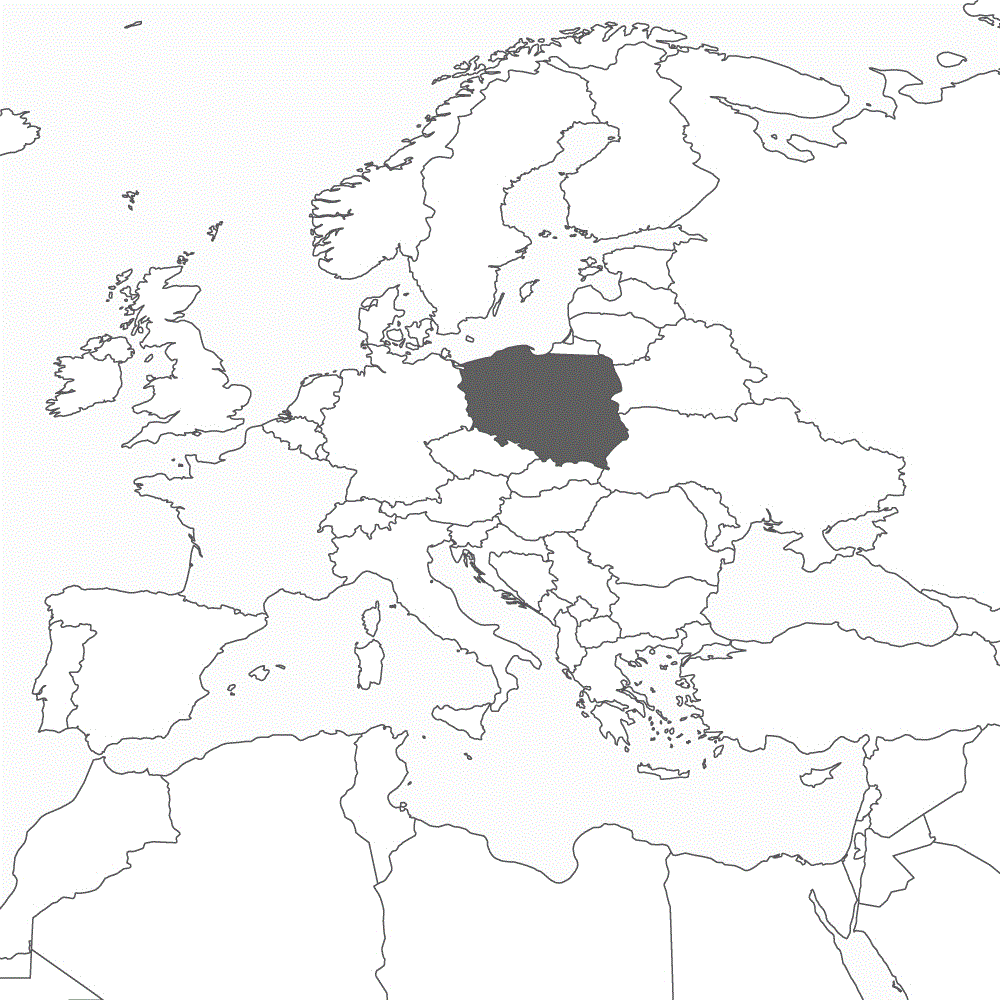
In Central and Eastern Europe, the so-called Visegrád countries (Poland, Hungary, Czechia and Slovakia) occupy a prominent position as some of the most important foreign production sites worldwide for German industry. From a German perspective, they offer several investment advantages: geographical proximity to Western Europe, a well-developed industrial infrastructure, a large pool of skilled labour, and comparatively low wage levels. German companies already have a strong local presence in the chemical and electrical sectors, as well as in the core sectors of mechanical engineering and automotives.[4] While German exports to China fell by 12.4 per cent in the first half of 2026, compared with the same period the previous year, and exports to the United States by 6.5 per cent, German exports to Hungary rose by 6.7 per cent,[5] to Poland by 9.2 per cent, and to Czechia by as much as 14 per cent.[6] From January to June, Germany exported goods worth 53.8 billion euros to Poland, while the figure for China is put at just 36.3 billion euros. This means that Germany exported almost 50 per cent more goods to Poland than to China. Poland has been the fourth most important export market for German companies since 2024. China now ranks only ninth. Even the significantly smaller Czech economy came close to China’s figures, with Germany selling goods to Czechia worth 30.3 billion euros.[7]
Between Germany and China
The statistics also show that Poland is increasing its imports from China. In the first half of the year, the country imported German goods worth 43.1 billion euros (18.6 per cent of all imports) and Chinese goods worth 36.7 billion euros (15.9 per cent). The US ranked third, selling goods to Poland worth 12.7 billion euros (5.5 per cent).[8] By July, more goods were, for the first time, shipped from China to Poland than from Germany. A triangular trade pattern is increasingly emerging in Poland: China is gaining in importance as a supplier of electronics, cars and other consumer goods, while Germany remains central to foreign direct investment and European production chains.[9] In the other direction, Germany accordingly remains clearly in the lead as an importer of Polish goods. Poland exported goods worth 59.7 billion euros to Germany from January to July, which constitutes 26.3 per cent of all Polish exports. Czechia and France are the next biggest markets for Poland, each with imports to the value of around 14 billion euros.[10]
Competition and division of labour
In this pattern of trade, Chinese companies do not only operate as competitors to German producers in Central and Eastern Europe. This is apparent from the interconnections within the German automotive industry in Hungary. Contemporary Amperex Technology Co. Ltd (CATL) is the world’s largest battery manufacturer. The Chinese corporation announced in 2022 that it would build a new factory in Debrecen, in the east of Hungary. CATL now supplies batteries to BMW, Mercedes, Volkswagen and Stellantis, amongst others, who all also manufacture in Hungary. In 2023, CATL was joined by other Chinese companies (Huayou Cobalt and Sunwoda Electronics) as producers in Hungary. In 2024, Eve Energy followed suit with a factory supplying BMW.[11] The integration of Chinese car manufacturers and suppliers into the European automotive sector has now become a common strategy as the legacy carmakers struggle to cope with the automotive crisis. In Spain, France and Italy, Stellantis plans to leverage underutilised production capacity by manufacturing models from the Chinese groups Leapmotor and Dongfeng. Leapmotor cars are to be produced at the Stellantis plants in Madrid and Zaragoza. In France, Stellantis plans joint production with Dongfeng of an electric car and, in Italy, a collaboration with Leapmotor on another small electric car. Meanwhile, an Opel SUV featuring Chinese technology is to be built in Madrid. Volkswagen’s new strategy, too, aims to manufacture VW models for the European market that were previously available exclusively in China. The plan to bring its own Chinese models to the European market not only by importing them from China but, at a later stage, also producing the vehicles or their components in Europe.[12]
[1] Mark Simon Wolf: Deutschlands Exportmotor läuft in der Nachbarschaft: Deswegen ist die EU wichtiger als USA und China. merkur.de 24.08.2026.
[2] Nils Jannsen, Stefan Kooths: German Trade Performance in Times of Slumping Euro Area Markets. intereconomics.eu 11/12.2012.
[3] Julian Olk, Frank Specht: Deutschland erlebt plötzlich einen Exportboom nach Osteuropa. handelsblatt.com 13.08.2026.
[4] See: Deutschlands industrieller Hinterhof.
[5] Benjamin Bidder, Michael Brächer, Florian Diekmann und Alexander Trempler: Wie Polen die deutsche Wirtschaft rettet. spiegel.de 28.09.2026.
[6], [7] Liudmila Kotlyarova: Nach jahrelanger Überheblichkeit: Osteuropa fängt Deutschland jetzt auf. berliner-zeitung.de 14.08.2026.
[8] Hannah Petersohn: Deutschlands China-Problem erreicht jetzt sogar Polen. focus.de 18.09.2026.
[9], [10] Lukas Plewnia: China überholt Deutschland: Polens Importrekord ist noch kein Machtwechsel. polen-heute.de 16.09.2026.
[11] See: Hungary hub for Chinese EV competitors.
[12] See: Zeitenwende in der deutschen Autoindustrie.