Hungary hub for Chinese EV competitors
Germany’s crisis-stricken automakers expand e-vehicle production in Hungary in cooperation with Chinese suppliers. Chinese competition now looming within the EU.
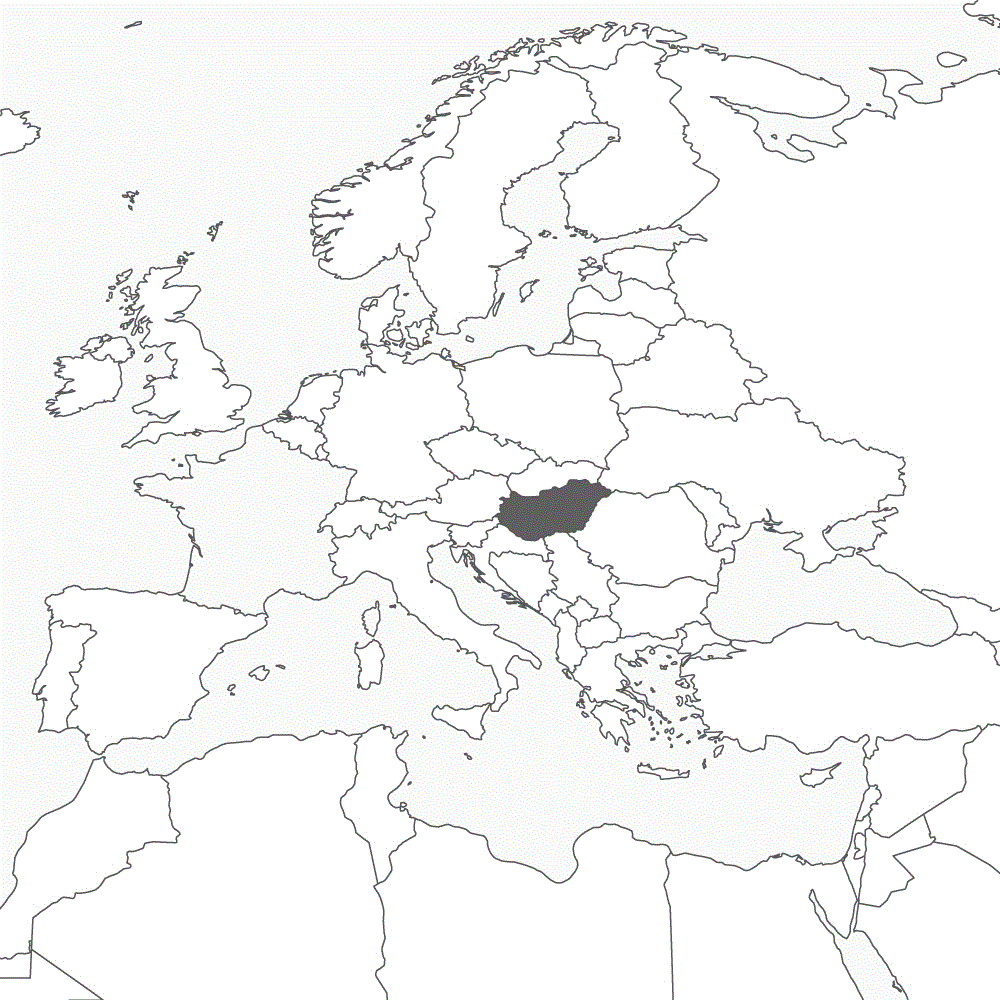
BUDAPEST/BERLIN (own report) – Hungary as a production location has become a key player in Europe’s automotive and battery value chain. The ailing German car manufacturers face the prospect of Chinese competition emerging for the first time from within the EU. While Hungary’s automotive industry has long been dominated by German car manufacturers, the country is now also attracting companies from China. Major Chinese investment, initially focused on battery production, is part of a wider strategy: the new plants are being built primarily in the vicinity of German production facilities. These supplies have already developed well-established relationships with Germany’s automotive groups. Chinese battery manufacturers are linking into industrial structures built up in Hungary over decades-long German corporate presence, which was attracted by government incentives to locate eastwards. So Hungary, having become an industrial hub within Europe, is strengthening its position, in the short term at least, by adding value for German companies in particular. In the meantime, however, BYD is building a major plant in Hungary, becoming the first Chinese carmaker to begin vehicle assembly in Europe. This investment represents a significant expansion of China’s presence. In the medium term, it means that the crisis-ridden German automotive industry will face tougher competition from within the EU.
Restructuring the automotive industry
Hungary has become one of the most important production centres for the German automotive sector. According to data from the International Organization of Motor Vehicle Manufacturers, around 437,000 vehicles were produced in Hungary in 2024. This puts the country behind the Czech Republic (1.45 million), Slovakia (one million) and Romania (560,000 vehicles). However, Hungary is also a major supplier of combustion engines. Against the backdrop of the planned phase-out of petrol and diesel engines, it has for some time become increasingly important to attract foreign investment in electric vehicle components. The Hungarian government has had considerable success in this regard. In particular, it has managed to attract large Chinese battery makers like CATL, Sunwoda and Eve Energy with large-scale investments. High-volume agreements between German vehicle manufacturers and Chinese battery producers have contributed to this trend. A key incentive for Chinese investment is the state support measures that Hungary offers to foreign investors. In August, the European Commission announced that it had approved Hungarian state aid amounting to 264 million euros.[1]
German automotive groups: biggest investors
Among foreign investors in Hungary, Germany was the leader by a long shot in 2023, with direct investment totalling 21.3 billion euros. Germany was followed by the USA, with 9.4 billion euros, France with 5.2 billion and China with 4.5 billion.[2] In addition to extensive government incentives to invest, the German companies benefit from comparatively low wages and a highly skilled workforce. Added to this is the geographical proximity to Germany along with a well-developed infrastructure. So from the perspective of German industry, Hungary offers favourable conditions for production within the European Union. In 2024, Hungarian labour costs were the third lowest in the EU. Only Romania and Bulgaria were lower.[3] From the perspective of German industry, however, even these wage levels are increasingly considered too high. In mid-2019, the Frankfurter Allgemeine Zeitung was predicting that Volkswagen would be more likely to plan new plants in Serbia, Turkey or Bulgaria rather than in Hungary, Czechia or Slovakia.[4] For its part, the Hungarian government has sought to limit the rise in real wages by means of persistently high inflation. This trend occurred in 2021 when the inflationary spike completely offset the country’s official increase in the minimum wage.[5]
Multi-billion scale investments by German carmakers
In 2022, BMW followed Audi and Mercedes, which were already producing in Hungary, with an announcement – after several delays – of its investment in a new Hungarian factory, initially set at over one billion euros. This is the most modern BMW plant worldwide.[6] In autumn 2022, BMW increased the investment plans again, rising to a total of around two billion euros. There are also plans for the construction of a battery production facility. BMW sources the battery cells from Chinese manufacturers CATL and Eve Energy, which enjoy very large orders.[7] BMW’s investment breaks down into around 1.5 billion euros towards vehicle production and around 0.5 billion euros towards battery production.[8] In February of this year, BMW was able to announce that all the necessary facilities in Debrecen had been built.[9] The plant was officially opened in September. At the opening ceremony, Hungarian Prime Minister Viktor Orbán delivered a speech in which he voiced criticism of the trade conflict between the United States and China. Orbán also pledged that Hungary would continue to guarantee low tax rates for foreign investors.[10] Although BMW confirmed Orbán’s presence at the factory opening, the company avoided quoting anything he said in its official press release.[11]
Hungary becoming Europe’s battery hub
Thanks in part to this major automotive investment, Hungary is emerging as one of the world’s largest locations for battery production. The battery boom had begun in full by 2021, when South Korean manufacturer SK Innovation announced the construction of a new battery plant in Hungary. The company’s planned investment volume will climb to 2.3 billion US dollars by 2028.[12] This decision was followed in 2022 by an announcement by the world’s largest battery manufacturer, Contemporary Amperex Technology (CATL) from China, that it would build a factory in Debrecen in eastern Hungary. CATL is to supply batteries to a number of carmakers including BMW, Mercedes, Volkswagen and Stellantis.[13] With a volume of around 7.5 billion euros, this represents the largest single investment in Hungary’s economic history.[14] Further announcements from Chinese battery companies then followed in 2023: Huayou Cobalt is investing around 1.4 billion dollars in Hungary,[15] and a further 1.7 billion dollars is committed by Sunwoda Electronics.[16] In 2024, Eve Energy announced plans to build its first European plant in Debrecen for around 1 billion euros to supply BMW in the future.[17] In fact, BMW received around 34 million euros in state aid from the Hungarian government to incentivise this project.[18]
Chinese vehicle assembly in European
In addition to battery cell production, the surging Chinese automotive group BYD also announced at the end of 2023 that it would build its first European EV plant in Hungary. The announcement followed a state visit by Viktor Orbán to China, during which he met with President Xi Jinping and BYD founder and CEO Wang Chuanfu. Rather than just producing batteries, the Hungarian plant will make complete electric vehicles for the European market.[19] This is a crucial breakthrough. In 2025, the plans for the site were upgraded to include an R&D centre. As a global player, BYD’s goal is to sell around half of its EV output outside China by 2030.[20] In Germany, sales of electric cars rose again after a downturn in 2024. While the US group Tesla has recorded a decline in sales in Germany, BYD has been able to increase sales figures.[21] Slowly but surely, Chinese competition to Germany’s major automotive corporations is growing in Hungary.
[1] Tobias Piller, Michaela Seiser: Mit BMW zur Hochburg für Elektroautos. faz.net 06.09.2025.
[2] Magyar Nemzeti Bank (own calculation).
[3] Eurostat: Hourly labour costs. ec.europa.eu 28.03.2025.
[4] Christian Geinitz: Osteuropa in der Pubertät. Frankfurter Allgemeine Zeitung 08.05.2019.
[5] Munkástanácsok: Óriási csapást mér az árrobbanás a legszegényebb magyarokra. portfolio.hu 07.06.2021.
[6] Markus Fasse: BMWs elektrischer Vorreiter. Handelsblatt 02.06.2022.
[7] BMW stockt Investitionen in neues Werk in Ungarn auf. handelsblatt.com 25.11.2022.
[8] BMW stockt Investitionen auf. gtai.de 29.11.2022.
[9] Ősszel indul a sorozatgyártás a BMW debreceni üzemében, Szijjártó szerint az egész cég sorsa is múlik ezen. hvg.hu 12.02.2025.
[10] Fidesz: igy kepzeltuk a magyar es a nemet ipar egyuttmukodeset. 26.09.2025.
[11] Das jüngste und innovativste Werk der BMW Group: neuer Produktionsstandort in Debrecen. press.bmwgroup.com 29.09.2025.
[12] Bau einer Fabrik für Elektroauto-Batterien. gtai.de 02.02.2021.
[13] Michaela Seiser: China festigt seine Macht in Ungarn. faz.net 09.09.2022.
[14] Henning Peitsmeier, Michaela Seiser: BMW baut in Ungarn eine Batteriefabrik. faz.net 25.11.2022.
[15] Richard Gardham: Deal focus: Huayou takes advantage of Hungary’s automotive expertise. investmentmonitor.ai 07.07.2023.
[16] Richard Gardham: Sunwoda Electronic to open first eastern European plant in Hungary. investmentmonitor.ai 31.07.2023.
[17] Chris Randall: Eve Energy to build battery factory in Hungary. electrive.com 10.05.2023.
[18] Henning Peitsmeier, Michaela Seiser: BMW baut in Ungarn eine Batteriefabrik. faz.net 25.11.2022.
[19] EU hält deutlich mehr Gelder für Ungarn zurück. handelsblatt.com 22.12.2023.
[20] BYD baut in Ungarn aus. Frankfurter Allgemeine Zeitung 17.05.2025.
[21] Fast 60 Prozent mehr Elektroautos im November neu zugelassen. handelsblatt.com 03.12.2025.