Europe’s mid-terms campaign gift to Trump
German government agrees to release some of its emergency diesel reserves to lower world prices – under pressure from Trump and at the expense of Germany’s energy security.
BERLIN/WASHINGTON (our own report) – The German government is releasing a part of Germany’s emergency diesel reserves - unnecessarily. This coordinated move by Europeans to ease market tensions will boost US President Donald Trump’s flagging campaign for the American mid-term elections. Trump is keen to avoid a painful fuel crisis shortly before the elections because significant sections of his voter base are threatening to defect. US farmers, for example, are facing record-high diesel prices and are threatened with economic ruin. The chief cause of an unprecedented hike in diesel prices is the US-Israeli war on Iran. While 19 per cent of all global diesel exports came from the Middle East last year, the Iranian response to being attacked means that a large proportion of this supply source is missing. At the same time, Ukraine’s drone attacks on Russian refineries are damaging Russian diesel production. Although German politicians regard these hits with schadenfreude, it is bad news for the global economy. Moscow has now moved to halt exports. As the world’s second-largest diesel exporter, Russia is making the diesel market even tighter. Trump reacted last week by forcing Europe’s G7 economies, including Germany, to release part of their emergency reserves under the threat of the US cutting of all future American diesel supplies to Europe. Europe’s, and especially Germany’s, dependence on the US is also acute when it comes to crude oil and liquefied natural gas imports. The US share of European LNG imports has risen to around 60 per cent.
Diesel shortage on global markets
The current shortage of diesel on the world market is primarily driven by the US war on Iran and the resulting disruption to supplies from the Middle East. On the one hand, there is still a shortage of the crude oil destined for refining into diesel in other countries, despite recent reports of a significant rise in tanker movements through the Strait of Hormuz. On the other hand, the refineries in Persian Gulf states have been damaged by Iranian counter-strikes and targeted by Yemen’s Houthis. This is all the more serious given that the Arab states had only recently boosted their refining capacity and doubled their diesel exports between 2017 and 2025. Their contribution had lately accounted for 19 per cent of all global diesel exports.[1] The extent of the damage done to Middle Eastern refineries remains unclear, as does the time needed to repair them. The situation is compounded by cutbacks in exports from other sources. Although India, for example, had pledged not to curb diesel exports, a blaze at a major Indian refinery last Tuesday has reduced its export capacity.[2] China, too, has just announced a significant reduction in diesel exports, limiting its supplies to those countries with which it closely cooperates, such as Cambodia. The reason is clear. China needs to replenish its own reserves.
Russia’s export ban
Diesel supplies from Russia are currently on hold. Ukrainian drone attacks on Russian refineries have caused significant damage to processing capacities in recent months. Western media, not least in Germany, have regarded these strikes with a palpable sense of schadenfreude. However, gloating may be misplaced. After all, Russia was previously the world’s second-largest exporter of diesel, supplying approximately ten per cent of the total volume of diesel traded by sea. So the damage caused by Ukrainian attacks is deepening the energy crisis. With falling production at the vulnerable refineries temporarily disrupting domestic supplies, Moscow finally moved, on 8 July, to halt diesel exports.[3] The export ban has subsequently been extended several times, most recently last Wednesday, and will now remain in place until at least 31 October. An even longer extension is also under consideration in Moscow as Ukraine continues to target Russian refineries. Several plants were once again severely damaged last week and there is no end in sight.
More expensive than ever
Diesel prices have recently soared to record highs as a consequence. In the United States, diesel recently peaked at 6.53 dollars per gallon. Just a year ago, the price per gallon was still 3.75 dollars. As for the European Union, the European Commission’s statistics show an average price of 2.24 euros per litre, again higher than ever before.[4] Expensive energy is placing a rapidly worsening burden on industry, transport and agriculture. The scale of the problem is illustrated by a case recently reported in Handelsblatt. The business newspaper looked at consumption for the combine harvester belonging to a pig farmer who grows maize, wheat and barley as feed for his livestock. The machine reportedly consumes 1,000 litres of diesel a day for his operations. A litre of diesel “currently costs 82 cents more than before the Iran war”, which means the additional costs faced by the pig farmer amount to “several tens of thousands of euros” per year.[5] And our farmer has more problems: due to the increased fuel costs, slaughterhouses are now charging “transport surcharges for taking the animals”. What is more, “prices for fertilisers have risen sharply”. The fertilisers are made from fossil fuels, which, again, have become much more expensive. The de facto blockade of the Strait of Hormuz is preventing fertiliser manufacturers in the Persian Gulf from supplying global markets. The situation is critical, and many smaller farms have already gone bankrupt.
Trump’s election woes
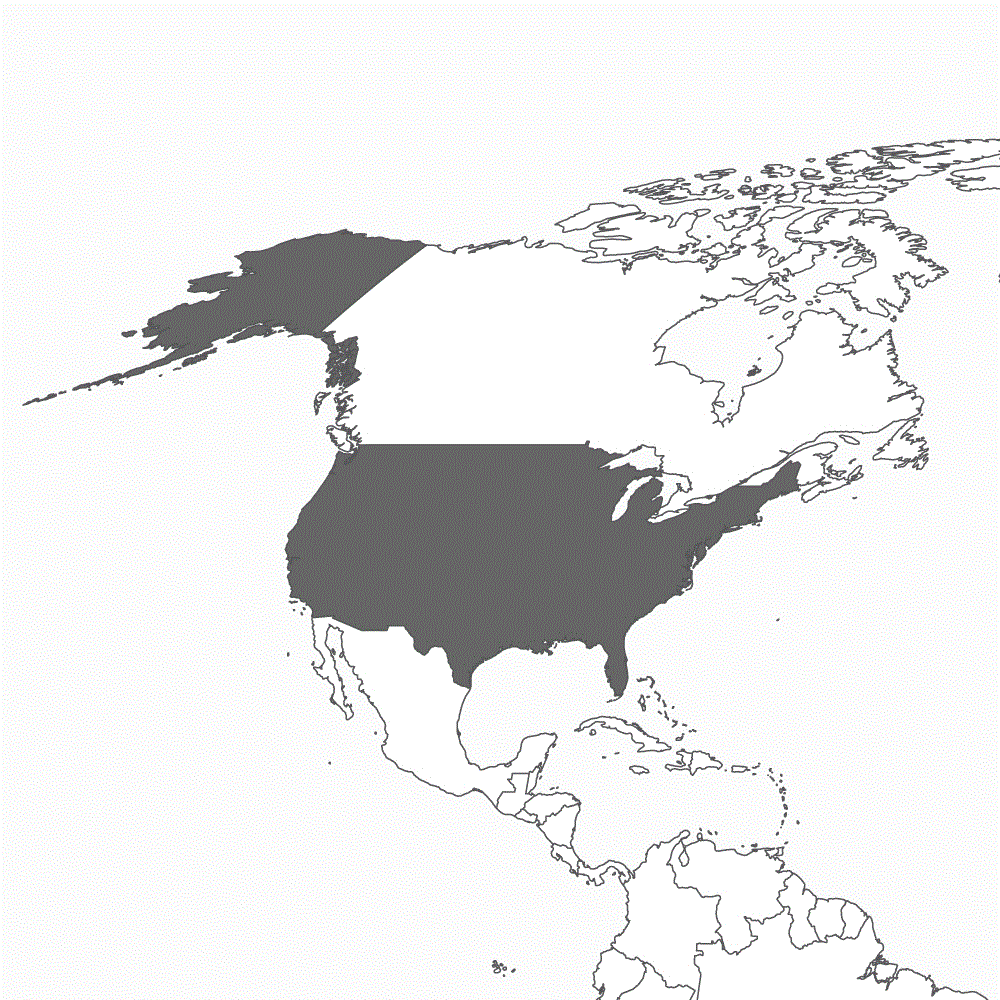
The situation facing German farmers is faced by farmers in the United States, who were once regarded as US President Donald Trump’s most loyal voter base. This is another reason why Trump has, for weeks, been eager to increase the global supply of diesel. Bringing down the price of diesel is a move that could avert a Republican collapse in the US mid-term elections, scheduled for 3 November. Trump has already called on Ukraine on several occasions to cease its attacks on Russian refineries. Kyiv has not yet complied. For his part, however, the US President is not prepared to reach an agreement with Iran that could stabilise supplies from the Middle East in the medium term. And US refineries have long been running at full capacity. The market is so tight that even routine maintenance work, which involves a brief fall-off in output, threatens to drive prices up even further. The Trump administration therefore moved last week to issue an ultimatum to European governments, demanding they release part of their emergency reserves. Otherwise, Trump warns, he will halt long-term diesel exports to the EU.[6]
Where dependency leads
American threats have had the desired effect. Since deciding to boycott fossil fuel imports from Russia, Germany and the rest of the EU have become increasingly reliant on US energy sources. Last year, the EU was already sourcing 17 per cent of its diesel imports from the US. That provides around 6 per cent of Europe’s total consumption.[7] Germany met 5 per cent of its requirements from US imports, but since the start of the war on Iran, dependence on US diesel has risen further. The volume of US diesel supplied to the EU between February and June 2026 was double the figure for same period last year.[8] At the end of last week, the European G7 countries felt what dependency on US imports can mean. Having objected to being told to free up emergency reserves, they caved in within just over 24 hours. Even though the law only permits reserves to be run down in the event of an acute shortage, they agreed to use these stocks to help bring down prices. By Friday, the Europeans were already agreeing to release 100 million barrels of diesel and crude oil over the course of the next four months.[9] The US price of diesel, which most recently stood at a weekly average of around 6.48 US dollars per gallon, then fell to 6.35 US dollars per gallon as early as Saturday.
Europe’s exposure to blackmail
These events show that Europe has ended up giving de facto support for Trump’s election campaign. They are revealing in two respects. Firstly, they have demonstrated the consequences of Europe’s growing dependence on US energy sources. And this goes well beyond the diesel crisis. Indeed, the United States accounted for 16.4 per cent of Germany’s oil imports last year, making it in second biggest supplier just behind Norway (16.6 per cent).[10] Above all, however, the US currently supplies around 60 per cent of all the EU’s liquefied natural gas imports. If Washington decided to halt LNG exports to Europe, energy supplies would collapse within a very short space of time. The scope for economic blackmail is correspondingly high.
Taking a big gamble
Allowing the emergency diesel reserves to be drawn down in this way is a further step towards undermining Europe’s security of supply. Every EU Member State is obliged by statute to maintain diesel reserves equivalent to 90 days’ net imports or 61 days’ consumption. It is not known what proportion of the 100 million barrels of oil now agreed for release consists of diesel rather than crude oil. What is clear, however, is that this move will reduce the volume of the emergency reserves. And this is happening at a time when natural gas stocks in the EU – and particularly in Germany – are also significantly below the prescribed minimum level. On 1 October, natural gas storage facilities across the EU were only 72 per cent full. This level is significantly lower than the long-term average of 87.6 per cent. Gas storage facilities in Germany have even been as low as 58.2 per cent capacity. Both the Bundesnetzagentur, which oversees the supplies secured by gas traders, and the Federal Government still maintain that there is no cause for concern. They are still asserting that Germany’s supplies for the winter are secure. On the question of diesel supplies, the Minister for Economic Affairs, Katherina Reiche, boldly claimed on Friday that despite tapping into the emergency diesel reserves there would remain “sufficient reserves to secure supplies at all times”.[11] But is Berlin gambling with the population’s energy security?
[1] Matthew Dalton: Refineries Are Now the Main Chokepoint for Global Energy Supplies. wsj.com 20.09.2026.
[2] Keith Bradsher, Alexandra Stevenson: China Resumes Curbs on Fuel Exports, Tightening Global Energy Markets. nytimes.com 02.10.2026.
[3] See: The costs of war.
[4] USA fordern Deutschland zur Freigabe von Dieselreserven auf. faz.net 02.10.2026.
[5] Judith Henke, Jens Koenen, Katrin Terpitz, Silke Kersting: Die Kostenwelle rollt durch die Wirtschaft. handelsblatt.com 22.09.2026.
[6] Erwogener US-Diesel-Exportstopp stößt in EU auf Ablehnung. faz.net 02.10.2026.
[7] Johannes Winterhagen, Niklas Záboji: G-7-Staaten wollen 100 Millionen Barrel Diesel und Rohöl freigeben. faz.net 02.10.2026.
[8] Europe’s other oil problem: Diesel, Jet Fuel, and the chokepoints that matter. gtpo.eu 24.09.2026.
[9], [10] Was bringt die Freigabe von Öl-Reserven? handelsblatt.com 03.10.2026.
[11] Jakob Hanke Vela, Friedrike Hofmann: Industrieländer wollen Dieselreserven freigeben – Preis fällt. handelsblatt.com 02.10.2026.