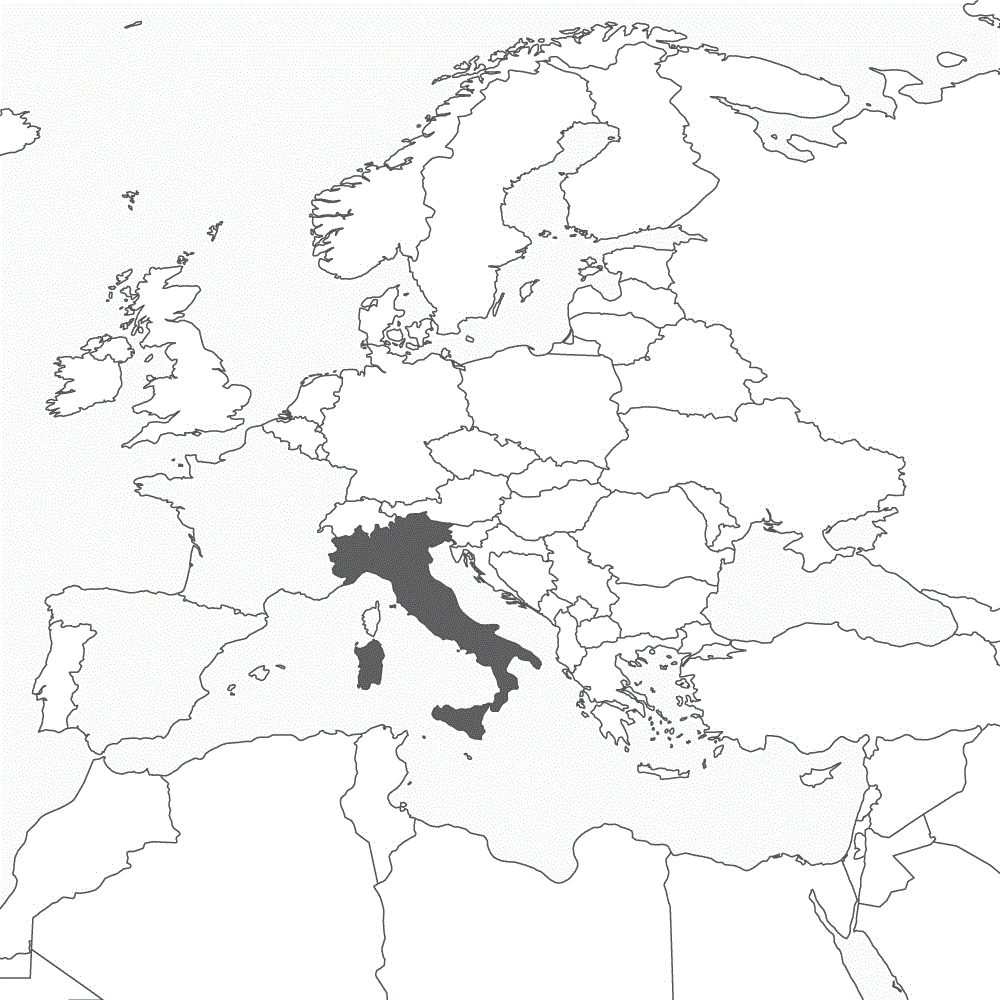
Germany – Italy 0:1
With the successful takeover bid for Commerzbank by Italy’s UniCredit, one of the biggest power struggles in European banking goes Italy’s way. Is German finance on the defensive?
BERLIN/ROME (our own report) – The takeover battle for Commerzbank has been decided. Following its successful bid, Italy’s UniCredit has secured just under half of the voting rights and will now be in a position to take control of the supervisory board and executive board of Germany’s second-largest private-sector bank at the 2027 annual general meeting. Not having sufficient resources of its own, UniCredit was supported in this move by a network of international financial institutions, including Japan’s Nomura, France’s BNP Paribas and several US banks. This not only brings to an end a power struggle lasting almost two years between the major banks from Germany and Italy; the takeover also reflects an ongoing process of consolidation across the European banking sector. Whilst Italy’s UniCredit is positioning itself as a powerful new European banking group, Germany is increasingly on the back foot. Commerzbank is a key lender to the German Mittelstand, the country’s once thriving small and medium-sized enterprises. This cornerstone of the Frankfurt financial hub is now coming under foreign control. The conflict highlights a contradiction between European integration of the financial sector and the interests of nation states. The latter seek to retain some control over the centres of their economic decision-making.
UniCredit secures a majority stake
In early May, UniCredit submitted a takeover bid which expired in early July. As part of its bid, it offered 0.485 of its own shares for every Commerzbank share.[1] After the tender period expired, the Italian bank announced that it had received 17.6 per cent of Commerzbank’s shares as part of the swap deal. This move increased its stake in the Frankfurt-based bank from 26.77 per cent to 44.37 per cent, enabling it to win a takeover battle that had been rumbling along for almost two years.[2] Together with the 3.22 per cent held in derivatives by UniCredit, its total stake amounts to 47.59 per cent. According to UniCredit’s figures, this corresponds to a 49.65 per cent share of voting rights, as the shares still held by Commerzbank do not confer voting rights. In addition, UniCredit holds derivatives on a further 13 per cent of Commerzbank’s shares, although voting rights are not at stake here either. At the next Annual General Meeting in spring 2027, eight of the ten shareholder representatives on the Supervisory Board will stand for re-election. With its majority at the Annual General Meeting, UniCredit can play a decisive role in determining the allocation of these positions.[3]
Criticism of the takeover bid
Allegations of market manipulation have now been raised in connection with the takeover bid. However, Commerzbank’s General Works Council filed a complaint against persons unknown but suffered a defeat in the courts. Commerzbank’s management has also repeatedly challenged UniCredit’s takeover data and brought in Germany’s financial regulator BaFin. According to BaFin, the shares being tendered originate largely from banks and market players already affiliated with UniCredit. Commerzbank’s case has been that there is no transparency as to what extent borrowed shares were tendered and what hedging arrangements were in place.[4] It is known that the Japanese bank Nomura, the US bank Citigroup and the French bank BNP Paribas had agreed with UniCredit swap contracts on Commerzbank shares.[5] In addition to these banks, UniCredit can rely on support from other financial institutions such as Jefferies and Bank of America. The banks aligned with UniCredit enable the Italian bank to access a further 13 per cent of Commerzbank’s shares at a given future date.[6]
Attack on the management
In mid-June, UniCredit threatened to replace Commerzbank’s supervisory board and management board. This would not be straightforward, however, since the Italian bank would have to replace the two supervisory board members who are appointed by the German government. Following the public bailout of Commerzbank in 2009, the German government secured the right to propose two representatives for the supervisory board.[7] UniCredit has now stated that, provided it receives “sufficient support from shareholders” at the next annual general meeting, it would be “in a position … to elect all shareholder representatives to the supervisory board”.[8] So should UniCredit actually replace Commerzbank’s supervisory board and management board at the 2027 annual general meeting, the move would be a snub to the German government, as it would also eliminate the positions of supervisory board members which are nominated by the federal government until 2029.[9]
Commerzbank: a strategic institution
For the Frankfurt’s position as a major financial hub, the whole takeover saga poses a serious problem. Commerzbank is a core institution in the German finance sector and has deep roots in the German Mittelstand. Should it become merely a branch of UniCredit, key lending decisions would, in future, be taken in Milan rather than Frankfurt. As a result, Frankfurt would lose influence, decision-making authority and economic sovereignty.[10] Commerzbank data indicate that the bank handles around 30 per cent of Germany’s foreign trade. Many of the bank’s staff regard this as a key competitive advantage. Commerzbank mediates the international business of numerous small and medium-sized enterprises. Its customers often cannot find a comparable service at other big international banks.[11]
Knee-jerk ownership reaction?
The takeover of Commerzbank has met with widespread resistance in Germany’s political establishment. Yet there is certainly some support on the part of economists – admittedly primarily economists from other EU member states. One of the German academics welcoming a deal is Monika Schnitzer, who chairs the German Council of Economic Experts. She takes the view that there are sound economic reasons for considering cross-border consolidation rather than rejecting such deals out of hand. In her opinion, the European financial market is not sufficiently integrated. What’s more, she argues that German banks are relatively unproductive by international standards, which is why they can fail to compete against major global players. The French president of the ECB, Christine Lagarde, stated as early as 2024 that cross-border bank mergers were “desirable” if they would strengthen European banks in their competition with the major US banks. The Spanish vice-president of the ECB, Luis de Guindos, has also criticised the German government’s negative stance on the issue.[12] Finally, in an opinion piece for the Handelsblatt, even the Vice-President of the German Bundestag, Omid Nouripour (a Green party member), accused the German government of inconsistency. He pointed out that while advocating a banking union at EU summits, Berlin reacts to an actual cross-border bank merger “with the knee-jerk reaction of national ownership”. The German government praised, he said, European integration “as long as it remains abstract”.[13] EU Competition Commissioner Teresa Ribera has also called on Member States to support cross-border bank mergers. “Member States should welcome such transactions in the public interest,” declared Ribera.[14]
Signalling a compromise
The German Government reacted at first very negatively to UniCredit’s successful takeover bid. “In the Federal Government’s view, UniCredit’s aggressive and hostile approach remains unacceptable,” stated the Federal Finance Ministry. It also refused to make its shareholding in Commerzbank available to the Italian bank.[15] Last week, in his speech delivered prior to Parliament’s summer recess, Chancellor Friedrich Merz (CDU) reiterated that the government – unlike “a significant proportion” of the other shareholders – had not accepted UniCredit’s offer and would retain its own shares.[16] In the same speech, however, Merz also struck a different note, assuring his critics that, “We are not standing in the way of this merger.” According to the Handelsblatt, conditions for the takeover are currently being finalised within the federal government. These include the requirement that Commerzbank should remain a key lender to the German Mittelstand. Another condition set by the government is the demand that Frankfurt, as the institution’s previous headquarters, remain at least a significant location for the bank. UniCredit’s German headquarters have been in Munich since it took over HypoVereinsbank in 2005.[17]
[1] Andreas Kröner: Unicredit erhöht Anteil im Übernahmekampf auf über 44 Prozent. handelsblatt.com 08.07.2016.
[2] Dennis Kremer: Unicredits Sieg hat viele Gewinner. faz.net 11.07.2026.
[3] Christian Schubert, Archibald Preuschat: Unicredit hat bei der Commerzbank bald das Sagen. faz.net 08.07.2026.
[4] Ermittler sehen keine Marktmanipulation. handelsblatt.com 10.07.2026.
[5] Hanno Mußler: Wer hat Commerzbank-Aktien an Unicredit verkauft? faz.net 04.06.2026.
[6] Hanno Mußler: Unicredit bekommt 12,5 Prozent aller Commerzbank-Aktien. faz.net 19.06.2026.
[7] Andreas Kröner: Bund lehnt Angebot für Commerzbank ab. handelsblatt.com 16.06.2026.
[8] Andreas Kröner, Hannah Krolle: Unicredit droht mit Austausch von Aufsichtsrat und Vorstand. handelsblatt.com 15.06.2026.
[9] Andreas Kröner: Unicredit erhöht Anteil im Übernahmekampf auf über 44 Prozent. handelsblatt.com 08.07.2016.
[10] Daniel Schleidt: Herzstück des Finanzplatzes. faz.net 08.07.2026.
[11] Andreas Kröner: Drei Punkte prägen den Kampf um die Commerzbank. handelsblatt.com 23.06.2026.
[12] Christian A. Conrad: Die deutsche Regierung sollte die Commerzbank-Übernahme verbieten. faz.net 18.05.2026.
[13] Warum Deutschland die Übernahme der Commerzbank erlauben sollte. handelsblatt.com 01.06.2026.
[14] EU-Kommissarin dringt auf grenzüberschreitende Bankenfusionen. handelsblatt.com 17.06.2026.
[15] Christian Schubert, Archibald Preuschat: Unicredit hat bei der Commerzbank bald das Sagen. faz.net 08.07.2026.
[16] Merz kritisiert Vorgehen der Unicredit bei Commerzbank als aggressiv. handelsblatt.com 15.07.2026.
[17] Jan Hildebrand, Yasmin Osman: Bundesregierung rückt von Blockadehaltung bei Commerzbank ab. handelsblatt.com 17.07.2026.