Orbán’s legacy, Magyar’s course
Following Péter Magyar’s victory in Hungary, EU pushes for swift reforms. Magyar seems willing, but won’t commit to all EU demands. German corporations are monitoring developments.
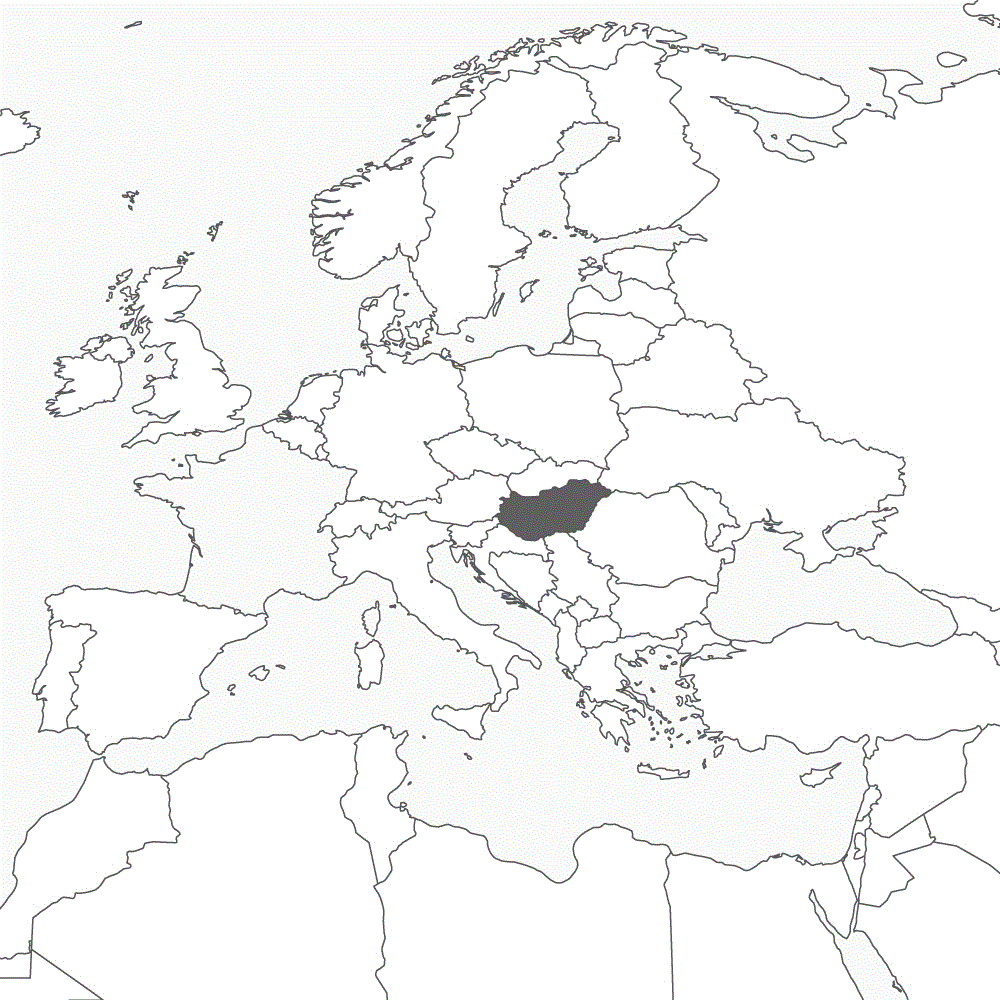
BRUSSELS/BERLIN/BUDAPEST (our own report) – Following the landslide victory of Péter Magyar’s Tisza party in the Hungarian election, initial signs of differences with EU policy and with the interests of German corporations are emerging. Magyar has pledged to anchor his country firmly within the EU and NATO. He also ran on a policy of introducing the euro. He is appointing a cabinet that will include managers from major corporations with transatlantic experience. This signals a departure from outgoing Prime Minister Viktor Orbán’s policy of cooperation with Russia. Yet Magyar is criticising the award of subsidies to large corporations and has said he would diversify the Hungarian economy. This means he may be distancing himself from German companies that have benefited for years from the political and financial support of the Orbán government in return for inward investment. There are just under 6,000 German companies operating in Hungary. They have transformed the country into a core element of Germany’s industrial backyard. In line with previous policy in Budapest, Magyar also rejects the EU Migration and Asylum Pact. Brussels has gone on the offensive: by August, Hungary must fulfil twenty-five reform requirements set by the European Commission in order to release the substantial funding frozen during Orbán’s term of office.
Germany’s industrial backyard
In Hungary, German companies make up the largest group of foreign investors. There are just under six-thousand businesses that have created more than 300,000 jobs and invested around 18 billion euros in the process.[1] German employers account for seven per cent of Hungarian jobs, more than eleven per cent of gross value added, and around one-sixth of investment in the private sector. Outgoing Prime Minister Viktor Orbán was able to leverage low taxes, labour law deregulation and his country’s central location in Europe to build what has effectively been a paradise for German investors.[2] So Hungary has become a central part of Germany’s industrial backyard.
Compliant partner
One particular group of companies has benefited especially from Orbán’s policies – the German automotive giants. Mercedes, for example, is currently doubling production capacity at its plant in Kecskemét, transitioning from 200,000 to 400,000 vehicles per year. In Debrecen, BMW has invested more than two billion euros in a new plant to begin production in Eastern Europe for the first time. Cupra, a VW brand, began production of the Terramar SUV a few months ago at Audi Hungaria in Győr. Audi has expanded the plant and now employs 11,000 people there. According to Eurostat data, labour costs in Germany averaged 43.30 euros per hour in 2024, while in Hungary, by contrast, they were just 14.19 euros. According to Mercedes, production costs in Hungary are as much as 70 per cent lower than in Germany.[3] In contrast to Germany’s politicians, the German carmakers did not protest against Orbán. After all, he created ideal investment conditions for them. There are also German suppliers with a strong presence in Hungary. Bosch, for instance, operates its largest development hub in Europe outside Germany at its Budapest Innovation Campus. With some 17,000 employees, Bosch generated turnover of over five billion euros there in 2024. The Henkel Group, for its part, has been producing industrial adhesives in Környe for fifteen years and supplies some seventy countries from there.[4]
Restrictions on strategic sectors
The Hungarian investor’s paradise does, however, have its limits. Whilst Orbán promoted the export industry, strategically defined sectors have been subject to protection under a restrictive industrial policy since the 2008/09 global economic crisis. This applies in particular to telecommunications, banking, logistics, construction and retail. Foreign companies in these sectors have been complaining about special taxes, regulatory hurdles, price controls, state intervention and delays in approvals.[5] In recent years, Hungary has recorded the highest inflation within the EU. Food prices have at times seen hikes of up to 45 per cent. Orbán’s government has actively intervened with price controls that affect retail chains like Spar from Austria and Tesco from the UK along with the big German discounters like Lidl (the market leader in Hungary), Aldi and Penny. Price caps apply to more than forty staple food items, and, since May 2025, also to thirty drugstore products, affecting the German retail chains dm and Rossmann. Even stronger interventionist measures are being applied in other sectors. German and other foreign companies must pay additional levies on the extraction and supply of building materials such as sand, gravel and cement.[6]
Competition from the oligarchs
Another problem concerns the losses arising from Orbán’s power struggle with the European Commission. Brussels has frozen funding amounting to tens of billions of euros since 2022. For instance, a representative of the German steel company ThyssenKrupp Materials in Budapest complains that his industry is suffering because government funding is no longer flowing. Orders for his company have plummeted, and business is going “really badly”. He says, “We hope that relations with the EU will improve again after the election”.[7] An analysis by the Financial Times estimates that 14 per cent of all government contracts since Orbán took office in 2010 have gone to companies owned by thirteen people in his inner circle. On average, these companies received contracts worth three times as much annually as in the five years prior to his taking office. They include companies from the banking, logistics and construction sectors. Orbán’s successor, Péter Magyar, is now promising a fresh start, even announcing his “struggle against 3,000 oligarchs”.
Western corporate executives as ministers
Immediately after his landslide victory in the 12 April election, Péter Magyar declared war on Fidesz and its inner circle. He called on the country’s President, Tamás Sulyok, to resign. Should Sulyok not step down voluntarily, he would, he said, expedite the president’s removal through a constitutional amendment – a move not really typical for liberal democracies.[8] Magyar brings with him a new cabinet that includes several managers from major foreign corporations. András Kárman, for instance, who became Magyar’s economic adviser back in the autumn, was previously in charge of the mortgage sector at Austria’s Erste Bank. Prior to that, he had served on the Board of Directors of the European Bank for Reconstruction and Development (EBRD) for three years. Kárman had initially worked in Orbán’s first government, but soon left because he disagreed with the Prime Minister’s confrontational stance towards the IMF. István Kapitány, 64, who is set to head the Ministry of Energy, spent his entire career at the British oil company Shell.[9] The designated Foreign Minister is Anita Orbán. She initially worked at the Foreign Ministry during the tenure of the Fidesz leader (who is not related to her). After leaving in 2015, she spent several years working for the US LNG companies Cheniere and Tellurian before moving to Vodafone as a lobbyist in 2021. This senior executive and energy expert formerly belonged to the transatlantic wing of Fidesz. She served as Hungary’s ‘Ambassador-at-Large for Energy Security’ from 2010 to 2015, but stepped down after the Prime Minister struck a major deal with Russia in 2017.[10]
Back on track with the EU?
Magyar’s Tisza party announced in its election manifesto that Hungary would now be firmly integrated in the EU and NATO and soon introduce the euro. Dependence on Russian energy sources was to be phased out by 2035, and the share of renewable energies doubled by 2040. Although the party is determined to meet growing energy demand by continuing the construction of a second nuclear power plant at Paks, it said there would be a “comprehensive review” of the Paks 2 plant with its Russia-supplied reactors.[11] Magyar has claimed that some German companies in Hungary had been “persecuted” by the outgoing government. He says he wants “to offer equal conditions for all.” It was important, he insists, for “Hungary to become predictable again.”[12] The introduction of the euro can be regarded more as a long-term goal. Péter Virovácz, an economist at the Dutch bank ING, believes it is out of the question within a single parliamentary term – given Hungary’s economic situation. The country is currently far from meeting the Maastricht criteria; these include persistently low inflation, a stable exchange rate, a budget deficit below three per cent of GDP and public debt of no more than 60 per cent of GDP. Experts estimate it will take at least five to ten years before the euro is introduced.[13] So Magyar is economically more closely aligned with the EU. Tensions are, however, emerging due to his rejection of the EU Migration and Asylum Pact.
Magyar under pressure
Shortly after Magyar’s election victory, European Commission President Ursula von der Leyen sent her chief of staff and several directors-general to Budapest for political talks. They brought with them a list of reform demands, draft legislation and other EU proposals. Their leverage is the EU funding that was frozen as part of Brussel’s stand-off with Orbán. Von der Leyen insists that Magyar’s new government submit a revised plan for the use of recovery funds by the end of May. And a list of twenty-five reform requirements must be met by the end of August, seventeen of which concern effective anti-corruption measures, disclosure obligations for government representatives and greater competition for public tenders.[14] The release of the EU funds would, as mentioned above, particularly benefit German corporations like ThyssenKrupp Materials.
Reviewing the investment climate
It is, however, also conceivable that Magyar will take steps that run counter to German corporate interests. For instance, the Prime Minister-designate has repeatedly criticised Orbán’s heavy subsidisation of large production plants. He argues that these grants have been inefficient. Small and medium-sized Hungarian enterprises have not benefitted from the location of large corporations. Magyar’s has criticised the resulting vulnerability: “Due to the dominance of the automotive and battery industries, the economy is not sufficiently diversified and is extremely exposed to external shocks and economic cycles.”[15]
More on this topic: Ungarn: EU vs MAGA.
[1] Michael Seiser: Ungarn spaltet die Investoren. Frankfurter Allgemeine Zeitung 28.03.2026.
[2] Anna Westkämper: Orbans Politik spaltet die deutsche Wirtschaft. handelsblatt.com 07.04.2026.
[3] Michael Scheppe, Felix Stippler, Roman Tyborski: Premiumhersteller verlagern Produktion nach Osteuropa. handelsblatt.com 17.03.2026.
[4] Anna Westkämper: Orbans Politik spaltet die deutsche Wirtschaft. handelsblatt.com 07.04.2026.
[5] Michael Seiser: Ungarn spaltet die Investoren. Frankfurter Allgemeine Zeitung 28.03.2026.
[6] Anna Westkämper: Orbans Politik spaltet die deutsche Wirtschaft. handelsblatt.com 07.04.2026.
[7] Carsten Volkery: Das System Orbán wankt. handelsblatt.com 29.03.2026.
[8] Magyar fordert Präsidenten zum Rücktritt auf. tagesschau.de 15.04.2026.
[9] Carsten Volkery: Ein Kabinett voller Topmanager – das sind Magyars künftige Minister. handelsblatt.com 13.04.2026.
[10] Manuela Honsig-Erlenburg: Orbán übernimmt das Außenministerium. derstandard.de 13.04.2026.
[11] Hungary's opposition Tisza promises wealth tax, euro adoption in election programme. reuters.com 07.02.2026.
[12] Carsten Volkery: Wie Wahlsieger Peter Magyar sein Land umkrempeln will. handelsblatt.com 13.04.2026.
[13] Stefan Reccius: Bekommt Ungarn unter Magyar jetzt den Euro? handelsblatt.com 13.04.2026.
[14] Thomas Gutschker: Wie Brüssel Péter Magyar unter die Arme greift. faz.net 17.04.2026.
[15] Carsten Volkery, Anna Westkämper: Was deutsche Unternehmen von Orbans Nachfolger erwarten können. handelsblatt.com 14.04.2026.