German dominance
Massive German rearmament triggers warnings in several European countries: Is Germany becoming a ‘military superpower’ that will openly dominate the continent?
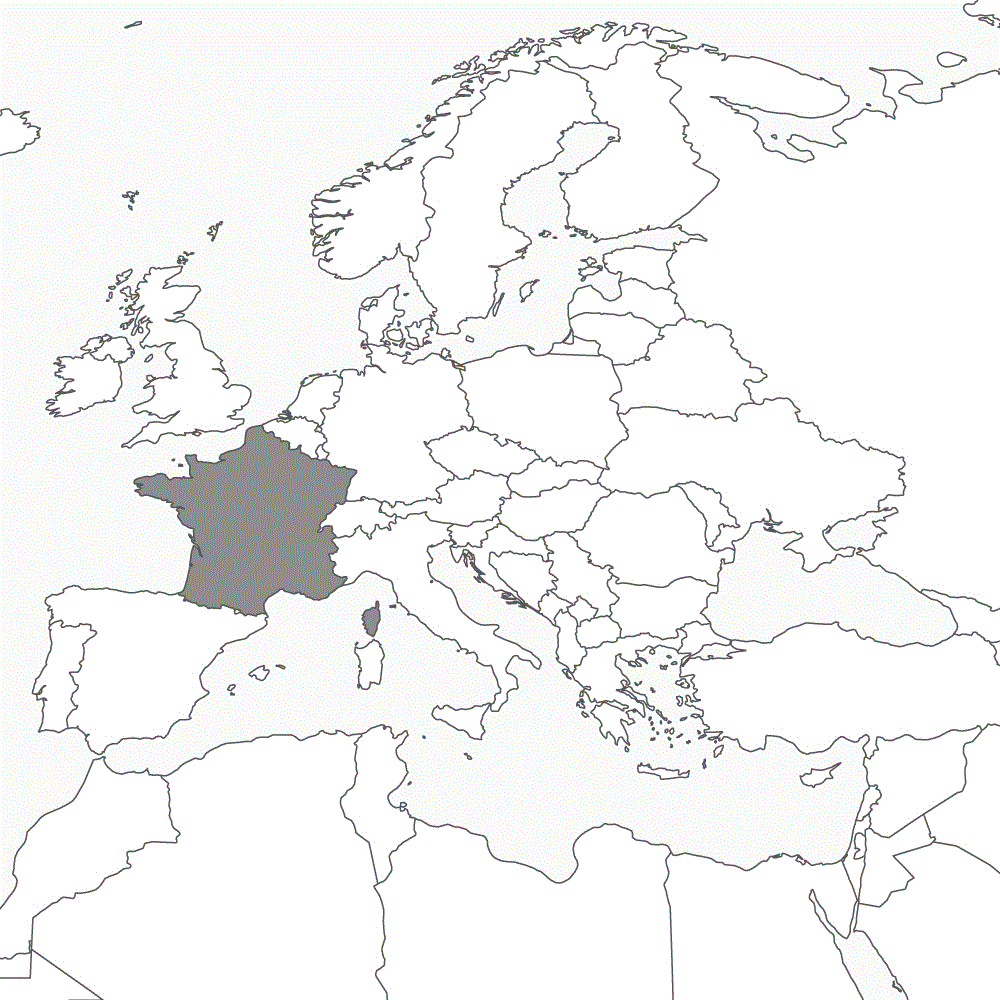
BERLIN/PARIS/WARSAW (own report) – German Foreign Minister Johann Wadephul says France should pursue austerity, including more welfare cuts, in order to shift significant resources into rearmament. “Unfortunately,” Wadephul says, the French government’s “efforts” to reallocate money to the military budget have been “insufficient”: Paris is “called upon” to change course. The background to this incidence of open interference in France’s domestic affairs is a growing unease registered in several European countries over Germany’s huge military build-up, brazenly intended to turn the Federal Republic into a “military superpower” in just a few years, as a recent article in the US journal Foreign Affairs notes. Warnings could be heard from Paris back in the autumn: if Germany succeeded in becoming a military power, it would be “extremely dominant” within the European Union. And Wolfgang Ischinger, the head of the Munich Security Conference, confirmed only recently that he sensed, in conversations in France and Poland, that “old reservations are resurfacing” as policy circles express “concerns about German dominance”. EU diplomats are already diagnosing a “tectonic shift” on the continent. In France, the first public warnings about a “German Europe” are being voiced.
Germany’s debt facility for rearmament
Berlin’s decision to push ahead with a national rearmament programme costing hundreds of billions of euros was already causing concern last year in other EU countries. To enable the procurement of unprecedented quantities of weaponry and equipment for an expanding Bundeswehr the German government has set a fiscal course of massive new borrowing. Previously committed to maintaining a “debt brake”, Berlin then performed a policy reversal and launched a major credit arrangement to finance military expenditure. For its part, the European Commission has exempted military expenditure from the Maastricht fiscal criteria. Berlin wants to increase the German military budget to a target of over 150 billion euros by 2029. Germany’s relative scope for government borrowing derives from the fact that public debt currently amounts to just over 62 per cent of gross domestic product (GDP). The level of debt in France, by contrast, now stands at 116 per cent of GDP. So Paris can hardly afford to increase its borrowing for the military. Last year, the French government announced plans to increase the military budget to 67.4 billion euros by 2030. Anything above that level is considered unaffordable.[1] This spells the end of France’s previous practice of compensating for Germany’s economic superiority by having an advantage in terms of military potential and armaments. This advantage is disappearing as German leader Friedrich Merz pushes ahead with his aim of making the Bundeswehr “the strongest conventional army in Europe”, an intention that has every chance of being realised.[2]
‘A tectonic shift’
Back in the autumn, various media were already highlighting foreign concerns triggered by Germany’s rapid military build-up, and not only in France. Germany, clearly the economic powerhouse of the EU, was now, according to reports, on the verge of also becoming dominant in terms of military might. In this field, it was said, Berlin had previously been held in check by Paris. An unnamed EU diplomat was quoted as saying that fast-tracked German militarisation amounted to a “tectonic shift”: “It’s the most important thing happening right now at EU level.”[3] Some in Brussels were already wondering how “European” a heavily armed Germany would still be. A French defence official warned that it would be “very difficult” to work with Germany in the future “because they will be extremely dominant”. Germany’s economic strength has already been seen in part as a threat. The official went on to quip with reference to German annexations in the 1930s that, “They wouldn’t need to invade Alsace; they could just buy it”. But today we see a new combination of both industrial and military strength coming into play. Concerns have also been voiced in Poland. Deputy Defence Minister Paweł Zalewski, for example, said, “Looking at history, a situation where Germany would link its economic power with military might has always raised fears.”[4] Although it is Poland that currently commands the largest land force in Europe.
Military superpower
A few weeks ago the influential US journal Foreign Affairs examined the consequences of Germany’s military build-up. According to Liana Fix, Senior Fellow at the Council on Foreign Relations, if Germany continues on its current path of militarisation it could become a “military superpower” by 2030 at the latest: “left unchecked, German military dominance might eventually foster divisions within the continent.”[5] France, for example, feels “uneasy about the fact that its neighbour is becoming a major military power – as are many people in Poland.” In the worst case, the militarisation of the Federal Republic could lead to new rivalries. “France, Poland and other states could attempt to counterbalance Germany,” warns Fix. France, in particular, “may seek to reassert itself as the continent’s leading military power.” While Paris could join forces with London, it is conceivable that Poland could form closer alliances with the Baltic or Nordic states in the future. All of this, Fix notes, might exacerbate rivalries with Germany and leave “Europe divided and vulnerable”. The possibility of the far-right AfD entering government in the future is deepening fears among Germany’s neighbours.
‘Old reservations’
Shortly before the Munich Security Conference, veteran German diplomat and head of the event in 2026, Wolfgang Ischinger, echoed the warnings.[6] “The huge financial windfall in the defence sector” meant, said Ischinger, that “Germany will spend more than twice as much on its military as France in the coming years.” In conversations Ischinger has had in France and Poland he had sensed “that old reservations are sometimes resurfacing.” He referred to “the concern about German dominance”. Ischinger strongly advised Germany to proceed “with tact and sensitivity”. In view of the size of funding being invested in the Bundeswehr, Ischinger suggests that, “a small portion of this money goes to Poland”, in part to tackle “the unresolved issue of reparations from the Polish perspective”, but also for security reasons: he states bluntly that “Poland is a frontline state” and Poland’s current “defence capabilities also protect us”. So, runs his argument, “How about Germany – in recognition of Poland’s role as a frontline state – donating a submarine, a frigate or a few battle tanks to Warsaw?” Ischinger’s proposal is guided by a desire to closely integrate neighbouring states into German hegemony over the European continent by granting them a certain degree of participation.
‘A German Europe’
It may already be too late for that to succeed. In France, voices have been raised in recent days, especially in conservative and right-wing circles, warning of a new German dominance. “Germany is rearming in the German way, which means massively,” wrote the conservative daily Le Figaro at the beginning of the week.[7] “Berlin’s industrial and financial go-it-alone and the danger that the AfD ... will come to power,” ran the commentary, “are casting a shadow over the pro-European commitments of the current heads of government.” Yesterday, Wednesday, the national-conservative politician Philippe de Villiers cautioned against a “German Europe” on the website of the Journal du Dimanche.[8] The Journal du Dimanche has been owned since 2021 by Vincent Bolloré, a billionaire who has been supporting France’s extreme right for years and has steered the Journal du Dimanche to the right. Opinion polls show that public objections to German dominance are forming mainly on the right. And the right have good chances of winning the 2027 presidential election.
Cuts in social spending
Responding to the growing concerns and mounting discontent over Germany’s impending dominance in Europe, German Foreign Minister Johann Wadephul spoke out on Monday, calling for France to keep up. Addressing French proposals to finance broad rearmament across the EU through Eurobonds, Wadephul said, “That would be something completely novel”, something Germany would “not be prepared” to support.[9] In other words, Berlin is ready to engage in deep national borrowing for its own rearmament, but will not accept new debt for an arms build-up at EU level. The latter course would enable other EU states to militarise at levels that could match Germany. Berlin prioritises Germany’s advancement as the leading military power. What is more, while Wadephul is openly criticising France, he is fully aware of its precarious financial situation: “Unfortunately, efforts in the French Republic” to seriously upgrade its military “have so far been insufficient,” he complains. Paris is, he says, “called upon ... to make one or two cuts in the social sector” and “make savings in other areas so as to create the latitude needed for the core goal of Europe’s defence capability.” His message: “There is still room for improvement.”
[1] De 32 milliards en 2017 à plus de 67 prévus en 2030… Comment le budget de la défense française a évolué ces dernières années. Franceinfo.fr 13.07.2025.
[2] See: Military Republic of Germany.
[3], [4] Chris Lunday, Jacopo Barigazzi, Laura Kayali, Paul McLeary, Jan Cienski: Germany’s rearmament upends Europe’s power balance. politico.eu 12.11.2025.
[5] Liana Fix: Europe’s Next Hegemon. foreignaffairs.com 06.02.2026.
[6] Thorsten Jungholt, Jacques Schuster: „Wie wäre es, wenn Deutschland Warschau U-Boot, Fregatte oder Kampfpanzer schenkt?“ welt.de 08.02.2026.
[7] L’éditorial de Philippe Gélie : « Faut-il s’inquiéter du réarmement de l’Allemagne ? » lefigaro.fr 16.02.2026.
[8] Philippe de Villiers: « L’Europe allemande ». lejdd.fr 18.02.2026.
[9] „Erst einmal Hausaufgaben machen“ – Wadephul attackiert Frankreich für „unzureichende Anstrengungen“. welt.de 17.02.2026.