‘Down with weapons, up with wages!’
Interview with Cinzia Della Porta about the day of action against militarisation and war in more than 20 ports around the Mediterranean – from Morocco to Italy to Turkey.
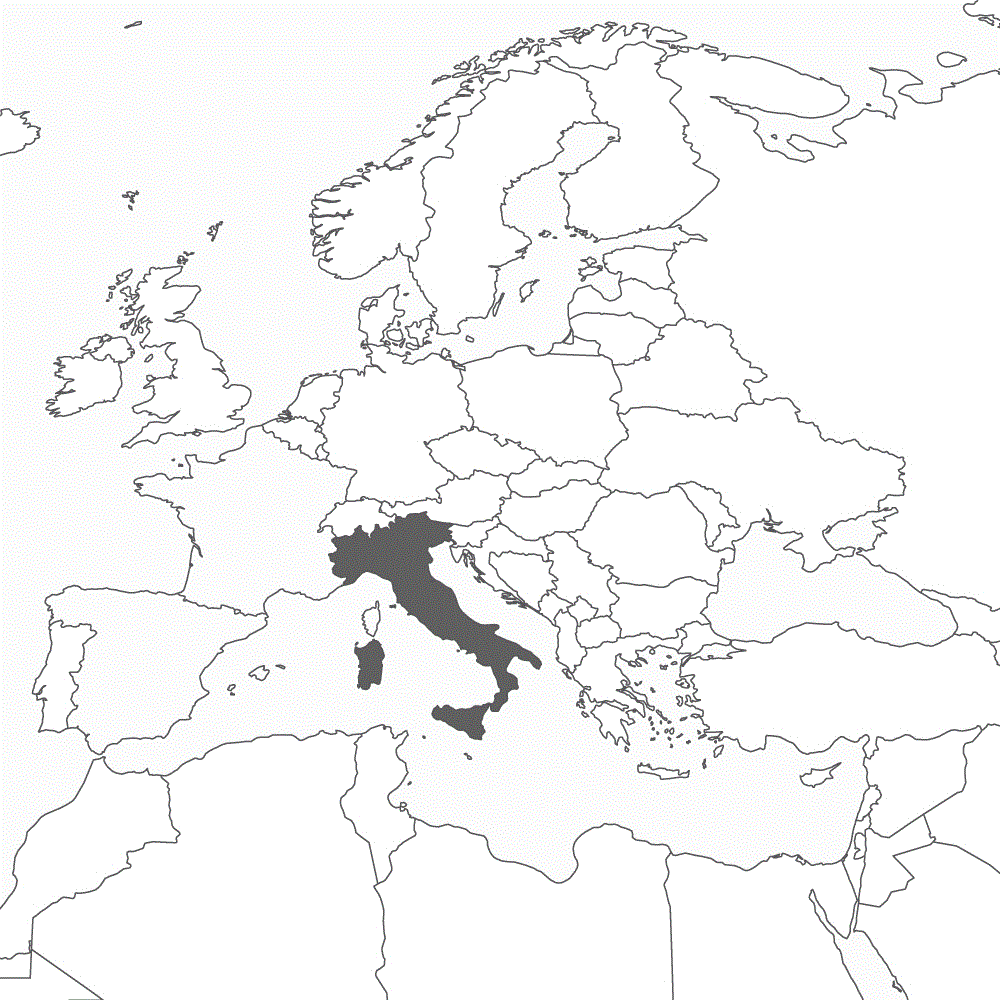
ROME (own report) – A day of action by workers in more than twenty major ports around the Mediterranean was called this Friday. They are protesting against the EU’s militarisation policies and against the use of ports for arms supplies fuelling the war in Ukraine and in Israel. The campaign focuses on resisting “the transformation of the Mediterranean into a hub for the war economy,” explains Cinzia Della Porta in an interview with german-foreign-policy.com. Della Porta is a member of the executive committee of the Italian trade union Unione Sindacale di Base (USB), which is involved in organising the day of action. The USB wants Mediterranean ports to be made “places of peace”. As Della Porta points out, workers are always among the first to pay ‘the price of war’. They suffer wage cuts and restrictions on trade union rights, which are “direct consequences of the war economy”. Dockworkers in particular have to load weapons and are forced into being involuntary accomplices in wars they reject. Della Porta advocates combining “resistance to war with social struggles for wages, public services and workers’ rights”.
Friday’s protests were organised by the USB together with the trade unions Enedep from Greece, Liman-İş from Turkey and ODT from Morocco, among others. Strikes and other actions are planned from Tangier to Genoa, Palermo and Trieste to Piraeus, Antalya and Mersin, as well as on the Atlantic coast, for example in Bilbao. The protests are specifically directed against the use of ports for arms deliveries, and against the wage and pension cuts being forced through to help pay for wars. But the actions are also directed against the EU’s plans for a massive arms programme, including the militarisation of ports and other strategic infrastructure in Europe. The USB notes that rallies are also planned in Hamburg and Bremen. german-foreign-policy.com spoke with Cinzia Della Porta.
german-foreign-policy.com: On Friday, a joint day of action will take place in more than twenty Mediterranean ports. What exactly is it about?
Cinzia Della Porta:Our coordinated action schedule for Friday is intended to oppose the growing militarisation of ports and logistics, the use of civilian infrastructures for war purposes. We object to the Mediterranean being transformed into a hub for the war economy. Our message is clear: ports must not be used to load, unload or transport weapons destined for wars, massacres and occupations.
Workers from a number of Mediterranean countries are taking part. There will be a show of strength in Italy, Spain, France, Greece, and at other ports in Southern Europe and North Africa. This mobilisation reflects a shared awareness among dock workers and logistics workers that war is not an abstract issue of geopolitics, but something that impacts directly on their workplaces. The strike is part of a broader international mobilisation against war and the war economy.
german-foreign-policy.com:Italy and other Mediterranean countries have a history of protesting against weapon supplies, don’t they?
Cinzia Della Porta: Yes, there have been a number of concrete actions. In Italy, dock workers and airport workers refused to load or handle military cargo, including weapons and explosives. In some cases, workers have blocked port operations or suspended their labour when military shipments were identified.
Specifically, Italian port and airport workers collectively refused to load arms shipments destined for Israel or Ukraine. This forced the companies and authorities involved to reroute or delay transportation. Similar actions have taken place in other Mediterranean ports, where workers used strikes, spontaneous stoppages and public campaigns to expose and denounce the military nature of these shipments.
For those in Germany and elsewhere who have not heard the news from the mainstream media, here is what we have already done in Italy:
One case concerned the “Ships of Death” operated by the ZIM and Bahri cargo shipping companies. In Genoa, USB workers have been able to monitor the cargoes thanks to “worker intelligence”, cross-referencing data on routes and cargoes. ZIM is one of the main shippers of weapons and military equipment to Israel. When a vessel from ZIM came into port, the dockworkers went on strike and picketed the gates.
Then there was the case of Pisa airport. This time it was about weapons destined for Ukraine. USB workers denounced the role of the airport and refused to do their usual operations. They exposed the fact that an aircraft at the civil airport was being loaded with crates of weapons and ammunition disguised as “humanitarian aid”. The workers identified thee containers and documented their cargo of weapons instead of food or medicine.
Finally, there have been cases of administrative sabotage. This involves the refusal to provide technical services, such as tugboats and mooring crews, in order to force ships loaded with armaments to remain in the harbour for days, causing huge economic losses to the companies and sending a political signal to governments.
These actions were not just symbolic. They directly have interfered with the logistics of war and made visible what governments try to hide.
german-foreign-policy.com:Why should workers in particular stand up against militarisation and war?
Cinzia Della Porta: Workers are the first to pay the price of war. Militarisation inevitably means cuts to wages, welfare, healthcare, education and public services because enormous resources are diverted to weapons and military spending. Inflation, job insecurity and the deterioration of working conditions are direct consequences of the war economy.
What’s more, workers are often forced to become unwilling accomplices of war through their labour. Opposing militarisation is therefore both a material and an ethical imperative. Workers have a unique power: by stopping production and logistics they can disrupt the war machine at its roots.
War is not an isolated event but the only way the capitalist system in a serious crisis can continue. Look at wealth extraction. The Italian government is increasing military spending to 2% of GDP. That comes to over 100 million euros per day. And that money is being taken directly from collectively agreed wages and conditions, from the national health system and from education. Militarisation is, in fact, an economic class manoeuvre against the poor.
Then, there is authoritarianism and repression. The war economy requires “discipline”. This translates into tougher anti-strike laws as well as precariousness and repression of trade union dissent. As a class oriented trade union, we are now linking the struggles for workers’ rights to the struggles against war. Our slogan, which we adopted back in February 2022, is: “Down with weapons, up with wages!”
german-foreign-policy.com: The USB has also been involved in the protests against genocide in Gaza.
Cinzia Della Porta:Support for Palestine has always been in our DNA. We have engaged in initiatives and strikes in support of Palestine since the beginning of the genocide. And we have played an active part in all the national demonstrations that have taken place in Italy. Our workers have been active in blocking ships in ports, but also in refusing to participate in research projects with Israel in universities and public research institutions. What happened with the USB strikes on 22 September and 3 October last year was incredible. Hundreds of thousands of people joined the strikes and filled the streets and squares in around one hundred Italian cities. We declared that we would “block everything”, and we did! The strikes and demonstrations were called to stop the genocide and to stop the complicity of the Italian government in Israel’s crimes. The strike on 28 November combined support for Palestine and the demand for an end to the genocide with the struggle against the war economy and against the internal war against workers and the population.
We consider the strike a political success. It broke the silence about the complicity of institutions, and clearly linked the Palestinian struggle to opposition to the war economy and to Italy’s role in supplying weapons. It showed that a part of the working class refuses to accept genocide, occupation and war as “normal”.
german-foreign-policy.com: You are confronted by growing repression. We heard, for instance, that several fire fighters were punished for taking part in the protests.
Cinzia Della Porta: Yes, a number of firefighters who publicly expressed solidarity with the Palestinian people or took part in protests have faced disciplinary measures, investigations and sanctions. In some cases, they were accused of impairing the “neutrality” of public institutions – simply for expressing political opinions in the face of genocide and war.
This kind of repression is designed to intimidate workers and silence dissent. It is part of a broader authoritarian trend in which those who oppose war and militarisation are treated as a problem rather than those who support or enable war crimes.
german-foreign-policy.com: How will the USB be continuing the struggle against militarisation and war after Friday’s day of action?
Cinzia Della Porta: Friday’s strike is not an isolated event. We will continue our struggle as class oriented trade union that links opposition to war to social struggles over wages, public services and workers’ rights.
We will continue to build networks for international coordination among workers, especially in strategic sectors like ports, logistics, transport and public services. The USB will keep fighting against the war economy, against arms shipments, against Italy’s involvement in NATO wars, in solidarity with the Palestinian people. And we will continue to oppose the genocide in Gaza and the sending of weapons to Ukraine. Our struggle against war is inseparable from the struggle for social justice and workers’ dignity. We will continue to fight in Italy and at an international level within the World Federation of Trade Unions (WFTU).
We are well aware that the situation is difficult. And we know that the Italian government has opted for repression. The government has proposed a new Security Decree that aims to reduce the scope for protest and to criminalise dissent.
We have a situation in which worsening economic conditions and growing international instability are creating a sense of insecurity that is spreading across ever-wider sections of the population. The government is responding with more and more repression. This makes it all the more imperative that we continue our struggle.