The new era of nuclear weapons
Germany and France launch their first military exercises for cooperation on potential French nuclear weapons deployment. But ‘German bomb’ discussions also continue in Berlin.
PARIS/BERLIN (our own report) – Germany and France have conducted their first concrete exercises to trial cooperation on potential French nuclear weapons deployments. On Friday the Franco-German Defence and Security Council held a meeting at Nörvenich Air Base, south-west of Cologne. The occasion was used for joint exercises in which two Mirage fighter jets from France’s nuclear forces and two German Eurofighters performed coordinated flight operations, including aerial refuelling. The deployment of German military personnel as observers on a French nuclear manoeuvre is planned for this autumn. The underlying military doctrine, called by the French ‘forward deterrence’ (‘dissuasion avancée’), was introduced by President Emmanuel Macron and publicly unveiled on 2 March. It provides for the sharing of procedures and practices with other European states, including Germany. However, participating European states are excluded from taking part in decision-making regarding the actual use of nuclear weapons, or in the planning of any nuclear strike operations. Here, Paris retains sole command, which is why Berlin had long declined to participate. Domestically, discussions are still ongoing in Germany about an exclusively ‘German bomb’.
‘Forward deterrence’
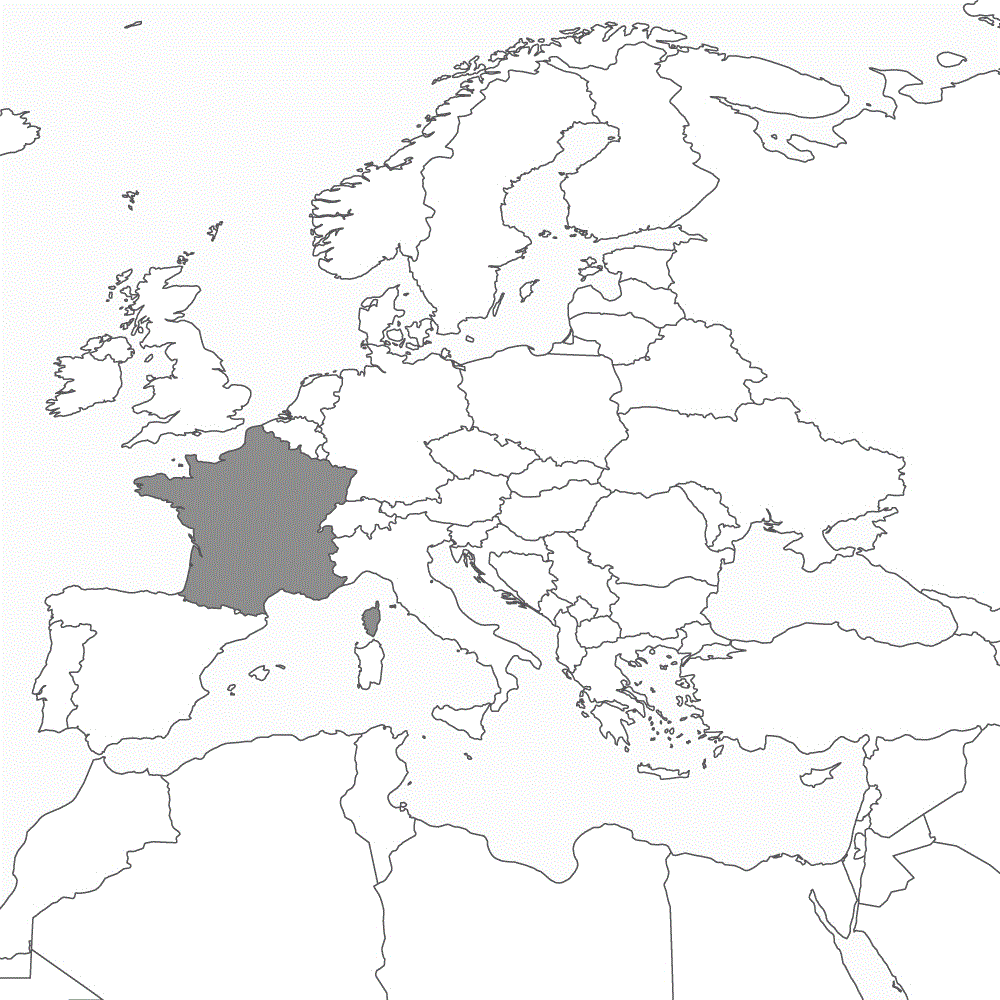
French President Emmanuel Macron presented the new concept of ‘forward deterrence’ (‘dissuasion avancée’) on 2 March in a keynote speech on French nuclear weapons at the Île Longue naval base in Brittany. That is where the nuclear submarines of the French nuclear deterrent force (‘Force de dissuasion nucléaire française’) are based. In his speech Macron spoke of the dawn of a new “era of nuclear weapons”, Macron announced a number of changes to the composition and doctrine of the French nuclear forces. France will now increase the number of nuclear warheads at its disposal – previously said to be 290. The exact number to be held in a future arsenal has not, however, been specified. This lack of explicit numbers, along with the way France’s “red lines are not entirely clear”, is intended to create uncertainty among potential adversaries.[1] The underlying strategic thinking is that such uncertainty enhances the deterrent effect. Deterrence is also supposed to be strengthened by changing descriptions: the French military describes the damage caused by a French nuclear strike not merely as “unacceptable” but as so massive that the adversary nation, however large it may be, would never “recover”.[2]
The European component
There are various European components to this new nuclear strategy. Firstly, nuclear-capable Rafale fighter jets from the airborne half of French nuclear forces are to be deployed to bases in other European countries – albeit only temporarily or rotationally, not as a permanent arrangement like Europe’s ‘nuclear sharing’ of American warheads. This temporary redeployment is supposed to “complicate our adversaries’ calculations”, explains Macron.[3] What’s more, plans are afoot to involve the nuclear cooperation partners in joint strategic discussions. This involvement does not, however, extend to partner states being granted a say in the use of nuclear weapons or in the planning of their use. And France will continue to have exclusive powers when it comes to defining the “vital interests” for the protection of which the nuclear forces are supposedly needed. This means, in terms of protection for the European partners, there would be no nuclear “guarantee in the strict sense”. On the other hand, an attack on them would automatically affect France’s vital interests simply by virtue of the close interdependence of European countries. So the French argue that their vital interests, and thus their “red lines”, are structurally bound up closely to those of the other European states.
Options for active participation
On 2 March, Macron outlined various options for active participation by European partners in his ‘forward deterrence’ strategy. Firstly, he would like to see shared support in the form of satellite and radar reconnaissance. The aim would be to detect incoming enemy missiles.[4] Secondly, Paris wants to see “enhanced air defence and protective measures” against incoming “missiles and drones”. Thirdly, the strategy requires the development of “capabilities for deep strikes” far inside enemy territory. By focusing this Europeanisation of defence on France’s nuclear forces, Paris is also securing a strong position in the context of the continent’s ongoing arms race. According to Macron, France’s ‘nuclear umbrella’ is by no means intended to replace ‘nuclear sharing’ within the American-led NATO framework. It is being pitched merely as a complement. In this venture, Germany is described as a “key partner”. Other countries agreed to join Paris back in early March: Belgium, the Netherlands, Greece, Poland, Denmark and Sweden. In May, Norway then came in – a move regarded as highly significant, given that Norway is considered to be particularly strongly aligned with the US.[5] Estonia is also considering participation in ‘forward deterrence’,[6] while other states may follow suit.
Nuclear Steering Group
French President Macron and German Chancellor Friedrich Merz signed a memorandum of understanding on 2 March, announcing the establishment of a Franco-German nuclear steering group. The MoU was said to provide a “framework for defence policy dialogue and the coordination of strategic measures.” More specifically, the aim was defined as identifying the “right mix of conventional capabilities, missile defence and French nuclear capabilities” for “nuclear deterrence”.[7] That was when there was some initial talk of “conventional German participation in French nuclear exercises” to take place before the end of this year. The two sides also planned “joint visits to strategic facilities”.
First joint exercises
The Franco-German Defence and Security Council came together last Friday at Nörvenich Air Base, south-west of Cologne. It was the backdrop for the first practical steps. The day before, two Mirage fighter jets from the French nuclear forces, together with two Eurofighters from the German Luftwaffe completed their first joint exercises. The German warplanes were refuelled by a French MRTT Phenix tanker aircraft. They subsequently landed at Nörvenich Air Base [8] and then parked in the hangar where the Franco-German Defence and Security Council met on Friday. Media photos show Merz, Macron and the foreign and defence ministers of both countries in session in front of the fighter jets. This autumn, German soldiers are to be invited for the first time to the underground command centre in Taverny near Paris to take part as manoeuvre observers of the French nuclear forces exercise, known as ‘Poker’. Poker is held four times a year and simulates air-launched nuclear strikes.[9] Last year, British officers were invited to one of those exercises for the first time.
The German bomb
France has previously offered Germany integration into its ‘nuclear deterrence’ on several occasions. Macron voiced this prospect most recently in 2020.[10] Until now, Berlin had consistently rejected the offer, because Paris reserves the right to decide alone on the actual use of nuclear weapons. On Friday, Macron placed considerable emphasis on the fact that France continues to finance its expensive nuclear forces entirely on its own. The significance of this point is that a move to co-financing could justify a German demand to have a say in nuclear decision-making – something Paris categorically rejects. As for Berlin, there has been an ongoing debate for some time over the possibility of Germany acquiring its own nuclear weapons. A discussion is scheduled, for example, on 24 June on this topic at the CDU-aligned Konrad Adenauer Foundation. Featured as part an event series on ‘Past and Future of Warfare’, politicians and academics will consider ‘The return of the nuclear question – does Germany need the atomic bomb?’[11] This “old question”, it is explained, has arisen “once again”.
[1] Discours du Président sur la dissuasion nucléaire. uk.diplomatie.gouv.fr 04.03.2026.
[2] Chloé Hoorman : La dissuasion nucléaire française fait un grand pas vers l’Europe. lemonde.fr 03.03.2026.
[3], [4] Discours du Président sur la dissuasion nucléaire. uk.diplomatie.gouv.fr 04.03.2026.
[5] La Norvège rejoint l‘initiative française sur la dissuasion nucléaire, l’autonomie européenne s’organise. radiofrance.fr 29.05.2026.
[6] Fabrice Wolf: L’Estonie se dit prête à discuter de l’extension du parapluie nucléaire français. meta-defense.fr 10.03.2026.
[7] Joint declaration of President Macron and Chancellor Merz. bundesregierung.de 02.03.2026.
[8] Starkes Duo für Europa: Deutsch-Französischer Verteidigungs- und Sicherheitsrat. bmvg.de 17.07.2026.
[9] Michaela Wiegel, Matthias Wyssuwa: Gemeinsam abschrecken. Frankfurter Allgemeine Zeitung 18.07.2026.
[10] See: Ein Nuklearschild für die EU.
[11] Konrad-Adenauer-Stiftung: Gegenwart und Zukunft der Kriegsführung. Politisches Bildungsforum Sachsen.