Carbon giants in court
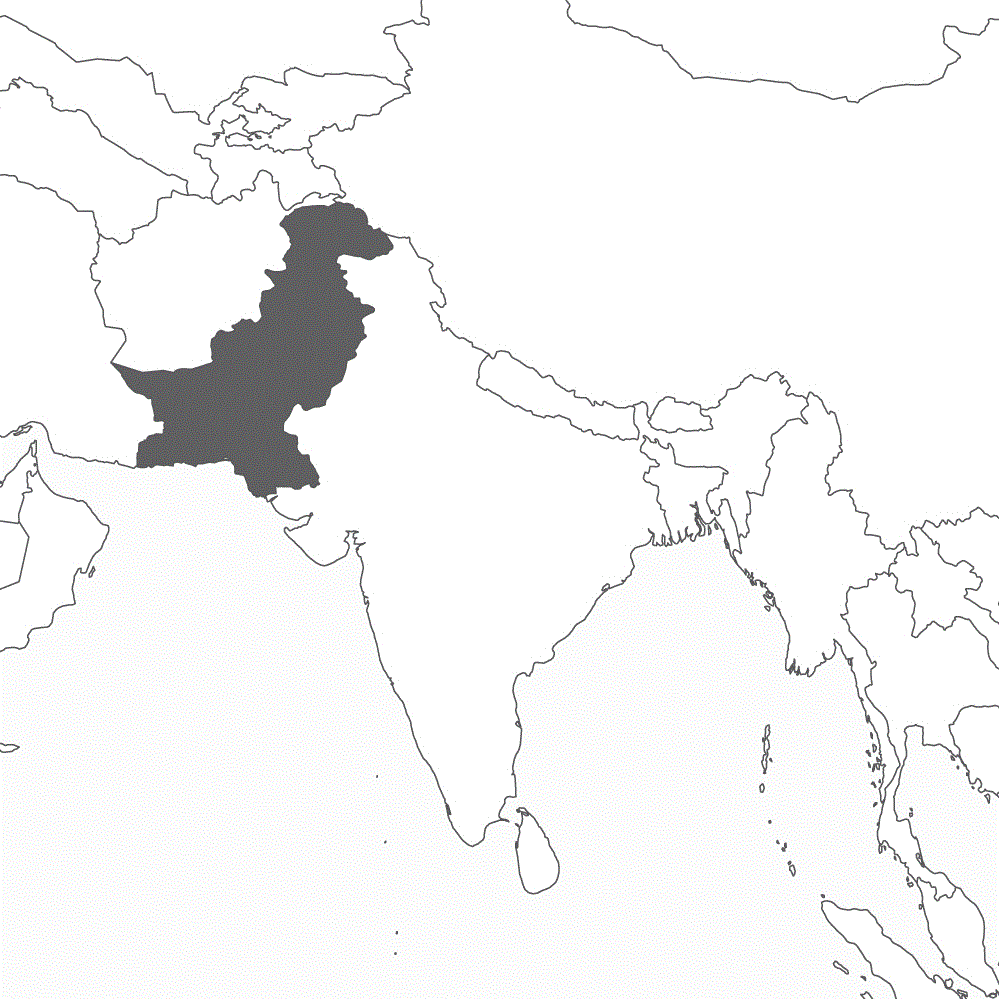
Pakistani farmers are suing two big German corporations for losses from the 2022 climate change-driven flood disaster. RWE and Heidelberg Materials both rank as ‘carbon majors’ among the world’s top hundred CO2 emitters.
ISLAMABAD/BERLIN (our report) – Farmers from Pakistan are suing two German corporations, RWE and Heidelberg Materials, over the deadly and costly consequences of carbon emissions for which they are partly responsible. The lawsuit filed at Heidelberg District Court, entitled “Climate Cost Case Pakistan”, seeks partial compensation for the losses incurred by 39 Pakistani farmers as a result of the 2022 flood disaster. The floods were the worst in Pakistan’s history. They claimed over 1,700 lives, displaced around 33 million people and caused total damage to the country’s economy amounting to 30 billion dollars. Experts see that disaster as a clear consequence of climate change. RWE and Heidelberg Materials can be counted among the just over one hundred companies worldwide that together account for more than 70 per cent of historical industrial greenhouse gas emissions. The lawsuit is based on the legal principle of polluter-pays: those who cause damage must pay. A similar case against RWE was already filed by a Peruvian farmer back in 2015. Although it was ultimately thrown out, the competent German court did rule that companies can, in principle, be held liable for certain damages related to human-made climate change.
‘Climate Cost Case Pakistan’
Thirty-nine farmers from Pakistan are taking two German companies, RWE and Heidelberg Materials, to court. They allege that they have been seriously harmed by their cumulative greenhouse gas emissions. According to the lawsuit, the climate-damaging impact of their emissions contributed to the catastrophic and deadly floods that struck the South Asian country in the summer of 2022.[1] Filed at Heidelberg Regional Court last December, the lawsuit seeks partial compensation for the losses suffered by the farmers, many of whom lost two full harvests. The floods plunged their families, who were already living on the poverty line, into crippling financial hardship. According to the European Centre for Constitutional and Human Rights (ECCHR), an advocacy NGO representing the farmers, the two companies were selected for legal action for being two of the three largest carbon dioxide emitters in Germany. The statement of claim states that the impacts of the greenhouse gases emitted by the two corporations in Germany can still be felt thousands of kilometres away, whatever the geographical proximity. The plaintiffs argue that the companies had a legal duty to minimise the damage they knew would result from their carbon emissions.[2] The lawsuit’s admissibility is currently under judicial review.
‘Monsoon on Steroids’
The unprecedented quantities of rainfall in the summer of 2022 left a third of Pakistan under water for months. These were the worst floods in the country since records began. Around 1,700 people died directly as a result of the flooding, and an estimated 33 million people were displaced.[3] According to Pakistan’s national disaster management agency, more than 12,000 kilometres of roads, 390 bridges and over 1,800,000 homes were destroyed by flooding. Some 925,000 livestock deaths were also reported, many dying due to the resulting lack of feed and clean drinking water. The flooding in some provinces of the country contaminated the soil and groundwater and destroyed an entire year’s harvest. The overall damage to the Pakistani economy is estimated at 30 billion US dollars at least. A website presenting the details of the ‘Climate Cost Case Pakistan’ lawsuit points out that Pakistan is becoming a “global hotspot” of climate change. The destructive forces unleashed by the climate crisis are concentrated in that country, leading to frequent disasters.[4] Pakistan’s Minister for Climate Change at the time, Sherry Rehman, described the floods as a “climate-induced humanitarian disaster of epic proportions”. UN Secretary-General António Guterres called them a “monsoon on steroids”.[5]
The polluter must pay
The legal proceedings were initiated on 28 October 2025 when the 39 farmers officially informed the two German companies of their intention to seek financial compensation. The initial step was to called on them to engage in dialogue and to enter into a mediation process.[6] When the companies refused, the farmers filed their claim with Heidelberg Regional Court on 22 December 2025. The farmers base their claim on a simple but important legal principle: whoever causes damage or loss must pay for it.[7] On the question of whether the German courts have jurisdiction in this case, the plaintiffs have referred to the precedent set in the case of Saúl Luciano Lliuya versus RWE. In that matter, a German court ruled in May 2025 that major CO2 emitters could be held partly liable for climate-related damage abroad. The ECCHR argues that the lawsuit admissible under two sections of the German Civil Code (BGB): Section 906, which relates to compensation for damages resulting from the “introduction of hazardous substances”; and Section 823, which relates to liability for damage or injury caused to another person intentionally or through negligence.
Carbon majors: the top hundred worldwide
Pakistan contributes less than one per cent of global carbon emissions. But the defendants RWE, one of Europe’s biggest electricity generators, and Heidelberg Materials, one of the world’s largest cement manufacturers, are among the greatest carbon emitters of all.[8] Both companies fall into the category of “carbon majors”, a term used to describe companies that have been significantly pushing climate change. The term was coined in studies by the Climate Accountability Institute. Its researchers have found that just over a hundred companies are responsible for almost 70 per cent of historical industrial greenhouse gas emissions worldwide. RWE and Heidelberg Materials are two of them. According to the ‘Climate Cost Case Pakistan’ complaint, RWE is responsible for at least 0.68 per cent, and Heidelberg Materials for 0.12 per cent, of global industrial emissions since 1965.[9] The website further states that, “despite their knowledge of this harm, RWE and Heidelberg Materials not only did very little to reduce emissions, but even tried for decades to weaken the binding rules for climate protection instituted by lawmakers.”[10]
Legal precedents
The lawsuit brought by the 39 Pakistani farmers is not the first such case to be put before a German court. In 2015, a Peruvian farmer called Saúl Luciano Lliuya sued RWE on similar grounds. By 2025 the competent German court had dismissed the case.[11] It did, however, rule that companies can, in principle, be held liable for certain climate-related damages caused by their carbon emissions. It is this decision that has paved the way for the current case brought by the Pakistanis. Miriam Saage-Maaß, Legal Director at the ECCHR, explains that rulings such as this make Germany “to a certain extent” a favourable venue for climate-related legal action. But she also points out that transnational climate prosecutions are increasingly being pursued worldwide. What is more, German companies have already been charged for causing suffering in Pakistan. In early 2012, following a fire at a textile factory in the southern Pakistani city of Karachi that claimed the lives of more than 250 workers, a lawsuit was filed against the German cheap-clothing company KiK, which sourced a large proportion of its goods from that factory. The allegation was that the company had failed to ensure basic standards of fire and building safety. Although the case was dismissed on procedural grounds, KiK ultimately did pay out compensation to the victims. Importantly, the case sparked a debate on the need for accountability along global supply chains.
[1] Pernia Mubashir: Why Pakistani farmers are suing two German companies for deadly 2022 floods. aljazeera.com 20.03.2026.
[2] Climate Cost Case Pakistan: Pakistani farmers vs. RWE and Heidelberg Materials. climatecostcase.org.
[3] Alia Chughtai: Mapping the scale of damage by the catastrophic Pakistan floods. aljazeera.com 16.09.2022.
[4] Climate Cost Case Pakistan: Polluters have to pay! climatecostcase.org.
[5] Pernia Mubashir: Why Pakistani farmers are suing two German companies for deadly 2022 floods. aljazeera.com 20.03.2026.
[6] ECCHR: Pakistani farmers demand compensation from RWE and Heidelberg Materials. ecchr.eu.
[7] ECCHR: Pakistani farmers take climate justice fight against RWE and Heidelberg Materials to German court. ecchr.eu 20.01.2026.
[8] Climate Cost Case Pakistan: Polluters have to pay! climatecostcase.org.
[9] Climate Cost Case Pakistan: RWE and Heidelberg Materials: A history of irresponsibility. climatecostcase.org.
[10] Climate Cost Case Pakistan: Pakistani farmers vs. RWE and Heidelberg Materials. climatecostcase.org.
[11] Pernia Mubashir: Why Pakistani farmers are suing two German companies for deadly 2022 floods. aljazeera.com 20.03.2026.