The civilisation killers
Trump’s plan to block the Strait of Hormuz has met with approval in Berlin. Previously, Chancellor Merz had even expressed a degree of understanding for Trump’s threat to destroy Iranian civilisation.
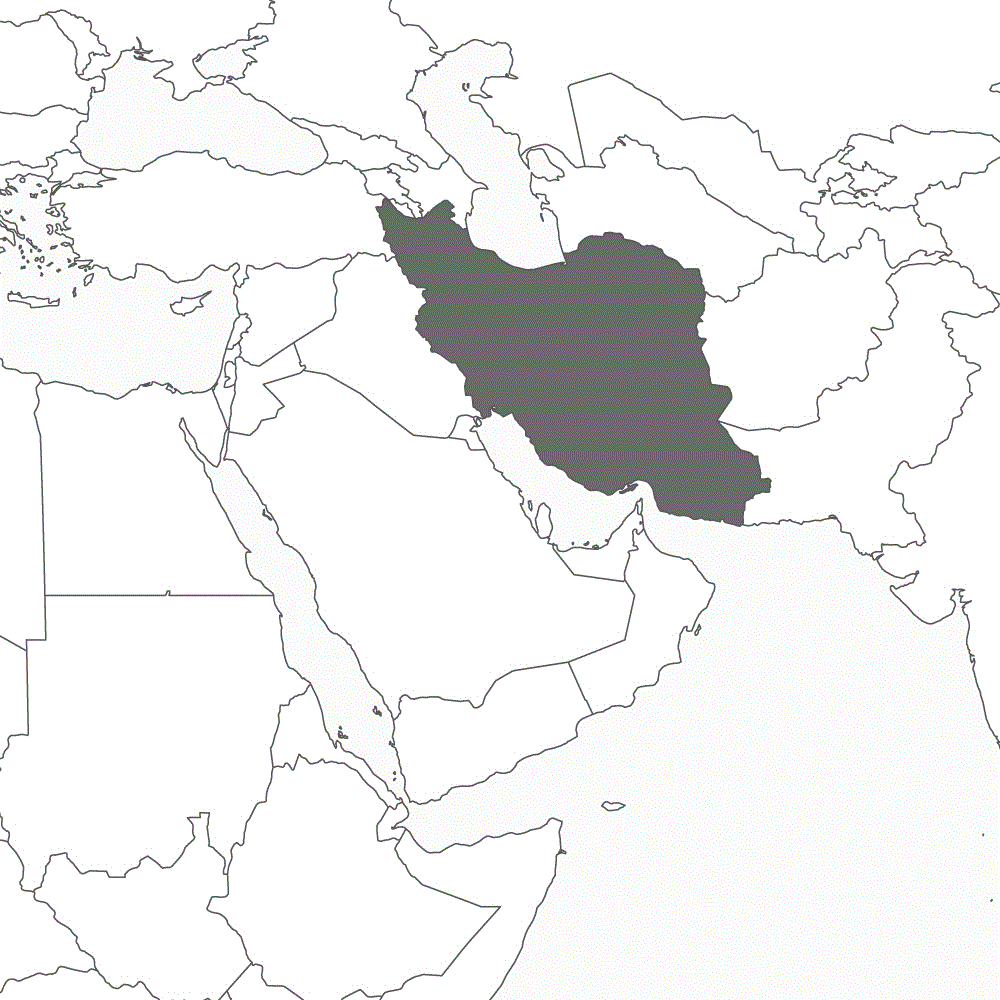
BERLIN/WASHINGTON/TEHRAN (our own report) – The naval blockade of the Strait of Hormuz announced by US President Trump has met with approval in Berlin. Steps by the United States were “long overdue” when it came to depriving Iran of any “use” of the strait and any revenues that Tehran can gain by exerting control, said CDU foreign policy expert Norbert Röttgen yesterday, Sunday. Trump had just declared that the US Navy would prevent all ships from passing through the Strait of Hormuz. The move to a naval blockade emerged from the breakdown of negotiations to resolve the conflict between Washington and Tehran. The US broke off talks by the United States over the weekend because Iran was not prepared accept “a deal”, i.e. to comply fully with US demands. The American air force would, Trump had already threatened, target bridges and power stations. He would bomb the country “back to the Stone Age”. The meeting in Islamabad took place under the shadow of Trump’s apocalyptic threat that “Iran’s civilisation will die”. The language sparked dismay and revulsion worldwide. Yet Trump’s stance met with a certain degree of understanding within the German government. Trump again issued an ultimatum on Sunday that without a deal his forces would “finish off the little that is left of Iran”.
Dictating the terms
American Vice-President JD Vance declared the talks on a settlement of the conflict with Iran a failure after a single 21-hour marathon session. Iran had not “chosen not to accept our conditions”, claimed Vance immediately before departing Islamabad.[1] According to reports, the US insisted on maximum demands, not least regarding the Iranian nuclear programme. The US delegation was in principle unwilling to discuss an alternative proposal from Iran, demanding the country should hand over all its enriched uranium. The US had also demanded the immediate and complete opening of the Strait of Hormuz but had refused, in return, to release Iran’s frozen foreign assets worth at least 27 billion dollars. These funds are held in Germany, Luxembourg, Turkey, Bahrain, Qatar, Iraq and Japan.[2] Speaking to the New York Times, Tehran-based expert Mehdi Rahmati said it was “unrealistic” for the US to negotiate in earnest whilst ruling out any concessions on principle. Iran’s former foreign minister, Javad Zarif, in turn, stated that the US was not in a position to “dictate terms to Iran”. Yet this is precisely what the Trump administration continues to attempt.
“Bombing back to the Stone Age”
Following the collapse of negotiations at the weekend, the wild ,threats made by President Trump shortly before a ceasefire agreement were reached are now back on the agenda. Trump had first announced that he would target and destroy Iran’s civilian infrastructure, including bridges and power stations. Indeed, he would bomb the country “back to the Stone Age”. He then took to social media to harangue Iranians as “crazy bastards”. They had to immediately “open the fucking Strait” (of Hormuz), he raged, or “you will experience hell”.[3] And in honour of Easter Sunday, Trump mocked the people of Iran by cynically adding “Glory to Allah!” The deliberate destruction of civilian infrastructure is, of course, a war crime. According to the Iranian Red Crescent, US and Israeli bombardments had already damaged or destroyed 763 schools and 316 healthcare facilities by 2 April.[4] Commenting on the completely unrestrained warfare waged by the US and Israel against Iran, the publicist Rami G. Khouri, who works at the American University of Beirut and the Arab Center in Washington, recently wrote that American threats now “confirmed the death of any international law or global treaty protections” that once differentiated between military and civilian needs: “All humans on Earth now live in danger.”[5]
Fantasies of annihilation
In addition to announcing his pursuit of far-reaching war crimes, Trump suggested last week that the armed forces of the United States and Israel would ensure that “a whole civilisation will die” in Iran. The statement has been interpreted not only in Iran and other Middle Eastern countries as the US and Israel preparing for genocidal warfare similar to that in Gaza, possibly even using nuclear weapons. The threat has caused dismay and revulsion worldwide. Pope Leo XIV described Trump’s threats of violence as “truly unacceptable”.[6] The UN High Commissioner for Human Rights, Volker Türk, deplored Trump’s “tirade of incendiary rhetoric” as “sickening”. Only German Chancellor Friedrich Merz expressed a degree of understanding for Trump. After days of silence on the matter, he said he had merely perceived the US President’s ferocious verbal outburst “as a rhetorical component of an Iran strategy”: “I believe he himself did not think a country like Iran could be completely wiped out.”[7] Nor are any objections to Trump’s annihilation fantasies known to have been voiced by German Foreign Minister Johann Wadephul, European Commission President Ursula von der Leyen or EU Foreign Affairs Commissioner Kaja Kallas.
“Eliminate officials”
It is not only these murderous threats that are once again hanging over the people of Iran following the failure of the negotiations. In the event that Iran is unwilling to completely surrender its enriched uranium, Marc A. Thiessen, an expert at the neoconservative American Enterprise Institute (AEI), proposed a number of US measures last week. Washington should, for instance, destroy the entire oil export infrastructure on Kharg Island, thus supposedly “eliminating the regime’s ability ... to spread terror across the region”.[8] What is more, any Iranian approaching a zone where the country’s enriched uranium is suspected to be stored should be killed. He also recommends that the US military unleash a “final barrage” of strikes against the Iranian leadership to eliminate “the Iranian officials who have been spared for the purpose of negotiations”.[9] The idea that an entire negotiating delegation of leading representatives of a state be publicly threatened with collective murder should they fail to agree to the other side’s demands in the desired form is unprecedented even for today’s bellicose Western world.
Trump’s naval blockade
Yesterday, Sunday, US President Trump, repeated his threat and announced that “at an appropriate moment”, the US armed forces would “finish up the little that is left of Iran”.[10] He also threatened, once again, to destroy Iran’s electricity and even water supplies. On the other hand, he announced that the US Navy would block the Strait of Hormuz. The background to this is that Iran is seeking to introduce a toll system in the strait under which ships passing through are to pay a fee to Tehran. Iran has been trying out the system in recent weeks, allowing individual ships from a number of countries with which it is not in conflict to pass through in return for payment. It now hopes to make this a permanent arrangement. In response, Trump is now saying that not a single ship should be allowed to pass through the strait. He also announced on Sunday that he had ordered the US Navy to stop “every vessel in international waters that has paid a toll to Iran”.[11] The US would, he claimed, be supported in this by other states. Whether there is any truth in the announcements of the American President is, yet again, not immediately clear.
Praise from Berlin
Words of praise for the naval blockade came quickly from Berlin. On Sunday, CDU foreign policy expert Norbert Röttgen said it was “essential that the Iranian regime does not retain control of the Strait of Hormuz” because it was “long overdue for the US to cut off the regime’s use of the strait and the revenue from it that is indispensable to the regime”.[12] Elsewhere, the responses being voiced have ranged from sceptical to critical. In the US media landscape, for instance, it is being pointed out that a naval blockade – Trump’s own term – must be considered an act of war, which means the ceasefire will come to an end with the start of the announced US blockade. The Wall Street Journal even noted that Iran has earned more than expected from its oil exports in recent weeks. And Iran might be better able to cope with a blockade than the economies of the Western world. The latter will soon have to reckon with shortages of numerous key raw materials – “from liquefied natural gas to jet fuel and helium”.[13] The expected economic damage is thought to be enormous.
[1] Erika Solomon: In Pakistan Talks, Iran Saw a U.S. Trying to Dictate, Not Negotiate. nytimes.com 12.04.2026.
[2] Farnaz Fassihi: Control of the Strait of Hormuz and Iran‘s uranium stockpiles were sticking points. nytimes.com 12.04.2026.
[3] Trump threatens ‘hell’ for Iran over Hormuz Strait as deadline approaches. aljazeera.com 05.04.2026.
[4] Leanne Abraham, Aurelien Breeden, Bora Erden, Anushka Patil, Christiaan Triebert, Daniel Wood, Karen Yourish: Iran’s Schools and Hospitals in Ruins, Times Analysis Shows. nytimes.com 09.04.2026.
[5] Rami G. Khouri: Iran ceasefire: Not an off-ramp for the US but a life-saving ejection seat. aljazeera.com 10.04.2026.
[6] Allerorts Abscheu über Trumps Drohpolitik. orf.at 08.04.2026.
[7] Merz: Erfolg bei Iran-Friedensgesprächen nicht sicher. handelsblatt.com 09.04.2026.
[8], [9] Marc A. Thiessen: Iran thinks it has leverage. Here’s how Trump can prove it wrong. washingtonpost.com 08.04.2026.
[10] Vera Bergengruen: Trump Says the U.S. Is Locked and Loaded to Finish Up Iran. wsj.com 12.04.2026.
[11] Vera Bergengruen: Trump Announces U.S. Blockade of Strait of Hormuz. wsj.com 12.04.2026.
[12] Mey Dudin, Birgit Marschall: Trump kündigt US-Seeblockade in der Straße von Hormus an. rp-online.de 12.04.2026.
[13] Georgi Kantchev: Iran Holds Strong Cards in Trump’s Blockade. wsj.com 12.04.2026.