The Subjugation of Latin America (II)
German government ignores US’s total blockade of Cuba and growing subjugation of Latin America. Other states, like Spain, speak out: solidarity flotilla arrives in Cuba.
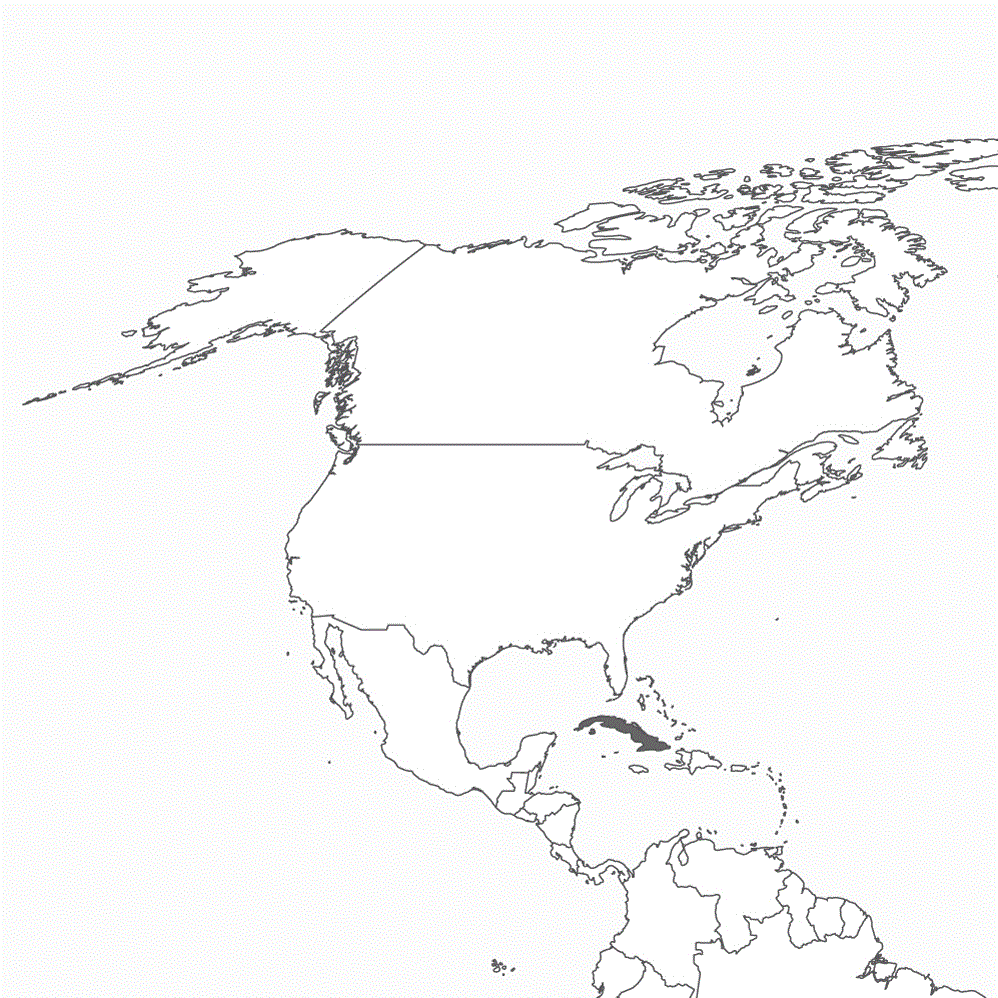
BERLIN/WASHINGTON/HAVANA (our own report) – The German government is ignoring the United States’ ongoing total blockade of Cuba along with further efforts by the Trump administration to subjugate the whole of Latin America. Bonn says it is seeking “transatlantic common ground”. An international solidarity flotilla arrived in Havana at the weekend and Spain, an EU member state, is sending more aid supplies to the Caribbean nation. Germany, on the other hand, remains silent and says it hopes for “partnership” with the US. Meanwhile, Trump is demanding the overthrow of Cuban President Miguel Díaz-Canel and boasts that he will soon be able to rule the country as he chooses. A US blockade of the island has, of course, been in place for over six decades and has long damaged its development. But the current fuel blockade has escalated the hardship by creating dramatic supply shortages. On Cuba, Trump has actually said that, “I think I can do whatever I want with it.” As regards the wider strategy for Latin America, Washington has founded a new regional military alliance, the Shield of the Americas, which comprises only far-right governments. It is ostensibly directed against drug cartels but the agenda is to curb China’s influence. In Colombia and Brazil, two countries that are not run by “Trumpistas”, the US has been interfering in upcoming elections – in each case promoting far-right candidates.
Opening for US companies
The Cuban government recently confirmed that it has entered into negotiations with the Trump administration to at least bring an end to the crippling oil embargo. According to US reports, Raúl Guillermo Rodríguez Castro, a grandson of Raúl Castro, is involved in the talks. He is said to have had personal exchanges with US Secretary of State Marco Rubio.[1] The government in Havana made its first major concessions early last week, announcing its willingness to take steps towards economic liberalisation. This means specifically that Cubans living abroad will be allowed to set up businesses in Cuba and invest in existing companies.[2] This offer is aimed, not least, explicitly at Cubans resident in the US: not only the many who have left the island in recent years but even the far-right anti-communist core of the old Cuban exile community based in Florida. It is a community from which Secretary of State Rubio, among other US politicians, hails. Moreover, Havana is also ready to permit US corporations in general to pursue wide-ranging investment activities in Cuba. Cuba’s Deputy Prime Minister, Oscar Pérez-Oliva Fraga, has insisted that, in particular, US investment in the country’s infrastructure will be welcome. Havana is fundamentally “open” to “flexible trade relations with US companies”, says Pérez-Oliva Fraga.[3] There has already been talk in the US media of a “Cubastroika”.[4]
“Do whatever I want with Cuba”
Yet these far-reaching concessions are still not enough for the Trump administration. It remains unwilling to scale back its fierce blockade, which is designed to force the entire Cuban population into abject poverty. According to reports, the US President is explicitly calling for the dismissal of his Cuban counterpart, Miguel Díaz-Canel. In addition, the US wants Cuba “to agree to remove some older officials who remain committed to the ideas of Fidel Castro.”[5] Meanwhile, Trump continues to disparage the Caribbean nation with his usual mix of chauvinistic posturing and infantile rhetoric. “I can tell you, they’re talking to us,” he remarked last week, “It’s a failed state. They have no money. They have no oil. They have nothing.”[6] He would first “deal with Iran”, then he would “have the honour of taking Cuba”. When asked what this meant, Trump explained: “Whether I liberate it or take it over, I think I could do whatever I want with it, if you want to know the truth.”
Shield of the Americas
Beyond Cuba, the Trump administration is pressing ahead with efforts to comprehensively subjugate the whole of Latin America and the Caribbean. To this end, Washington has recently established a new alliance under the name ‘Shield of the Americas’, which is officially aimed at combating drug cartels. It is, Trump stated, a “brand-new military coalition” that would “eradicate the criminal cartels plaguing our region.”[7] An inaugural meeting in Florida was attended by the heads of state and government from twelve countries in the region. Five more are reportedly ready to join ‘Shield of the Americas’.[8] As early as September last year, the Trump administration began targeting and destroying boats in the Caribbean. Designated as drug-smuggling vessels without any evidence, they were fired on and their crews murdered, including in deliberate “double tap” strikes. According to New York Times journalists tracking the strikes, 46 attacks have been conducted so far, resulting in the deaths of 159 people. Meanwhile, Washington has also launched military attacks on actual or alleged drug cartels in Ecuador. Expert observers do not expect the campaign to succeed, citing earlier phases of the ‘war on drugs’ as evidence. The drug cartels have never been definitively dismantled in this way.
Alliance against Beijing
There is, in any case, much to suggest that the Trump administration’s new ‘Shield of the Americas’ alliance is not primarily aimed at combating drug cartels. Under its new National Security Strategy, Washington is primarily seeking to push back against the influence of other powers in Latin America, like Russia and, above all, China (as reported by german-foreign-policy.com [9]). After all, the Shield of the Americas only comprises those states that are currently controlled by governments of the right or far-right. The State Department sees them as the most suitable partners in an economic struggle with China. And the countries not invited to join the ‘Shield of the Americas’ include those which face very significant problems with narco gangs but are run by left-wing governments. This makes them unsuitable allies in the push to squeeze out China. The exclusion of Mexico, Colombia and Brazil means that the ‘Shield of the Americas’ can be better understood as an emerging military alliance against Beijing.
“Priority target”
With elections upcoming in Colombia and Brazil, the Trump administration is also endeavouring to replace incumbent left-wing leaders with right-wing ones in two of the countries not in the ‘Shield of the Americas’ coalition. The US Drug Enforcement Administration (DEA) has even declared Colombian President Gustavo Petro a “priority target”, following the US Department of Justice’s launch of an investigation into his alleged drug trafficking.[10] Although Petro is no longer permitted to stand in the election on 31 May, US legal proceedings against him would undermine the election prospects of Iván Cepeda, a left-wing candidate with close ties to Petro currently leading in the opinion polls. As for Brazil, Trump’s people are campaigning for a victory by Flávio Bolsonaro, a son of far-right former president Jair Bolsonaro, in the country’s presidential election on 4 October. The entire Bolsonaro clan is close to Trump. An influential US State Department official, Darren Beattie, very recently sought to make a publicity-seeking visit to Jair Bolsonaro in prison. The ex-president is serving a long sentence for his attempted coup. Beattie also planned to meet Flávio in a barely veiled attempt to boost his standing. The Lula government objected to this open interference in Brazil’s internal affairs and revoked Beattie’s visa.[11]
Transatlantic common ground?
The Trump administration’s operations in Latin America, particularly the military intervention in Venezuela, the violent subjugation of the government there, and the current enforcement of a total blockade of Cuba, have met with fierce protest from numerous countries. Colombia’s President Petro recently warned that his continent was “not a land to be conquered”. He noted that members of the Trump administration, not least Secretary of State Rubio, had been promoting a “white, Christian, Western civilisation” reminiscent of “the age of the Crusades”.[12] US Secretary of War Pete Hegseth does in fact supports the idea of a Holy War and has repeatedly praised the Crusades. He wears body tattoos that reference the Crusaders.[13] Spain, for its part, has already sent several aid shipments to Cuba to at least alleviate the disastrous humanitarian consequences of the US blockade.[14] As for Germany, there has been no reaction whatsoever from Berlin. On the contrary, Chancellor Friedrich Merz stated in general terms last week that the German government seeks transatlantic partnership: “That is why we are talking to Washington at all levels. … We are seeking transatlantic common ground.”[15] Yet the US attempt to drive a country like Cuba into destitution by means of a total blockade and to subjugate an entire continent as part of a purse a revived Monroe doctrine does not seem to bother the German side.
[1] Frances Robles, Edward Wong, Annie Correal: Trump Administration Said to Tell Cuba That Its President Has to Go. nytimes.com 16.03.2026.
[2] Volker Hermsdorf: Kapital durch Exilkubaner erschließen. junge Welt 18.03.2026.
[3] George Solis, Alexander Smith: Cuba will allow nationals living abroad to invest in and own business on the island, economic czar tells NBC news. nbcnews.com 16.03.2026.
[4] Patrick Oppmann: Flailing Cuba invites exiles to return, but hurdles remain. edition.cnn.com 17.03.2026.
[5] Frances Robles, Edward Wong, Annie Correal: Trump Administration Said to Tell Cuba That Its President Has to Go. nytimes.com 16.03.2026.
[6] Jack Nicas: Trump’s Next t. nytimes.com 17.03.2026.
[7] Annie Correal, Shawn McCreesh: Trump Assembles a New Coalition to ‘Eradicate’ Cartels. nytimes.com 07.03.2026.
[8] Am ersten Treffen des Shield of the Americas nahmen die Präsidenten von Argentinien, Bolivien, Chile, Costa Rica, der Dominikanischen Republik, von Ecuador, El Salvador, Guyana, Honduras, Panama, Paraguay sowie Trinidad und Tobago teil. Mitwirken wollen Berichten zufolge die Bahamas, Belize, Guatemala, Jamaica und Peru.
[9] See: Die Unterwerfung Lateinamerikas.
[10] DEA names Colombian President Petro ‘priority target’ amid U.S. probe of drug trafficker ties. pbs.org 20.03.2026.
[11] Michael Pooler: Brazil blocks visit of Trump official to see jailed Jair Bolsonaro. ft.com 14.03.2026.
[12] Rory O’Neill: Colombian president warns US against building an empire in Latin America. politico.eu 12.03.2026.
[13] See: Auf ultrarechtem Kurs.
[14] España enviará a Cuba mil kits para necesidades básicas y placas fotovoltaicas. efe.com 16.03.2026.
[15] Regierungserklärung von Bundeskanzler Friedrich Merz zum Europäischen Rat am 19./20. März 2026 vor dem Deutschen Bundestag am 18. März 2026 in Berlin.