Military cooperation with Israel
Bundeswehr strengthens cooperation with Israel Defence Forces (IDF). Police and cybersecurity counterparts will also deepen collaboration, while Israel’s wars for dominance in the Middle East escalate.
TEL AVIV/BERLIN (our own report) – Germany is systematically stepping up military, police and cybersecurity cooperation with Israel. The agreements formally concluded at the start of the year are now being implemented. The ‘Cyber and Security Pact’, signed in January, provides for closer cooperation between the respective police agencies and the establishment of a ‘Cyberdome’ in Germany. Berlin hopes its security cooperation with Israel will offer “practice-based know-how from a country with a high frequency of military operations.” Another agreement, concluded in February, enables greatly intensified military cooperation designed to make the Bundeswehr “war-ready” in practice. The idea is for Israeli ground forces to pass on to the German army the capabilities and experience gained in Israel’s past and current wars. With their “unrivalled expertise in the field of ground operations”, the Israel Defence Forces (IDF) are helping the Bundeswehr “adapt to an increasingly volatile global environment”. These steps to strengthen security collaboration with Israel are taking place against the backdrop of the ongoing wars for dominance in the Middle East.
‘The most important partner outside NATO’
Just like cooperation on arms production (as reported by german-foreign-policy.com [1]), German-Israeli military cooperation essentially began way back in the late 1950s. This was when West German army personnel began training Israeli soldiers in the use of German weapon systems that were supplied under a secretive arrangement. From the 1980s there is a sporadic record of joint military training involving German mountain infantry. From 1998 onwards there have been, alongside exchange programmes for officer cadets, “regular meetings at the Army General Staff level”.[2] Official German government figures show that between 1984 and 2014 “up to 493” Israeli military personnel, including officers, took part in training and other programmes run by the Bundeswehr. Conversely, 254 German soldiers were sent to Israel for military training programmes and exercises.[3] It is, of course, unclear whether these figures really reflect the full extent of cooperation. After all, as indicated by a response from the Federal Government to a parliamentary question in the Bundestag, military cooperation measures with Israel are often kept secret.[4] What is more, German-Israeli cooperation is by no means limited to land forces. From 2017, the German Luftwaffe has taken part on several occasions in exchanges with the Israeli Air Force as part of ‘Blue Flag’ manoeuvres. The Inspector General of the Luftwaffe, Ingo Gerhartz, stated in 2022 that, speaking for his branch of the armed forces, the Israel Defence Forces (IDF) were the military’s “most important partner outside NATO”.[5]
Steps towards an operations-ready army
The intensification of German-Israeli military cooperation has been systematically pursued since the 1990s. Ever closer relations were confirmed by, for example, retired Lieutenant-General Helmut Willmann in 2002. As Inspector of the Army from 1996 to 2001, he was tasked with, among other things, institutionalising links between his units and IDF ground forces. He argued that, with the Bundeswehr being at the time in the process of transforming itself “from a peacetime army into an operations-ready army”, the German side was “naturally” seeking “contact with armies” that “already had more experience in this area than we did”.[6] It had been “clear” to everyone “that cooperation with the Israeli army naturally gives us professional advantages”. In 2014, for example, a training visit by German military personnel to Israel was announced (although realised belatedly in 2015) in which soldiers could learn about urban and tunnel warfare as part of the programme.[7] The Bundeswehr Command emphasised the army’s strong interest in the “specific operational experience of the Israeli armed forces”.[8] Commenting on the ever-closer military relations with Israel, the military attaché at the German Embassy in Tel Aviv, Colonel Jürgen Haffner, confirmed in October 2021 that there was “an incredibly close interest on the part of the Bundeswehr in the IDF and vice versa”. He mentioned that the frequency of reciprocal visits was “incredibly high”.[9]
Getting ready for war
Today, at a time when the Bundeswehr is to become “war-ready” without delay, the German military’s cooperation with the battle-hardened IDF is being further strengthened. On 20 February, eight months after Israel’s first war of aggression against Iran and a few days before the second US-Israeli wave of attacks on the country, the current Inspector of the German Army, Lieutenant General Christian Freuding, and the Commander of the Israeli Ground Forces, Major General Nadav Lotan, signed a cooperation agreement designed to closely link the land forces of both countries in four spheres: the plans included joint “training and exercises”, “joint capabilities development”, the “sharing of operational principles”, and “exchange programmes, particularly for young officers and officer cadets”, noted an army spokesperson.[10] With the signing of the agreement, Freuding was reportedly briefed by Lotan “on the tactical lessons learnt from the current war”. Which of Israel’s current wars was being referred to remained unclear.[11] The report went on to state that, thanks to its “unrivalled expertise in the field of ground operations”, the IDF was helping the Bundeswehr to “adapt to an increasingly volatile global environment”. The collaborations were reportedly giving rise to “an extremely effective alliance”.
‘Practice-based know-how’
Beyond armaments and military matters, Germany and Israel are also deepening cooperation between their law enforcement and cyber-security agencies. On 11 January, Germany’s Minister of the Interior Alexander Dobrindt and Israeli Prime Minister Benjamin Netanyahu signed a “Cyber and Security Pact” to this end. One aspect of this agreement on “digital defence” concerns steps to intensify cooperation between the police forces of both countries, which is already considered very close. The pact is also supposed to drive improvements in “drone detection and defence”, implement the “establishment of a joint AI and cyber innovation centre”, and promote “exchange and networking on the Cyberdome issue”. According to the Interior Ministry, this Cyberdome is “a semi-automated system for the detection, analysis and response to cyber-attacks”.[12] Whether “response” also refers to counter-attacks that “hack back” against an alleged adversary remains unclear. On the whole, Interior Minister Dobrindt expects the “exchange with Israel to yield practice-based know-how from a country with a high frequency of operations”, according to a government statement.[13]
Dominance in the Middle East
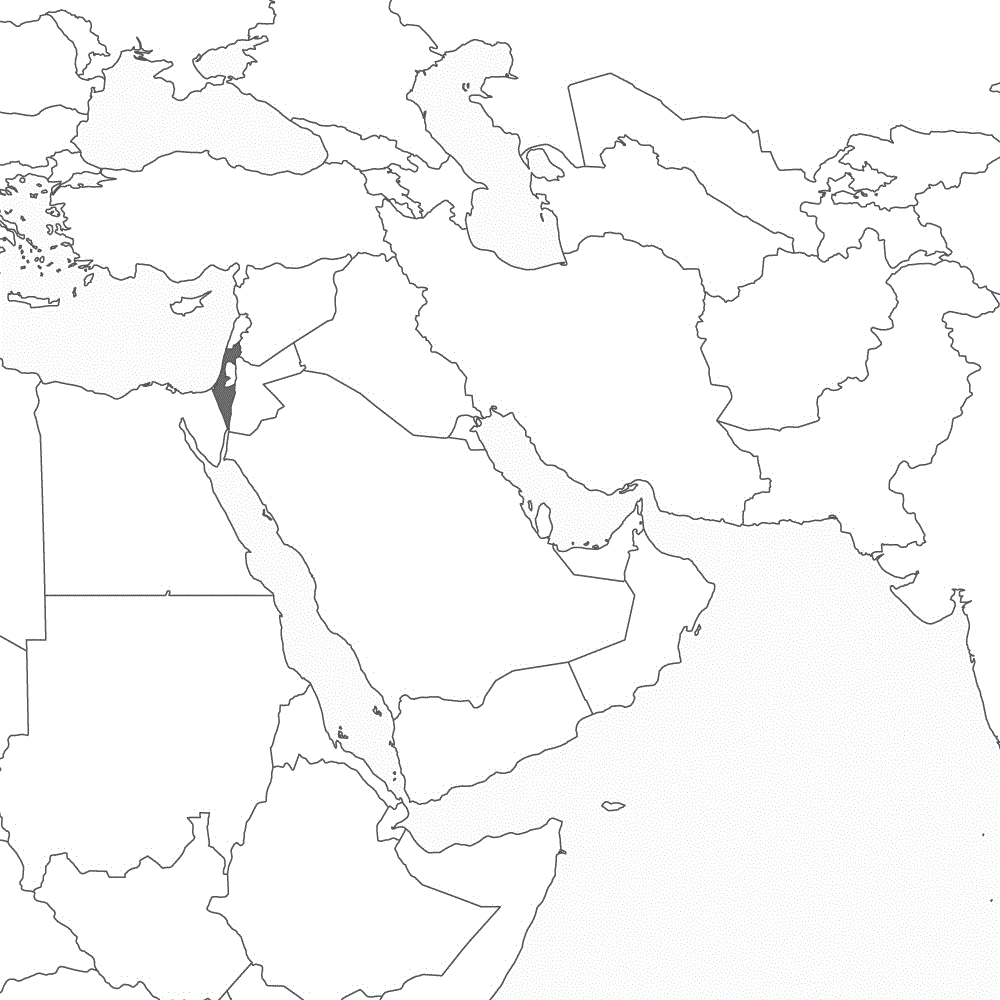
In deepening and expanding the already close cooperation between the respective defence industries,[14] armed forces and repressive and security apparatuses, Germany and Israel are moving closer together than ever before in key areas of the internal and external use of force. While the German side can learn and benefit from Israeli experience and capabilities, Israel is keen to bind the Federal Republic ever more closely to itself. This is happening in a situation where the wars for dominance in the Middle East continue to escalate. On the one hand, Western dominance is wavering. Iran has so far held its ground in the face of US and Israeli attacks. And Saudi Arabia, which has allied itself with Pakistan and Turkey under the recently signed Mecca Joint Defence Agreement, is seeking greater independence from the United States in a future security order (as reported by german-foreign-policy.com [15]). On the other hand, Israel is striking out in a continual push to expand its power in the Middle East. Israel can present itself to the German ruling elites as a bastion of influence in a geostrategically significant but fiercely contested region.
[1] See: Arms cooperation with Israel.
[2] Otfried Nassauer, Christopher Steinmetz: Rüstungskooperation zwischen Deutschland und Israel. Berliner Informationszentrum für Transatlantische Sicherheit. Research Report 2003.1. Berlin, September 2003. See also ‘In Germany’s national interest’ (III).
[3], [4] Antwort der Bundesregierung auf die Kleine Anfrage der Abgeordneten Christine Buchholz, Jan van Aken, Annette Groth, weiterer Abgeordneter und der Fraktion Die Linke. Deutscher Bundestag, Drucksache 18/2787. Berlin, 09.10.2014.
[5] Stephan Jeglinski: Inspekteur der Luftwaffe mit Ernst-Cramer-Medaille ausgezeichnet. bundeswehr.de 24.05.2022.
[6] Daniel Marwecki: Absolution? Israel und die deutsche Staatsräson. Göttingen 2024.
[7] Thorsten Jungholt: Bundeswehr soll in Israel den Tunnelkampf lernen. welt.de 10.08.2014.
[8] Thorsten Jungholt: Bundeswehr soll in Israel den Häuserkampf lernen. welt.de 30.08.2015.
[9] „Ich möchte mit keinem tauschen“. bundeswehr.de 21.10.2021.
[10] Deutsches und israelisches Heer vereinbaren Zusammenarbeit. israelnetz.com 25.02.2026.
[11] John Meister: Deepening military ties between IDF and Bundeswehr. blogs.timesofisrael.com 21.02.2026.
[12] Zusammenarbeit zur Cybersicherheit mit Israel wird ausgebaut. bmi.bund.de 12.01.2026.
[13] Antwort der Bundesregierung auf die Kleine Anfrage der Abgeordneten Jan Köstering, Clara Bünger, Doris Achelwilm, weiterer Abgeordneter und der Fraktion Die Linke. Deutscher Bundestag, Drucksache 21/4306. Berlin, 23.02.2026.
[14] See: Arms cooperation with Israel.
[15] See: Das Mekka-Abkommen und die Folgen.